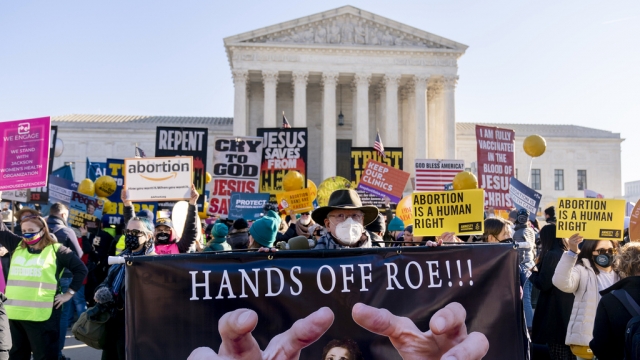
Reproductive rights and the economy: Abortion bans come with a cost
Newsy
Women's reproductive rights are interconnected with how state and local economies perform, and bans historically occur in underfunded areas.
Reproductive rights and policies regarding health care for childbearing have a significant impact on the economic future of both individuals and communities.
The Economic Policy Institute found that states where abortion bans take hold have historically had "intentionally constructed" economic policies with weak labor laws in underfunded areas with dysfunctional public services.
Sara Estep, an associate director with the Women's Initiative at the Center for American Progress, said the Congressional Budget Committee's hearing this week on the economic impacts of reproductive rights is "a huge deal."
"It's really important that we talk about this issue as an economic issue," Estep said. "Whenever women are forced to have children that they may not have wanted to have, it has profound economic effects on their lifespan."
This week, Republican Sen. Chuck Grassley of Iowa said, "Abortion, above all, is a moral and legal issue. Abortion is not an issue that lends itself to being looked at solely through an economic lens. After all, life is priceless."


A federal judge agreed Friday to block the Trump administration from enforcing a policy limiting news reporters’ access to the Pentagon, ruling that key portions of the new rules are unlawful.

Taylor Frankie Paul must have no contact with and stay 100 feet away from ex-boyfriend Dakota Mortensen after a protective order was issued against the Utah reality television star Friday.

As the war between the United States and Iran approaches the three-week mark, President Donald Trump and Iran’s new supreme leader are projecting strength.

James “Jimmy” Gracey, a college student from Illinois who was found dead after going missing while in Barcelona on a break, was likely the victim of an accident, Spanish regional police said Friday.

Clergy in Minnesota are suing ICE for access to minister to detainees at a Minneapolis holding facility, citing violations of religious freedom.

A reporter for a Spanish-language news outlet in Tennessee who contends she was wrongly held in detention for more than two weeks was released Thursday after paying a bond recently allowed by a judge.

Fireworks during a House Oversight Committee briefing with Attorney General Pam Bondi are raising more questions about her pending subpoena.

The national debt surpassed a record $39 trillion on Wednesday, a milestone that comes just weeks into the U.S.-Israeli war in Iran.

Crews began demolishing Orlando’s Pulse nightclub to make way for a $12M memorial honoring 49 victims of the 2016 attack, set to open in 2027.

Iran launched a wave of missile and drone attacks on Gulf Arab energy sites, hitting refineries in Saudi Arabia and Kuwait and a Qatari LNG plant, sparking major fires and sending Brent crude to $118.

There have now been multiple delays in the expected release of Estefany Rodriguez, a reporter for Nashville Noticias, who was detained on March 4.

The International Maritime Organization held an emergency meeting in central London Wednesday, searching for solutions to protect shipping amid a spreading war in the Middle East.

Continued blockages in the strait could lead to shortages of helium — the gas that is used in party balloons, and a lot more besides.