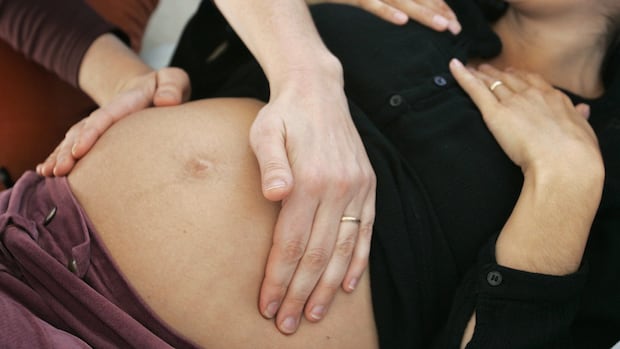
Report outlines how Indigenous survivors of coerced sterilization can pursue new pregnancies
CBC
A new report looks at how Indigenous people who have experienced coerced or forced sterilization may be able to pursue future pregnancies.
The report by the University of Ottawa Centre for Health Law, Policy and Ethics and the Survivors Circle for Reproductive Justice outlines the options, costs and barriers for survivors of coerced and forced sterilization to restore fertility.
The options outlined include tubal ligation reversal, in vitro fertilization (IVF), surrogacy and egg donation.
“This is an opportunity, a possibility that many may have never dreamed of being an option,” said Harmony Redsky, executive director of the Survivors Circle for Reproductive Justice.
Redsky, who is from Wasauksing First Nation in Ontario, said this is just the beginning of figuring out how survivors can have families after experiencing forced or coerced sterilization.
Lack of access to services, and the lack of comfort Indigenous people feel when trying to access those services, still remain major barriers, she said.
“How many opportunities have there been to have these discussions around reproductive justice,” Redsky asked.
“When before has information on those services and treatments… been shared with them?”
Redsky said she also hopes to see progress made on this issue when it comes to the law. A bill introduced by Métis Senator Yvonne Boyer aims to criminalize sterilization done without consent.
Katy Bear, a survivor of coerced sterilization two decades ago who recently gave birth to a baby girl, was one of the co-authors of the report.
Redsky said Bear’s contributions were key to understanding the wide-ranging impacts of the issue.
The report recommends patient advocacy positions along with a list of care providers who specialize in restoring fertility and creating more cultural safety guidelines for care providers.
Bear said of the roughly 300 members of the Survivors Circle who have experienced coerced or forced sterilization, she is currently supporting about five women who hope to have a child again.
“It is [re]opening not just the traumas but it's creating new traumas, unfortunately, to reverse what the government has done,” Bear said.


After several delays to the mission that will take four astronauts around the moon, NASA held a press conference today announcing that Artemis II is on track to launch as early as April 1.

Snuneymuxw First Nation is calling for a temporary closure and environmental investigation of a hazardous waste services company following a January oil spill on Duke Point near Nanaimo, B.C.

In February, five people were killed in separate avalanches across B.C. and Alberta. That same month, more than a dozen people were killed in California and Utah, including a particularly deadly avalanche that claimed the lives of nine. In Europe, from Andorra to Slovakia, the season has recorded 125 deaths from avalanches so far.

Getting a proper vehicle to transport people for urgent medical care is an ongoing challenge in fly-in First Nations in northwestern Ontario.

A new supergroup of musicians from Six Nations of the Grand River and Mississaugas of the Credit First Nation have collaborated on a Robbie Robertson-inspired song they will perform at the Junos Honouring Ceremony later this month in Hamilton.

People as young as 45 should be invited to provincial and territorial programs to screen for colorectal cancer, the Canadian Cancer Society urged on Wednesday.

The Métis Nation-Saskatchewan (MN-S) has opened an office and retail space in Ottawa to create a stronger presence in the capital since removing itself from the Métis National Council in 2024.

Toronto resident Winhan Wong's lung cancer journey began in 2016, with a nagging cough that just wouldn't go away.

Last month, Assembly of First Nations National Chief Cindy Woodhouse Nepinak pointed out on social media that history was made this year because there are a record 164 female chiefs serving across the country.

Most of humanity has a great propensity to think in the short-term, but generally, long-term considerations — air pollution, deforestation and emissions, for example — just aren't our thing.

As the COVID-19 pandemic began to unfold in early April 2020, Kolter Bouchard was just weeks into fatherhood when he noticed a lump on his neck.

Advocates and health care providers say they remain concerned about First Nations kids seeking services under Jordan's Principle even after the Canadian government’s recent promise of $1.55 billion in funding.

Contrary to science fiction, black holes are not portals to other dimensions or cosmic vacuum cleaners that swallow up everything around them.