Reimagining Sangam-era songs with a Carnatic touch
The Hindu
The Hindu Lit Fest 2024: Carnatic singer T.M. Krishna and Tamil writer Perumal Murugan collaborate to bring Sangam Poetry into Carnatic music, exploring contemporary politics and accessibility.
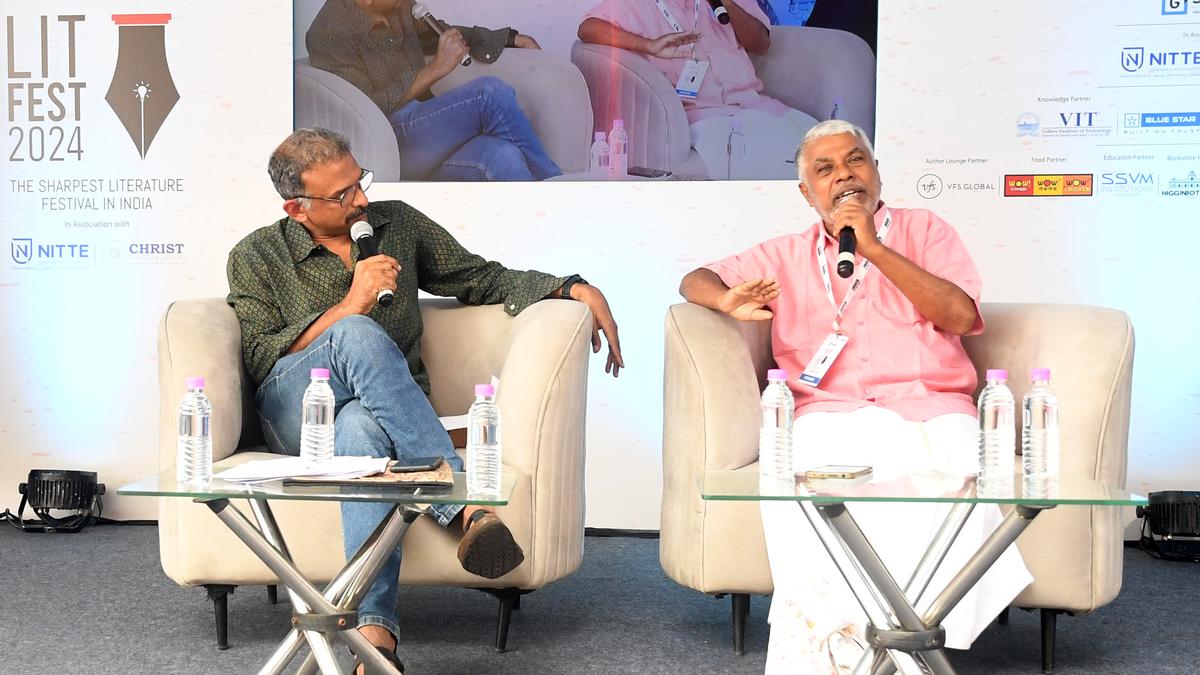
Carnatic singer T.M. Krishna and Tamil writer Perumal Murugan, who have collaborated recently in Introducing ‘Sangam Poetry into Carnatic music said the work was important because it engages with contemporary politics and makes Sangam works accessible to today’s world.
The duo, who are long time collaborators, took part in a bilingual session ‘Finding the song in Sangam Poetry’ during the first day of The Hindu Lift Fest 2024 at The Hindu Pavillion, near Sir Mutha Venkatasubba Rao Concert Hall, in Chennai on January 26, 2024.
Infusing Sangam poetry into the Carnatic repertoire
“We believe it important because it offers alternative themes for Carnatic music and a moving space, bringing back ideas from the past that have resonance for contemporary politics. It also has very important thoughts on caste,” said Mr. Krishna, who went on to sing the lines Semmannil Peitha Mazhi Pole, a Sangam poetry rendered into a keerthana format by Mr. Perumal Murugan.
Mr. Murugan explained that today caste has emerged as an important subject, but a Tamil song penned 2,000 years ago talks about a love affair between two, who were not relatives, not from the same place, not from the same background, but attracted to each other and came together like how rain water acquires the colour of the red sand on which it falls.
Dealing with the question whether a composition set to a raga alone could be called Carnatic music, Mr. Krishna, the Magsaysay award winner, felt that a composition should give a breathing space for a musician to fly with it. “Some of the compositions in this Sangam collection give me the breathing space whilst others may not,” he said and sang Mullaimalare Yen Poothai, a Puranaanooru song, set to Mukari raga to explain that it gave him the space to improvise (niraval).
On the other hand, he had struggled to tune Iniavane, a recreation of Avvaiyar’s poem in praise of Athiyaman, one of the philanthropist kings, since it refused to fit into the traditional carnatic music keerthana format.


The government plans to amend the FCRA, introducing new regulations for NGO asset management and accountability for key functionaries.

The draft policy for “Responsible Digital Use Among Students”, released on Monday by the Department of Health and Family Welfare, has recommended that parents set structured routines with clear screen-time rules and prioritise privacy, safety, and open conversation with children on digital well-being.

Police Observer Sushant Kumar Saxena conducts surprise inspection at Shencottai police station, reviewing warrants and security arrangements ahead of elections.

Andhra Pradesh government to launch key projects in April, focusing on industrial growth and infrastructure development, says Nara Lokesh.

Lok Sabha refers the Corporate Laws (Amendment) Bill to a JPC amid opposition concerns over CSR provisions dilution.

SHG members in Kanniyakumari use snakes and ladders to raise election awareness and boost voter turnout.

Government accelerates consultations for early implementation of the Women’s Reservation Act to ensure women’s representation in 2029 elections.

CM A. Revanth Reddy distributes ₹1 crore insurance cheques to families of deceased Electricity department employees, enhancing financial security for workers.

The Bengaluru Traffic Police (BTP) registered 634 cases of drunk driving during a week-long special enforcement drive conducted across the city between March 16 and March 22.

GHMC intensifies action against property tax defaulters, seizing properties and offering a One Time Settlement scheme for payments.

CCB arrests three drug peddlers in Mangaluru, seizing ₹2.5 lakh worth of MDMA and other valuables.

TVK's 28 candidates in Puducherry include former BJP MLAs, a sitting Independent, and a retired police IG.

BRS submits notice on private member bill to Speaker