Recreating sacred groves in Tamil Nadu’s northern region Premium
The Hindu
The Hindu Religious and Charitable Endowments Department in Villupuram has started a project to protect and recreate the rich diversity of the sacred groves in some of the 1,500 temples in its jurisdiction
Once found in plenty across the country, sacred groves have shrunk in many places due to rampant encroachments, the spread of invasive species, and unfettered human interference.
“We had a lot of sacred groves, not only in south India, but also in the northeast,” notes S. Theodore Baskaran, a well-known conservationist and former trustee of World Wide Fund for Nature (WWF) India. “But many of them have been destroyed. Only a few are left, and these must be protected,” he says.
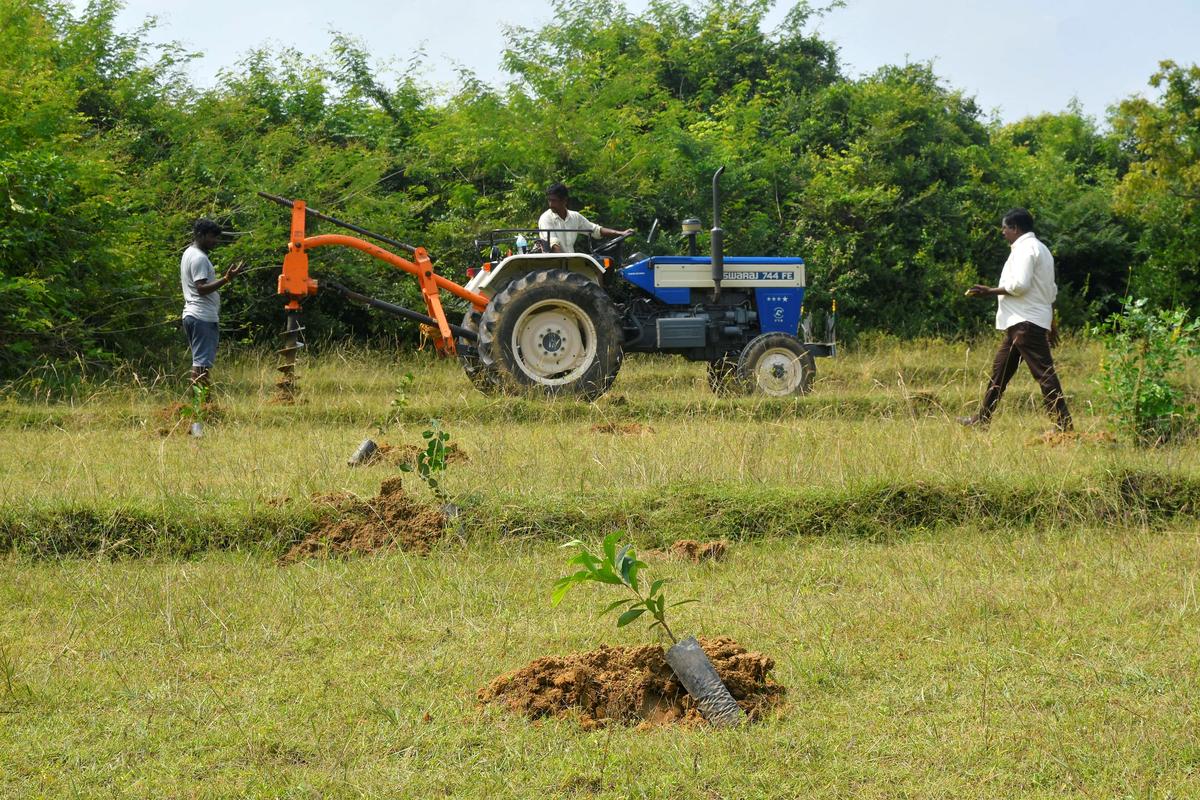
In Tamil Nadu’s arid northern Villupuram region, the Hindu Religious and Charitable Endowments (HR & CE) Department, which administers 1,500 temples in the Villupuram and Kallakurichi districts, has embarked on a project to protect these forest patches by recreating sacred groves. Along with nature enthusiasts and volunteers, the Department has now launched a campaign to maintain and protect these fragile ecosystems, which are vestiges of the past and recreate them on temple lands.
“Every temple has a Sthala Vriksham (sacred plant) and that denotes the importance given for plants and trees in the ancient days. A lot of these forest patches are found in Villupuram, Cuddalore, Puducherry, and the Coromandel Coast. While they are being protected in a few temples, the groves have been shrinking in size in others due to anthropogenic activities and the need is to protect them,” a senior official of the HR and CE told The Hindu.
The campaign began recently with the distribution and plantation of saplings at the Sri Manjaneeswarar Ayyanar temple at Kilputhupattu near Marakkanam in Villupuram district. Out of 110 acres of land owned by the temple, 35 acres are sacred groves.
The saplings were collected from Uyir Moochu, a nursery of the Indigenous Biodiversity Foundation (IBF), a Puducherry-based non-profit organisation near Morattandi in Villupuram district.
“Ayyanar temples are very important vestiges and relics of Jainism. Ayyanar, Karuppusamy, and Muniandi were part of the Jain pattern of gods. Ayyanar was very important in the pantheon of Jains. Though there are a lot of debates over this, it was part of Jainism,” points out Mr. Baskaran.


Learn how elderly and disabled voters can easily cast their ballots from home in the 2026 Assembly Elections.

Parliament Budget Session LIVE: Track updates on the Parliament Budget Session as the Transgender Bill moves to the Rajya Sabha. Follow The Hindu for the latest updates on the Budget Session on March 25, 2026.

Congress leaders in Kerala accuse LDF and NDA of a secret deal to undermine their influence in the upcoming Assembly elections.

Agnikul Cosmos successfully test-fires a revolutionary 3D printed booster engine, enhancing launch efficiency and scalability in space transportation.

Katha Dhara Hyderabad event by Katha&Krafts brings theatre to government school students. The initiative introduces government school students to theatre, puppetry and creative expression.

Gaurav Gogoi dismisses Himanta Sarma's Pakistan allegations as a "wild theory," asserting focus on corruption and government accountability.

T.N. CM Stalin urges the Centre to build consensus with transgender persons before imposing changes to the Trans Amendment Bill 2026.

Trump's engagement with Pakistan as a mediator for Iran echoes Nixon's historical diplomacy with China amid shifting geopolitical dynamics.

Telangana's Petroleum Dealers Association assures no fuel shortage, attributing temporary stock issues to panic buying fueled by rumors.

The Ottiyambakkam panchayat had an harrowingly difficult time keeping people from swimming in the deadly quarry with its protruding rocks under the water. There had been many deaths. And then nature intervened, and the fatal accidents stopped. An invasive, floating weed that is a bane of water sources everywhere, the water hyacinth is not just tolerated in the quarry but welcomed

Fuel supply panic causes severe traffic congestion in Hyderabad on March 25, 2026, prompting police intervention to manage long queues and road chaos.

Mohamed Salah will leave Liverpool at season's end, concluding a remarkable nine-year tenure at Anfield.

Telangana CM to hold urgent meeting on March 25 to address petrol, LPG, and urea stock concerns amid rising demand.