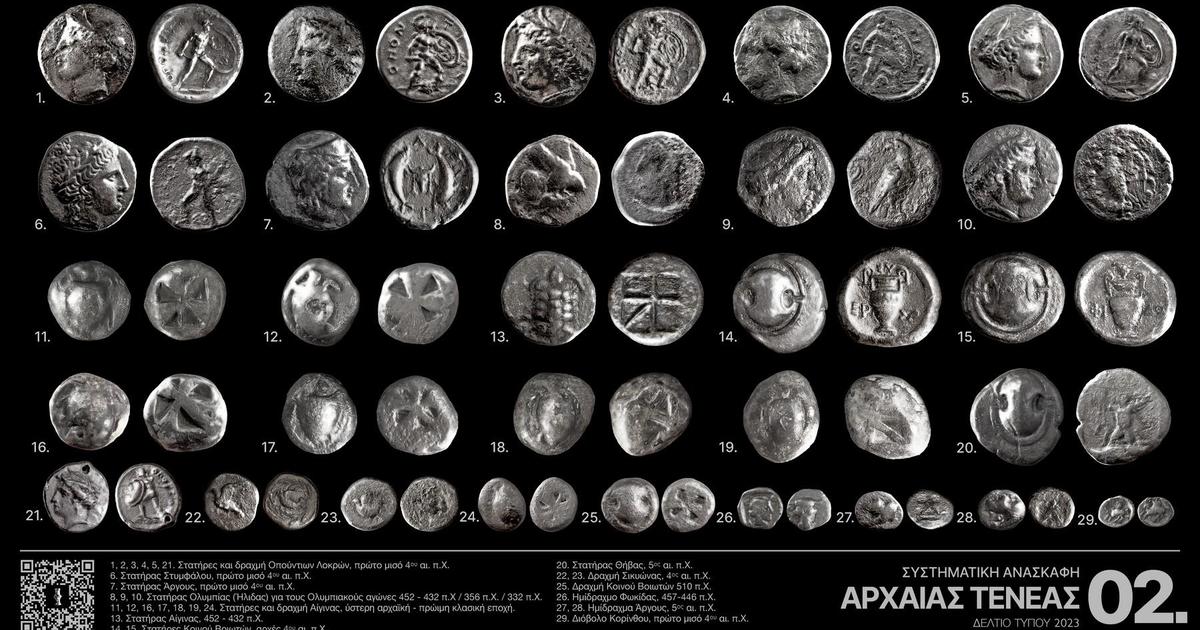
Rare coins and part of ancient aqueduct built by Roman emperor unearthed in Greece
CBSN
Greek archaeologists recently uncovered a trove of ancient artifacts while exploring the lost city of Tenea, which legend suggests was built some 3,000 years ago by Trojan prisoners of war. More than two dozen silver coins and remnants of an important primeval aqueduct were among the discoveries shedding light on settlements and infrastructure during some of the earliest parts of the common era.
The discoveries in Corinth — a city in south-central Greece that draws tourists to see its preserved medieval structures — were made in October by a team headed by the archaeologist Elena Korkas.
A section of an aqueduct thought to have been built by the Roman emperor Hadrian to supply water to Corinth from ancient Tenea was among the project's most notable archeological finds, the Greek Ministry of Culture said in a translated announcement. Hadrian ruled over the Roman Empire during the first century A.D., and remnants of another structure he ordered to be built during his reign, now known as Hadrian's auditorium, was uncovered in Rome in 2009 while construction was underway for a new subway line.


Officials in Cuba reported an island-wide blackout Monday in the country of some 11 million people as its energy and economic crises deepen. Cuba has blamed its woes on a U.S. energy blockade after President Trump in January warned of tariffs on any country that sells or provides oil to it. In:

Two boats carrying 21 people capsized Monday off Henoko, a controversial relocation site for a U.S. military base off Japan's southern island of Okinawa, throwing all into the water and leaving two of them dead, officials said. In:

Ecuador on Sunday began two weeks of operations against drug traffickers with support from the United States, the latest joint show of force against drug cartels in the South American country. In:

Right after Vladimir Putin's invasion of Ukraine, Karabash Elementary, like schools across Russia, was ordered to indoctrinate young minds with a so-called "patriotic curriculum." Pasha Talankin, the school's videographer, was assigned to shoot it all, to prove to Russia's government that the school was toeing the line. In:

Six U.S. service members who were killed in a military refueling aircraft crash over Iraq last week have been identified as members of the Ohio Air National Guard and Florida-based crew members. Tucker Reals contributed to this report. In:

Ten months after taking office, Pope Leo XIV on Saturday finally moved into his apartments in the Vatican's Apostolic Palace, a historic papal residence that his predecessor had eschewed. In:

President Trump said the U.S. military "totally obliterated" every military target on Kharg Island during large-scale precision strikes Friday, thrusting the strategic small isle into the global spotlight. In:

Hamas on Saturday called on Iran to refrain from targeting neighboring countries, while affirming Tehran's right to defend itself against Israel and the United States. In:

A Jewish school in Amsterdam was damaged after an overnight explosion against its exterior wall, Mayor Femke Halsema said in a statement Saturday, denouncing the blast as a "cowardly act of aggression." In:

A growing number of social media users, including foreigners, are facing charges in the United Arab Emirates under the Gulf state's broad cybercrime laws for sharing or possessing digital content that depicts or comments on the impact of ongoing Iranian attacks, the advocacy group Detained in Dubai has warned. In:

CBS News asked its reporters and editors to gauge the local mood in foreign capital cities as the U.S.-Israeli war with Iran, now nearing the two-week mark, leaves energy and stock markets in turmoil. In:

A court in Moscow on Thursday convicted 19 people of involvement in the 2024 shooting rampage in a Moscow concert hall that killed 149 people and wounded over 600 in one of the deadliest attacks in the capital in years. Agence France-Presse contributed to this report. In:

Three brothers have been arrested in connection with the explosion at the U.S. Embassy in Oslo, Norway, authorities said Wednesday. In: