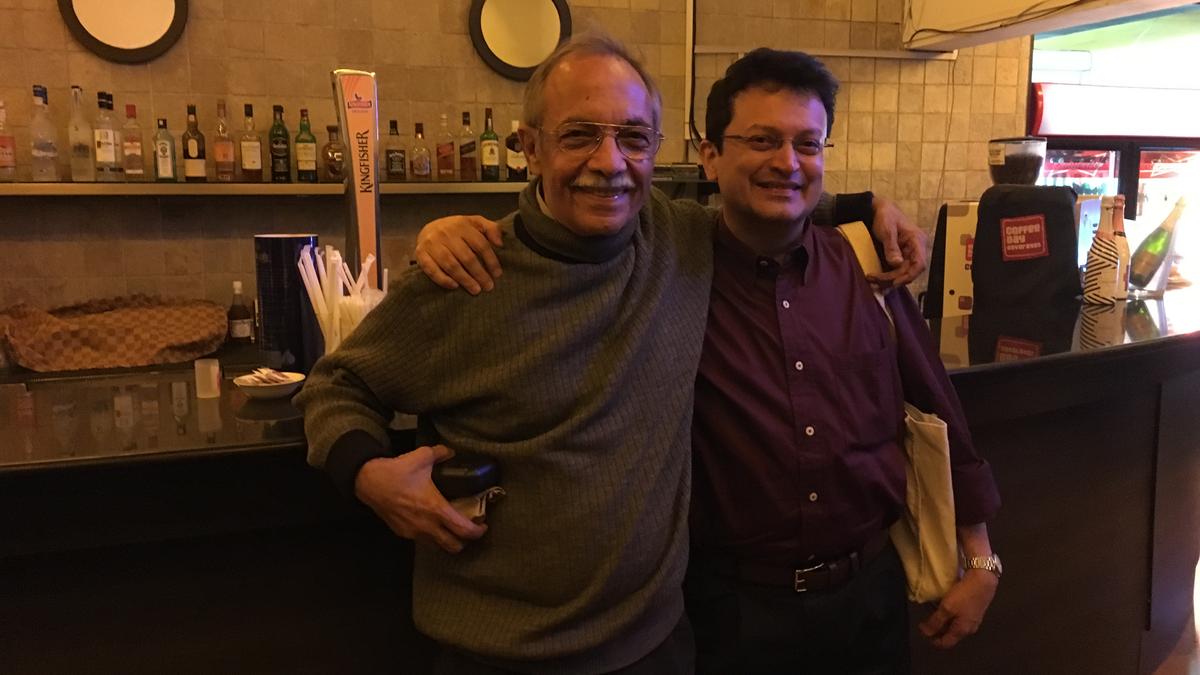
Ranjit Hoskote on his new book of essays that celebrates his long association with painter, poet and playwright Gieve Patel
The Hindu
Celebrating Gieve Patel's artistic legacy through essays by Ranjit Hoskote, reflecting on friendship, art, and cultural engagement.
Looking back at a friendship that spans almost four decades is no mean task but art critic, cultural theorist and poet Ranjit Hoskote has managed to do so with his trademark finesse in To Break and To Branch: Six Essays on Gieve Patel. Published by Seagull Books, it is a celebration of Hoskote’s long and deep engagement with the artistic oeuvre of Patel who was a painter, sculptor, translator, poet, teacher, playwright and a practising physician. Patel passed away last November at the age of 83. Hoskote recalls some fond memories. Edited excerpts:
I was in my late teens when I first met Gieve, was introduced to him by Nissim at his famous PEN All-India Centre office on the ground floor of Theosophy Hall in Mumbai, long a place of happy meetings, lively gatherings, and deep conversations. I’d read some of Gieve’s poems at that point, and he was already a name to conjure with, for me. Like so many of us, I’d studied his poem, ‘On Killing a Tree’, at school, and immediately found him congenial. He was a warm presence, friendly, engaging. We connected at once.
I must confess that, at the time Gieve gave me this advice, I found myself rebelling against it. It was a time when I was surging out of myself to engage with the larger things, the causes and urgencies. I was taking on big themes — myth, epic, history — and developing a rather baroque poetry. As I settled down — and, presumably, grew up — the large things and big themes began, increasingly, to find resonance and visceral reality in smaller, more intimate, everyday contexts. At this level, and as life and time began to impart their sad wisdom, Gieve’s advice assumed key importance and resonance for me. I believe — at least, I hope and trust — that my poetry has benefited greatly from his advice.
Gieve’s acceptance of the reality of spiritual experience was part of a gradual process, during which he saw clearly the limitations of a scepticism that enshrined rationality above all other modes of approaching the world. Through his encounters with devotion and spiritualism, Gieve began to find ways of being in the world that allowed him to combine scepticism with wonderment, stoicism with joy in the beauty of the present moment, to think about belonging in a larger context of interrelationships among sentient beings and with the cosmos.
Despite belonging to different places, periods and spiritual affiliations, both Lal Ded and Akho were impatient with organised religion, with the cant of conspicuous piety. They sought to liberate the soul from ritualist conceptions of the religious life. They expanded the range of emotional expression available to the questor.
Gieve’s Off Lamington Road embodies that memorable combination of the everyday and the phantasmagoric that imparted a distinctive quality to his paintings. At one level, it is meant to represent, quite literally, the view from Gieve’s clinic, which was situated on Lamington Road, round the corner from Mumbai Central station. But look closely, and mysterious elements announce themselves: a giant parrot hangs upside down in the top right-hand corner of this large work, above a group of revellers dancing and drumming up a storm in the street.
On the far side, a harnessed but riderless horse appears from behind a wall — we take a moment to register that a carriage may be following, but in itself, the horse strikes us as an omen, an augury. Everywhere, the currents and eddies of human life carry us along or bring us to a pause — and even as we settle into this evocation of a busy street in the middle of Mumbai, we recognise that the painting is in fact a visionary homage to the Sienese painters whose work Gieve loved — for instance, to the vastly populated civic panoramas of Ambrogio Lorenzetti’s multi-part fresco programme, The Allegory of Good and Bad Government.


‘Follower’ dives into the heated border dispute between Karnataka and Maharashtra in Belagavi while tackling the messy world of social media and its impact on friendships

India's NavIC satellite system faces setbacks, limiting its security capabilities amid concerns of reliance on foreign navigation systems

Harish Rana's last rites held, family donates his organs

Telangana's Rythu Bandhu budget allocation for FY 2026-27 is expected to decline, affecting agricultural support for farmers.

In Surendranagar, Gujarat, where only a handful of families continue to practise tangaliya weaving, we visit artisanal communities working with brands like Jaypore to revive the intricate craft for contemporary wardrobes

Madras High Court allows police to arrest YouTuber 'Savukku' Shankar if needed, dismissing claims of solitary confinement.

Lula leads Brazil's largest-ever business delegation to India, aiming for trade deals and global governance reforms amidst geopolitical challenges.

AIADMK reveals its first candidate list for Tamil Nadu Assembly election, featuring familiar names and few surprises.

A study reveals antibiotic resistance causes 87% of India's typhoid economic burden, significantly impacting children and families.

How Dikshitar was inspired by Vaduvur Rama to come up with a composition in a raganga raga

Lok Sabha passes Finance Bill 2026 with amendments, completing its budgetary approval before Rajya Sabha's consideration.

Karnataka government to consult legal experts on pursuing action against Adani Group's ACC Ltd. over ₹850 crore in disputed dues.

The FCRA amendment bill aims to create an authority for managing NGO assets after license loss, addressing misuse of foreign funds.