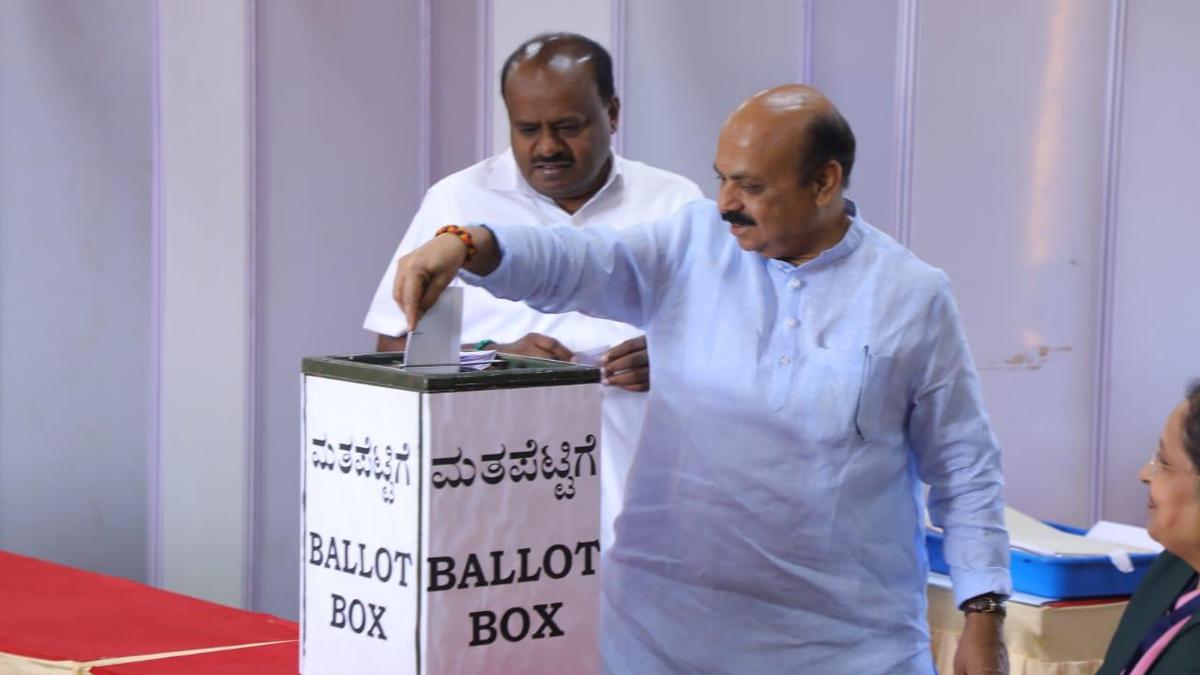
Rajya Sabha elections get underway in Karnataka
The Hindu
The elections are taking place as four members – Syed Naseer Hussein, G.C. Chandrashekar and L. Hanumanthaiah (Congress), and Rajeev Chandrashekar (BJP) are retiring in April after completion of their term.
Amidst fears of cross-voting, elections to the four Rajya Sabha seats from Karnataka got underway in Bengaluru on February 27. By noon, more than 112 legislators, including Chief Minister Siddaramaiah, had cast their votes. The result of the election will be announced by evening.
Five candidates Narayanasa K. Bhandage (BJP), G.C. Chandrashekar, Ajay Maken and Syed Naseer Hussein (Congress), and Kupendra Reddy (Janata Dal-Secular) are in the fray for the four seats.
The elections are taking place as four members – Syed Naseer Hussein, G.C. Chandrashekar and L. Hanumanthaiah (Congress), and Rajeev Chandrashekar (BJP) are retiring in April after completion of their term.
In the current strength of 223 members (after the death of Surpur MLA Raja Venkatappa Naik) in the Karnataka Legislative Assembly, Congress has 134 members, while BJP has 66 and JD(S) has 19 members. Latha Mallikarjun (Harappanahalli) and K.H. Puttaswamy Gowda (Gauribidanur) are independents along with Darshan Puttannaiah (Melukote) of Sarvodaya Karnataka Paksha, and G. Janardhan Reddy (Gangawati) of Karnataka Rajya Pragathi Paksha.
While 45 votes are required for a candidate to register a victory, Congress and BJP are comfortably placed to win three seats and one seat, respectively.
Meanwhile, despite a whip for BJP legislators to vote for the BJP candidate, its member representing Yeshwantpur Assembly constituency S.T. Somashekar is speculated to have cross-voted in favour of the Congress candidate after speaking about ‘conscience vote’.
He was among those legislators whose moves were keenly watched. Before casting his votes, he had said that so far no candidate had approached him for votes, and that he would vote for the candidate who would fund development works in Yeshwantpur Assembly constituency.


Thirty-three detained Bangladeshi nationals from Tamil Nadu are being deported to Bangladesh via West Bengal with police escort.

Tree felling for a flyover and underpass on the Manikonda-Hitech City stretch sparks outrage as Hyderabad’s road expansion drives another green loss.

Residents of Velachery express concerns over flooding and development issues, while welcoming the MRTS extension.

Seeman advocates for a benevolent authoritarianism and an agriculture-centered economy to ensure discipline and self-sufficiency in Tamil Nadu.

Residents of Velachery express concerns over flooding and development issues, while welcoming the MRTS extension.

Delhi Police allegedly manhandled UNI staff while enforcing a court order to vacate the agency's office, now sealed.

Supreme Court affirms the public's right to critique its judgments while addressing concerns over an NCERT textbook's content.

Amit Shah reviews Manipur's security, urging the CM to tackle drug cartels and aid displaced communities after ethnic violence.

Kerala's fisherfolk urge political parties to address livelihood concerns, demanding fair pricing, rule enforcement, and better support during elections.

Moderate rainfall in Visakhapatnam brings relief but causes traffic disruptions and power outages across the city.

Shubman Gill’s Gujarat Titans banks on its tried-and-tested formula

Agriculture Ministry reviews unseasonal rains' impact, assesses farm losses, and discusses relief measures for affected farmers.

Premium petrol prices rise by ₹2 per litre, but government claims no impact on the common man amidst global oil tensions.