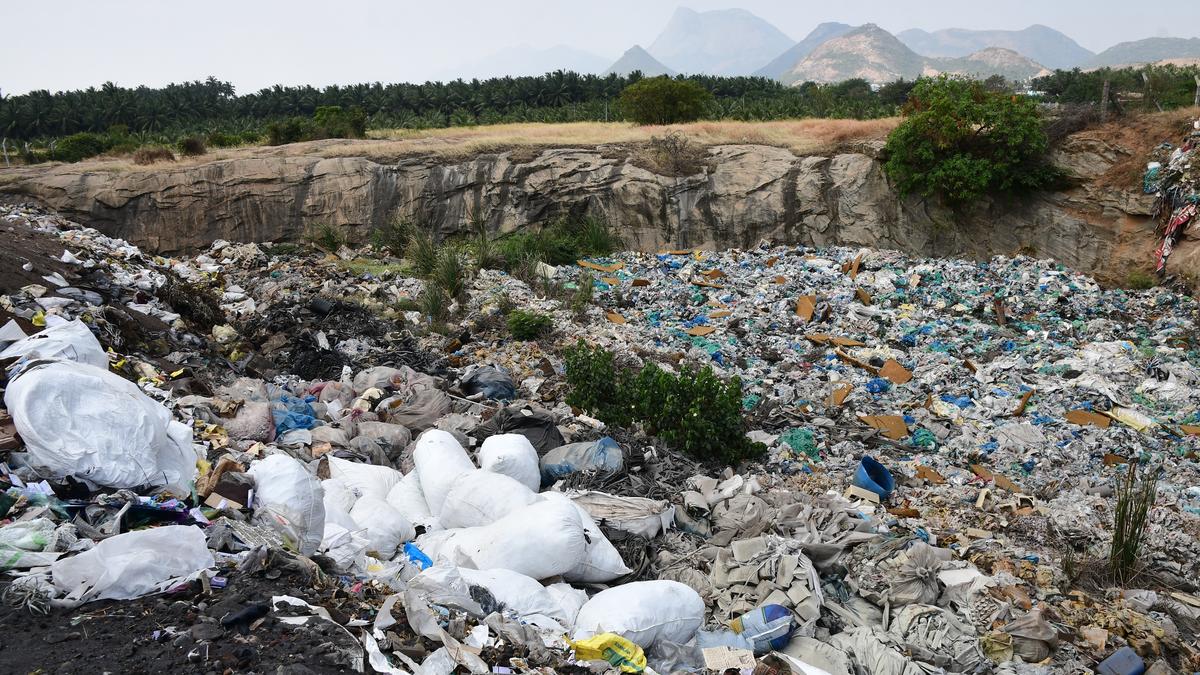
Raising high stink: T.N.’s bulk waste disposal issues
The Hindu
Tamil Nadu's waste disposal norms are being violated by industries, leading to environmental degradation and public health risks.
Tamil Nadu, despite all its industrial prowess, seems to be grappling with an issue that jeopardises its environmental well-being — the violation of waste disposal norms and “clandestine auction” of waste by the very same industries that are driving the State’s economic advancement. The Tamil Nadu Solid Waste Management (SWM) Rules, 2016, stipulate guidelines for Bulk Waste Generators (BWGs). Yet, many industries in districts such as Coimbatore, the Nilgiris, Tiruppur, Salem, Madurai, Tiruchi, Erode, and Chennai have acted in contravention of these rules, driving up hazardous dumping and waste-burning.
According to the SWM Rules 2016, BWGs, comprising mostly industries and manufacturing units, are required to segregate waste on their premises into three categories: bio-degradable, non-biodegradable, and hazardous. The rules emphasise that all institutions with an area exceeding 5,000 square metres, hotels, restaurants, and apartments must ensure waste segregation within a year of the rule’s notification. “Non-compliance could result in environmental degradation and jeopardise public health,” the guidelines state.
According to the SWM Rules, “BWGs must ensure segregation of waste at source, facilitate collection of segregated waste in separate streams, and hand over recyclable material to authorised waste pickers. The biodegradable waste shall be processed, treated, and disposed of through composting or biomethanation within the premises as far as possible.” Additionally, the residual waste must be given to the waste collectors or agency. The developers of special economic zones, industrial estates, and industrial parks must earmark at least 5% of the total area of the plot or a minimum of 5 plots for a recovery and recycling facility.
According to records of the Tamil Nadu Pollution Control Board (TNPCB), “These rules shall apply to every urban local body, including the municipal corporation, nagar nigam, the municipal council, nagarpalika, nagar palikaparishad, municipal board, nagar panchayat and town panchayat, census towns, notified areas, and notified industrial townships.”
As opposed to the directive of the TNPCB in 2018 to set up 1,000 micro composting centres (MCCs) across 15 Corporations, 121 municipalities and 42 town panchayats to treat 5,163 tonnes of waste per day (TPD), the TNPCB monitoring committee, in its 2023 SWM annual compliance report, accounts for the processing of only 3,600 TPD. Further, the State sanctioned the establishment of 69 more MCCs in 2020, of which only eight have been set up.
The State, consisting of 649 urban local bodies (ULBs), produces approximately 16,066 TPD, of which 5,979 tonnes is sent to landfills. However, to put the number into perspective, Coimbatore city alone produces around 1,200 tonnes, of which close to 900 tonnes is sent to the Vellalore landfill daily. The enforcement of the waste-management rules is hindered by discrepancies in data. For instance, while the Coimbatore Corporation reported around 250 registered BWGs in 2023, an order issued by the Southern Bench of the National Green Tribunal (NGT) in 2022 and records provided by the TNPCB indicate there are over 500 in the city. The district administration recorded over 25,000 industries, as of 2018, with no updated data thereafter.
In Chennai, 1,435 BWGs have been counted. However, in its 2020 research, the city-based Citizen consumer and civic Action Group (CAG), a not-for-profit entity working for consumer rights and environmental issues, identified many more. “Our data depend on inspections and updates sent by local bodies. Only with the right count can the monitoring of waste management be done properly. However, ULBs and industries have not been active in updating their number,” a senior TNPCB official told The Hindu.


Decomposed body of a missing 25-year-old man discovered in Dindigul stone quarry, prompting calls for investigation and quarry closure.

SVEEP activities launched in The Nilgiris aim to boost voter turnout at 13 polling booths with low participation rates.

Learn who can vote by postal ballot in the upcoming Tamil Nadu Assembly election, including seniors and persons with disabilities.

Shorts News:Watch: UDF linked to communal forces in Kerala: CPI(M) leader A Vijayaraghavan

Karnataka government postpones Deendayal Upadhyaya event at KSOU Mysuru due to protocol violations and lack of government involvement.

Sameer Wankhede denies bribery allegations involving Shah Rukh Khan’s son in drugs case during Bombay High Court proceedings.

What does it take to design gloves, masks and uniform that factor in the various challenges faced by workers on the waste beat? Indore, Bengaluru and Pune have an answer

Gaurav Gogoi files nomination for Jorhat Assembly seat, marking his electoral debut in the upcoming Assam elections.

A round-up of events and programmes held at colleges in Tiruchi and other Cauvery delta districts

CPI(M) and Congress clash over accusations of aiding BJP, threatening the LDF-UDF duopoly ahead of Kerala Assembly polls 2026.

Shivamogga veterinarians demand accountability for the death of trainee vet Dr. Sameeksha Reddy, citing systemic failures in zoo administration.

BJP launches 'Mana Ooru–Mana Jenda' campaign on April 6 to strengthen grassroots connections and promote development in Andhra Pradesh.

Anuradha Jonnalagadda took over as in-charge Vice-Chancellor of the University of Hyderabad, focusing on continuity during the transition.