Quirks of the world, as seen by kids
The Hindu
Filmmakers achieve this remarkably well with Assamese film Boomba Ride and Prasun Chatterjee's Dostojee
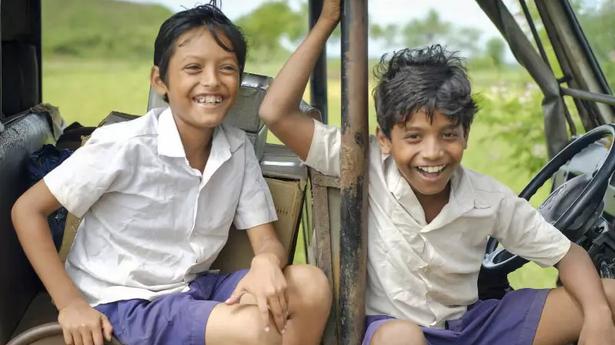
Some seemingly irresolvable issues take on a simple clarity when viewed through the eyes of children. In Biswajeet Bora's Assamese film Boomba Ride, screened in the Indian Cinema Now category at the 26th International Film Festival of Kerala (IFFK), and in Prasun Chatterjee's Dostojee, screened in the World Cinema category, the filmmakers achieve this remarkably well using a set of untrained young actors who play the protagonists.
Boomba Ride is set around a government school in rural Assam with a single student, Boomba (Indrajeet Pegu). The headmaster and the teacher have to cajole him every morning to attend classes, for the continued functioning of the school, and consequently their jobs, depend on his attendance. But the teachers are no saints either. They report inflated numbers of students, get Government funds for these, most of which goes into their pocket. Boomba is one step ahead of them and forces them to spend at least a part of these ill-gotten funds on him, for a mid-day meal with country chicken or kerosene supply for his home.
Filmmaker Bora attempts to shine a light on the pathetic state of government schools in the country's interiors, due to which those who can afford private schools in nearby towns, like the government school Headmaster's daughter in the film, get better education. However, the lack of public education facilities would mean that children from deprived sections would continue to remain uneducated. Though Boomba Ride is laced with a lot of humour, coming mostly from the young Boomba's wild antics, it succeeds in raising the issue without reducing itself to a mere awareness-generating film.
In Dostojee (Two Friends), Prasun Chatterjee banks on two young boys Palash (Asik Shaikh) and Safikul (Arif Shaikh), to chronicle the spread of communalism in a Bengal village bordering Bangladesh in the aftermath of the Babri Masjid demolition. The boys, living in neighbouring houses and attending the same class, are inseparable. Chatterjee paints a memorable picture of their idyllic childhood complete with kite flying, viewing the bioscope and sharing the sweets from each others' festivities.
But, around them, the world is changing as new divisions appear between the elders in the village, which threatens to drive a wedge between the two friends too. Viewed through the perspective of the two children, these newly created divisions appear absurd and irrational. In recounting a past tragedy, the filmmaker is not attempting to open old wounds, create more anger and call for retribution. Rather, he is showing us the pointlessness of such divisions and aid in the healing process, which is not something that can be said about many big-budget propaganda movies made at present.
Just like Boomba Ride, this film is also made on a low budget using untrained actors from the village where it is set in. But the magic that both these filmmakers create on screen with their limited resources shows that nothing can stop creative minds with a clear intent.


South African naturalist Steve Boyes speaks on ghost elephants, ancestral tracking, and Werner Herzog’s documentary exploring Angola’s elusive highland giants

Actor-director Amol Palekar will receive META's Lifetime Achievement award for 2026 on March 25 in New Delhi.

India's artists unite against rising censorship, advocating for creative freedom and support for marginalized voices in the arts.

Written and directed by Kunal, the film also stars Sparsh Shrivastava and Vanshika Dhir

This year, Bharatnatyam artistes will present the Tyagaraja Aradhane as a dance performance

This year, Bharatnatyam artistes will present the Tyagaraja Aradhane as a dance performance

The actor, along with director Sushant Shah, speak about their upcoming series ‘Chiraiya’, Divya’s process of working on the dialect, Sushant’s approach to telling a story about women, and more

An independent video, ‘Feel the Spark’ by Raleigh Rajan with vocals by Ciera Dumas that celebrates Tamil literary giants, garnered 1.4 million views in less than 36 hours.

In ‘Jack Ryan: Ghost War’, John Krasinski is back as the savvy CIA analyst, diving headfirst into a high-stakes mission that unravels a deadly conspiracy and pits him against a rogue black-ops unit

Shriram Bharatiya Kala Kendra’s Shankarlal festival showcased rare ragas, radiant artistry, and inclusive performances, from Pt Madhup Mudgal’s serene morning ragas to Ramana Balachandran’s Saraswati veena.

Explore "Threads that Bind: The Kantha Project," an exhibition in Delhi reimagining kantha as a medium of repair and renewal.

Sean Penn skips the Oscars to meet Ukraine's Zelenskyy, who praises him as a "true friend" amid the war.

The teaser of Tamil star Suriya’s much-awaited film with director Venky Atluri, titled Vishwanath and Sons, was unveiled by the makers on Monday