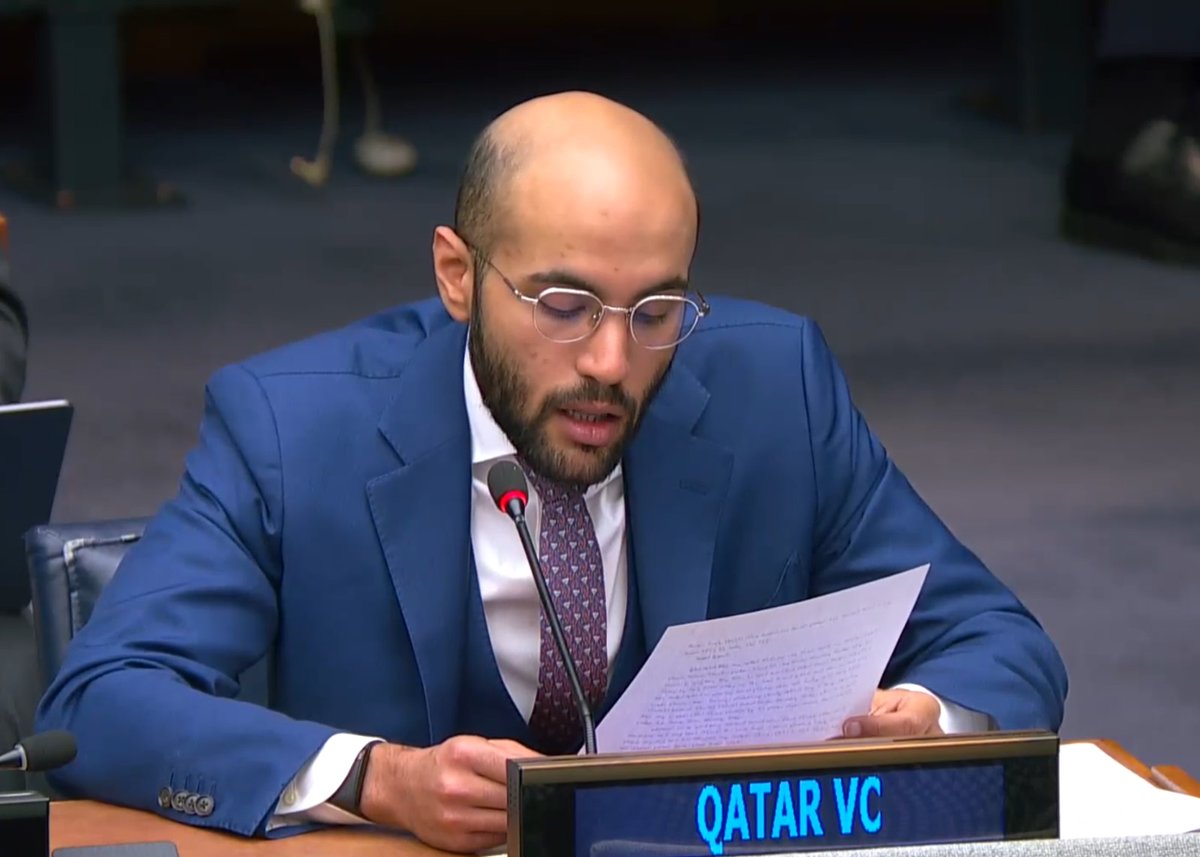
Qatar reaffirms commitment to UNRWA's political, diplomatic support
The Peninsula
New York: The State of Qatar reaffirmed its steadfast support for the United Nations Relief and Works Agency for Palestine Refugees in the Near East (...
New York: The State of Qatar reaffirmed its steadfast support for the United Nations Relief and Works Agency for Palestine Refugees in the Near East (UNRWA), emphasizing its commitment to international obligations, multilateral efforts, and its unwavering stance in supporting the Palestinian people, stressing that it would continue its political, diplomatic, and financial support for the agency, which is essential for addressing the urgent humanitarian needs of the Palestinian people.
This came in Qatar's statement delivered by Second Secretary at Qatar's Permanent Mission to the United Nations Sheikh Jassim bin Abdulaziz Al-Thani, during the Fourth Committee of the UN General Assembly's discussion on Agenda Item 49 regarding UNRWA, held at the UN headquarters in New York.
He noted that UNRWA has, since its establishment, been providing essential services and critical needs to over 5 million Palestinian refugees across the occupied Palestinian territories, Jordan, Lebanon, and Syria. It serves as the backbone of humanitarian aid in Gaza. He emphasized that its existence and continued operations are intrinsically tied to ending the occupation and enabling the Palestinian people to exercise their right to self-determination.
He also highlighted the State of Qatar's role as the first Arab country to sign a multi-year agreement with UNRWA in 2018 and one of its largest supporters, with the countrys financial contributions to the agency amounted to over $49 million in 2024.
He said that the besieged Palestinian people in Gaza continue to face catastrophic humanitarian conditions, with access to essential aid being obstructed, and food and medicine weaponized against them. He added that the prohibition of UNRWA's activities will result in severe humanitarian and political consequences, particularly depriving millions of Palestinians in Gaza and the West Bank of essential services, undermining the legal status of the Palestinian refugee issue and their right to return to their homes and lands, as guaranteed by international law and relevant UN resolutions, notably General Assembly Resolution 194 and Security Council Resolution 237.


Doha, Qatar: The Ministry of Commerce and Industry (MOCI) has intensified its market monitoring and inspection efforts in response to ongoing regional...

Doha, Qatar: Weather inshore until 6pm on Tuesday will be hazy and partly cloudy to cloudy at times with scattered rain may be thundery at times, the...

Doha, Qatar: Weather inshore until 6pm on Tuesday will be hazy and partly cloudy to cloudy at times with scattered rain may be thundery at times, the...

Doha, Qatar: Qatar s Public Works Authority (Ashghal) said on Monday its teams are working 24/7 to monitor drainage networks and ensure highways and t...

Doha, Qatar: Qatar s Public Works Authority (Ashghal) said on Monday its teams are working 24/7 to monitor drainage networks and ensure highways and t...

Bogota: AColombian military plane carrying 125 troops and crew crashed on take off Monday, with as many as 80 people aboard feared dead. The Hercul...

Doha, Qatar: The Chairman of the General Authority of Customs, HE Ahmed bin Abdullah Al Jamal, conducted an inspection tour on Sunday morning at Air C...

Riyadh: Saudi Arabia s Defense Ministry said it had intercepted and destroyed a drone in the country s Eastern Province on Monday evening. In a sta...

Doha, Qatar: Weather inshore until 6am on Tuesday will be partly cloudy to cloudy with scattered rain, thundery at times, the Department of Meteorolog...

Doha, Qatar: Weather inshore until 6am on Tuesday will be partly cloudy to cloudy with scattered rain, thundery at times, the Department of Meteorolog...

Doha, Qatar: The Ministry of Labour (MOL), in coordination with the Ministry of Commerce and Industry (MoCI) , announced on Monday, March 23, 2026, th...

Doha, Qatar: The Ministry of Labour (MOL), in coordination with the Ministry of Commerce and Industry (MoCI) , announced on Monday, March 23, 2026, th...

Berlin: Efforts are underway to rescue a huge whale that was spotted stranded on Germany s northern Baltic Sea coast early on Monday morning. A pol...