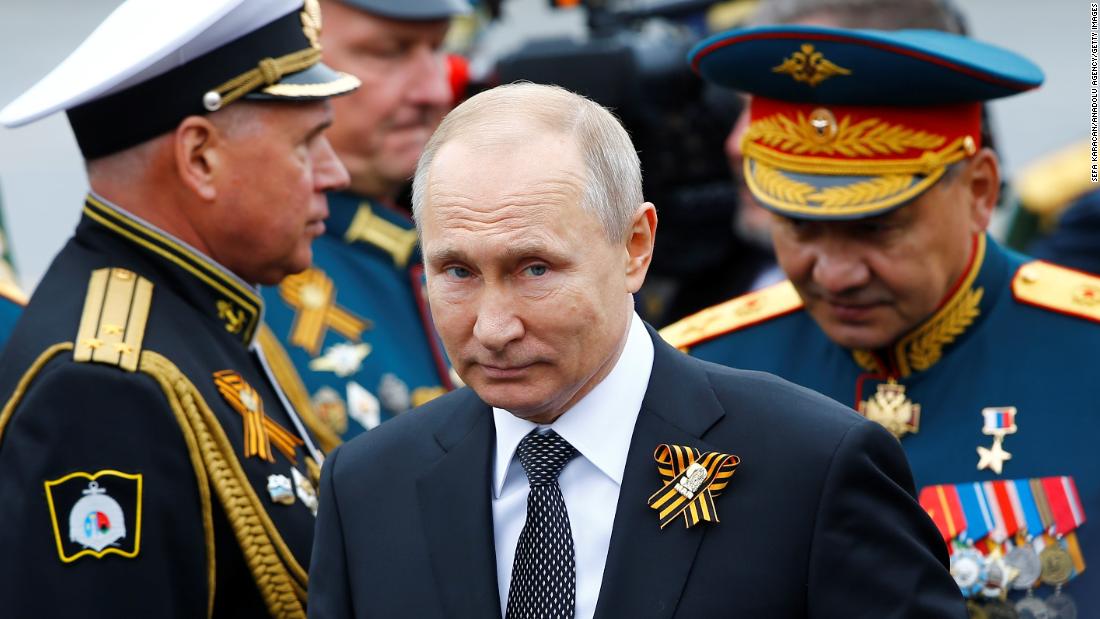
Putin has put himself at the center of Russia's Victory Day. But he has little to celebrate
CNN
President Vladimir Putin takes Russian anniversaries seriously. It was no coincidence that his invasion of Ukraine came a day after Defender of the Fatherland Day, a celebration of Russia's military achievements. It was on that same occasion in 2014 that Putin took the first step in annexing Crimea from Ukraine, through orchestrated pro-Russian protests on the peninsula.
The leader had clearly hoped to have more to celebrate by this Victory Day on Monday, the country's most patriotic of dates, marking the Soviet Union's role in defeating Nazi Germany in World War II. It was on May 8, 1945, (May 9 in Moscow's time zone) that Germany signed its Instrument of Surrender in Berlin, ending the fighting in Europe. The USSR suffered the biggest losses of any nation -- around 27 million soldiers and civilians died.
Russia's justification for war in Ukraine suggested a deadline for success by Victory Day. Putin and his government have repeatedly said the aim of their so-called "special operation" is to "denazify" Ukraine, and that freeing the country of Nazis is a matter of Russian survival. It's an argument that has no real weight; a blatant cover for Russian revanchism.


One person is in custody and an investigation is under way following an incident at the Ohio residence of Vice President JD Vance, according to a federal law enforcement source.

A school district police officer arrived at Robb Elementary in Uvalde, Texas, more than a minute before a gunman entered the building and shot and killed 19 children and two teachers in May 2022, a new CNN analysis has found.

Congress returns this week to a slew of bitter political fights and the threat of another government shutdown at the end of the month — all while facing high stakes as President Donald Trump and GOP leaders attempt to unify their fractured party in a midterm year.

An emboldened President Donald Trump declared Sunday night that the US is “in charge” of Venezuela after detaining President Nicolas Maduro in a military raid over the weekend, as he issued stark warnings to other countries that they could be next.

Deposed Venezuelan leader Nicolás Maduro is set to appear in a New York federal courtroom today for the first time since his capture by the US. Follow for live updates.

Residents of Venezuela’s capital reflect on the US attack and capture of their president, Nicolás Maduro, as they head out to run errands a day later.

The US military operation that led to the capture of Venezuelan President Nicolás Maduro and his wife, Cilia Flores, also left stranded tourists wondering how to get home — or to their next destination — after the FAA temporarily closed airspace over the Caribbean.

Hours after declaring from underneath the tented ceiling of Mar-a-Lago’s Tea Room that Venezuela’s leader was in American custody and the US was running the country on Saturday, President Donald Trump emerged victorious onto his club’s crowded patio as dinner-goers cheered the audacious mission he’d ordered from a few yards away.

President Donald Trump’s administration is working quickly to establish a pliant interim government in Venezuela following the dramatic capture of Nicolás Maduro, according to US officials, prioritizing administrative stability and repairing the country’s oil infrastructure over an immediate turn to democracy.

Venezuela is entering a new and very uncertain era after the sudden capture and removal of Nicolas Maduro, the country’s president for the last 12 years.

Heavy rain and high tides believed to be the most severe in two decades caused flooding in parts of Northern California on Saturday, prompting road closures and rescues of people trapped in cars.

Business owners and families in Minneapolis’ deeply rooted Somali community say they have been threatened, harassed and bullied on social media since a video was posted online alleging fraud at multiple child care facilities.

President Donald Trump’s allies in the Republican Party and his Make America Great Again movement — even some who previously warned against wading into new foreign conflicts — largely rallied behind his actions in Venezuela on Saturday, hours after the capture of President Nicolás Maduro in a large-scale military operation.