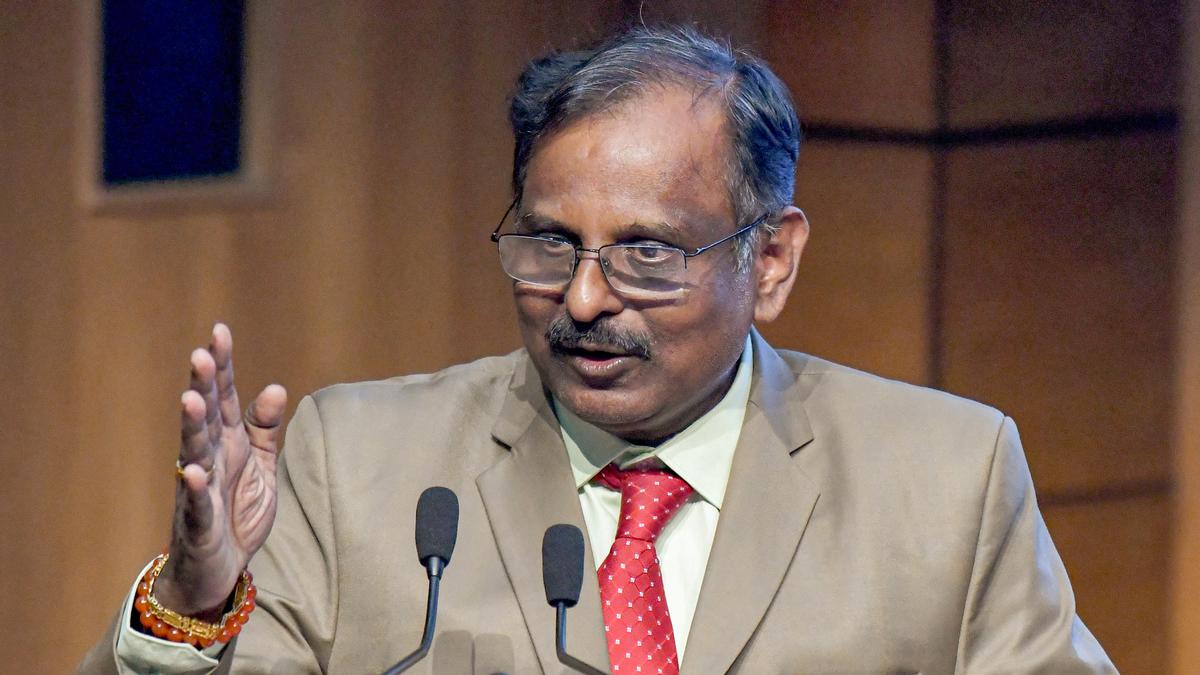
PSLV-C61 launch: ISRO chief Narayanan seeks blessings at Tirumala shrine
The Hindu
ISRO chairman seeks blessings for PSLV-C61 launch at Lord Venkateswara temple, marking milestone in India's space capabilities.
Indian Space Research Organisation (ISRO) chairman V. Narayanan on Friday (May 16, 2025) offered prayers at the Lord Venkateswara temple, seeking blessings for the successful launch of the Polar Satellite Launch Vehicle (PSLV)-C61/EOS-09 mission, a remote sensing satellite mission.
The launch is scheduled for May 18, 2025, at 5.59 a.m. from the Satish Dhawan Space Centre in Sriharikota. During the VIP darshan in the early hours of Friday (May 16, 2025), Mr. Narayanan participated in the ritual and placed a miniature model of PSLV-C61 at the deity’s feet, seeking blessings for the mission’s success and safety.
Vedic scholars offered blessings at the Ranganayakula Mandapam, while temple officials presented Tirtha Prasadam (holy water) and honoured Mr. Narayanan with a silk shawl.
"This 101st mission with PSLV-C61 will mark a major milestone for ISRO, showcasing India’s all-weather earth observation capabilities and reinforcing the country’s commitment to space-based solutions," Mr. Narayanan told reporters.
The mission will place the Earth Observation Satellite into a Sun-Synchronous Polar Orbit (SSPO), a unique type of polar orbit where the satellite maintains a consistent alignment with the Sun.
PSLV-C61 marks the 63rd flight of the Polar Satellite Launch Vehicle and the 27th using the PSLV-XL configuration. This mission continues the PSLV's record of delivering reliable performance across a wide range of payloads and orbits, according to the ISRO website.
EOS-09 is designed to deliver consistent and reliable remote sensing data for a range of operational applications across various sectors, as stated by ISRO.


Explore 2026's wallpaper trends in India, highlighting botanicals and handmade designs that enhance modern homes with nature-inspired aesthetics.

Mercedes-Benz CLA 250+ with EQ Technology review: design, performance, range and features explained. Discover how the new electric CLA combines advanced AI, long range, fast charging and futuristic styling for the next generation of luxury EVs.

AI tool for sparrow conservation

BTS’s comeback with ‘Arirang’ marks a major global music event. When does the album release, and where can you watch their concert live stream? We have all the details

The 2026 U.S. cholesterol guidelines urge starting screening and treatment at 30 to prevent cardiovascular disease effectively.

Olam Festival 2026 in Thiruvananthapuram returns March 27-29 with 120+ vendors, music, art, and cultural zones.

A few storytellers in Thiruvananthapuram share their journeys, challenges, and evolving methods on World Storytelling Day, inspiring young minds.

76-year-old Kurian Jacob from Kerala triumphs with seven medals, including five golds, at the Open Masters Games in Abu Dhabi.

Explore the nature of the human mind as an emergent property of brain activity and complex neural interactions.

CERN's Large Hadron Collider discovers the Xi-cc-plus particle, enhancing understanding of quantum mechanics and baryon behavior.

Vibha Batra’s latest book, Spotless (Hachette India) is a novel in verse for young adults

In its first edition, the Madras Art Salon spotlights the works of journalist and artist Narayan Lakshman at The Botanical Club, a social space in the British Deputy High Commission, Chennai

Cholesterol enhances melanoma cell invasion by making nuclei squishier, revealing a potential treatment target in cancer progression.