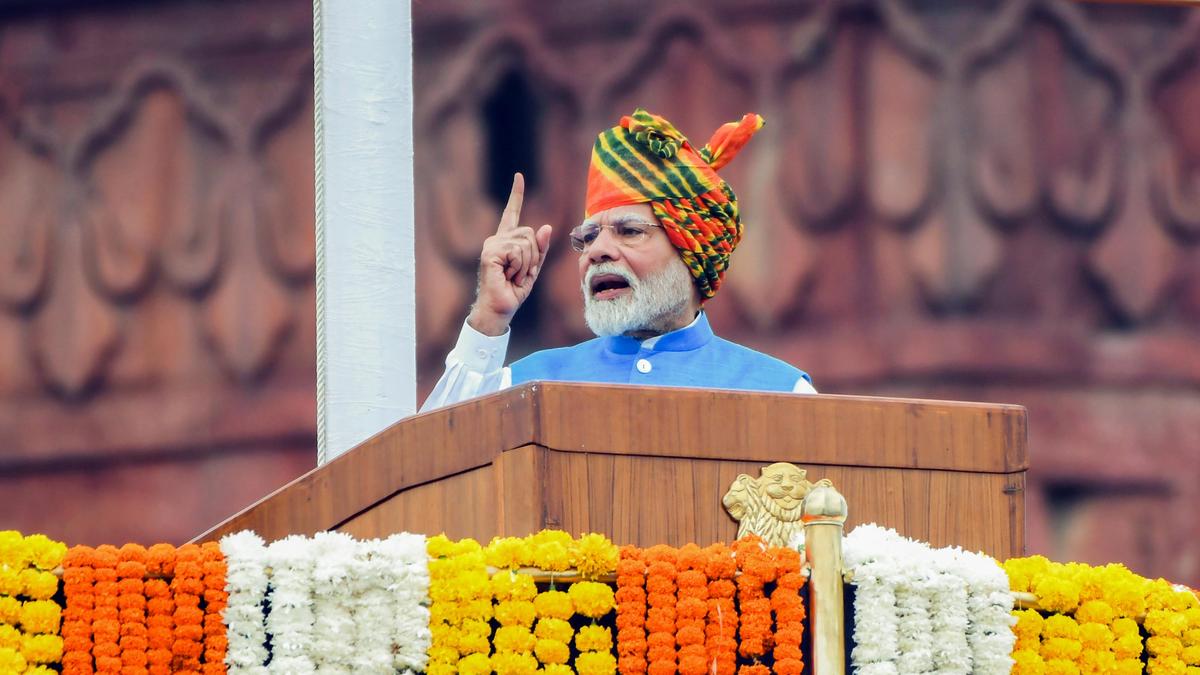
Promises made: What have newly sworn-in Prime Ministers pledged in their Independence Day speeches? Premium
The Hindu
In this two-part series ‘Promises made, promises kept’, we take a look at the promises made by every newly sworn-in Prime Minister to India on its Independence and if they have been implemented.
“At the stroke of the midnight hour, when the world sleeps, India will awake to life and freedom. It is fitting that at this solemn moment we take the pledge of dedication to the service of India and her people and to the still larger cause of humanity,” said Pandit Jawaharlal Nehru on August 15, 1947 to the Constituent Assembly, as India celebrated its first Independence Day (I-Day).
In his first speech as the newly sworn-in Prime Minister of India, Mr. Nehru promised to end poverty, ignorance, disease, to a build a “prosperous, democratic and progressive nation” and “to create social, economic and political institutions which will ensure justice and fullness of life to every man and woman.” Since then, his successors have made promises for building out their vision for India in their five-year terms.
Also read: Independence Day LIVE
After the first general elections held in 1951, Mr. Nehru was re-elected as the PM for a second term. Kicking off his term, he vowed to “uplift the poor, down-trodden suffering millions,” in his 20-minute Independence Day address in 1952. Talking of food shortages in Uttar Pradesh, Bihar, Bengal, Madras, Mysore, Rajasthan and Saurashtra, he shared the onus between citizens as well as his government to help them “stand on their feet.”
In his third term, he promised to “emancipate our people economically.” Addressing the nation from the ramparts of the Red Fort in 1957, he assured that India would “remain in peace and friendship with Pakistan” but would “defend its rights with all our strength and cool minds.” He also declared India’s neutral stance in the Cold War, saying, “We want to shake the hand of friendship of all countries.”
Five years later, in his fourth and last term, Mr. Nehru urged citizens to remain united amid border troubles. He also set the aim of closing the wealth gap between the rich and poor and making a socialist society in which the caste system does not count.
During Pakistan’s invasion of Kashmir, then-PM Lal Bahudar Shastri assured citizens that “Pakistan would not be allowed to annex any part of Kashmir,” while addressing the nation from the Red Fort in 1965. Demanding that Pakistan withdraw from Kutch, he ruled out any talks with it amidst a raid of Kashmir by Pakistani militants. Regarding the Vietnam war, he said that India sought a peaceful settlement and condemned China’s stance against it.


The ‘Swastha Mysuru’ initiative aims to promote healthy living and preventive healthcare in Mysuru through community engagement and awareness.

Farmers in Ongole protest against BJP's policies, citing dangers to their livelihoods and demanding support for local agriculture.

From March 24, paneer queserotta, prawn tostadas, beef birria and more feature on MadCo's special Mexican pop up menu by Chef Mathangi Kumar alongside experimental cocktails, including a marigold highball

Revenue Minister Krishna Byre Gowda defends subsidies as crucial for economic growth, emphasising their role in boosting consumer demand during recessions.

Three doctors were arrested by the Mico Layout traffic police on Monday (March 23) after a video allegedly showing them triple-riding without helmets with one of the pillion riders seen drinking from a bottle went viral on social media.

Assembly protest ends in arrests as BJP targets Government over guarantees

Andhra Pradesh accelerates city gas distribution with streamlined approvals, enhancing access to cleaner energy and supporting sustainable urban development.

Sattankulam father-son custodial deaths case: Trial court convicts all nine accused police personnel
Nine police personnel convicted in Sattankulam custodial deaths; sentencing to be announced on March 30.

Minister Laxmi Hebbalkar supports local protests against a solid waste management plant in Turmuri, addressing residents' concerns.

Sattankulam father-son custodial deaths case: Trial court convicts all nine accused police personnel
Nine police personnel convicted in Sattankulam custodial deaths; sentencing to be announced on March 30.

Erode district conducts first EVM randomisation for April 23 Assembly elections, ensuring transparency and fairness in allocation.

TNCC conducts public consultation in Erode to gather community input for its upcoming election manifesto.

CID to investigate sexual assault allegations against suspended Moodbidri Police Inspector P.G. Sandesh, reveals Home Minister Parameshwara.