‘Prince of Persia: The Lost Crown’ game review: Metroidvania meets mythological epic
The Hindu
Prince of Persia: The Lost Crown’s new direction pays off with stunning visuals, deep gameplay, and a captivating story
Jordan Mechner’s 1989 Prince of Persia remains an unforgettable classic, praised for its fluid rotoscoped animation and swashbuckling swordplay. Since then, the unnamed prince has embarked on several reboots, with The Sands of Time introducing Ubisoft’s signature parkour and time-bending mechanics, later echoing in the Assassin’s Creed series. Now, we have The Lost Crown, a remake that revisits the side-scrolling roots with stunning 2D-meets-3D graphics. Does this new title earn its place in the Prince of Persia legacy, and can it recapture interest after so long?
I initially expected a predictable “save the prince” story, but was surprised by the story’s depth. As one of The Immortals, elite warriors defending the Persian Empire, our hero, Sargon, is tasked with rescuing a kidnapped prince, with a traitor amongst them. The quest leads to Mount Quaf, a cursed mountain steeped in mythology, hinting at a darker plot involving sorcery.
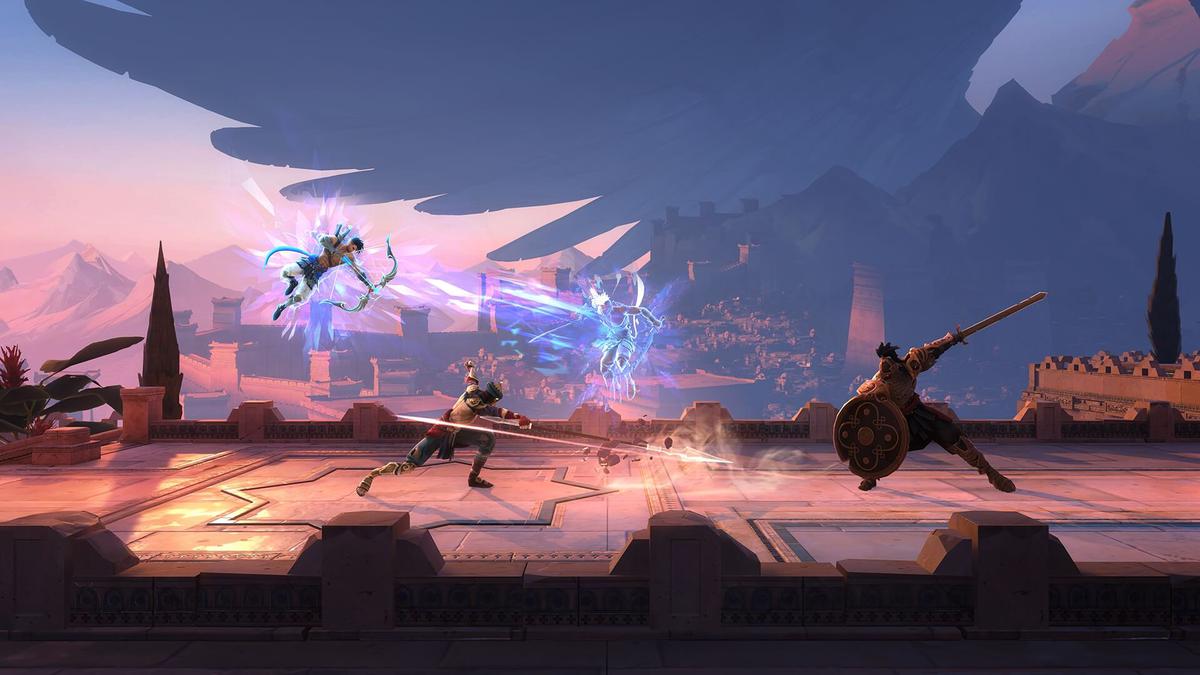
The Lost Crown‘s world, steeped in history and mythology, is engrossing. As Sargon wields time magic and battles mythical beasts and undead, encounters often evoke God of War‘s epic scale. The cast, particularly The Immortals, are well-designed and add personality. The game’s time disruptions create visually interesting platforming challenges, adding variety to the story.
For fans of anime, the combat is a treat. Expect quick strikes, neon slashes, screen-filling powers, and stylish 2D finishers with dynamic camera angles and vibrant backgrounds. Platforming features acrobatic double jumps and evades leaving blue trails, while cinematically-shot cutscenes complement the hand-painted art style, reminiscent of the Spiderverse films. This side-scroller packs a visual punch with blockbuster production values.
The Lost Crown follows the Metroidvania style (popularised by the side-scrolling games Metroid and Castlevania), offering large, interconnected levels that require exploration to unlock new paths. However, it differentiates itself with a more dynamic combat system. Risky aggression is rewarded with precise evades, parries, and mastery of mechanics. Combat becomes a beautiful dance of blades, each successful parry offering a satisfying visual and tactile burst. However, mistakes are punished swiftly.
The game’s bosses are intelligent, well-designed, and unforgiving. More than just tests of skill, they force you to learn their patterns and adapt. The key to victory is aggressive study and persistence.
The platforming levels often evoke the 1989 game, offering challenging puzzle-like obstacle courses with spikes and traps. While the action and platforming might seem daunting, the controls are simple, mechanics easy to learn, and the combat system engaging.


South African naturalist Steve Boyes speaks on ghost elephants, ancestral tracking, and Werner Herzog’s documentary exploring Angola’s elusive highland giants

Actor-director Amol Palekar will receive META's Lifetime Achievement award for 2026 on March 25 in New Delhi.

India's artists unite against rising censorship, advocating for creative freedom and support for marginalized voices in the arts.

Written and directed by Kunal, the film also stars Sparsh Shrivastava and Vanshika Dhir

This year, Bharatnatyam artistes will present the Tyagaraja Aradhane as a dance performance

This year, Bharatnatyam artistes will present the Tyagaraja Aradhane as a dance performance

The actor, along with director Sushant Shah, speak about their upcoming series ‘Chiraiya’, Divya’s process of working on the dialect, Sushant’s approach to telling a story about women, and more

An independent video, ‘Feel the Spark’ by Raleigh Rajan with vocals by Ciera Dumas that celebrates Tamil literary giants, garnered 1.4 million views in less than 36 hours.

In ‘Jack Ryan: Ghost War’, John Krasinski is back as the savvy CIA analyst, diving headfirst into a high-stakes mission that unravels a deadly conspiracy and pits him against a rogue black-ops unit

Shriram Bharatiya Kala Kendra’s Shankarlal festival showcased rare ragas, radiant artistry, and inclusive performances, from Pt Madhup Mudgal’s serene morning ragas to Ramana Balachandran’s Saraswati veena.

Explore "Threads that Bind: The Kantha Project," an exhibition in Delhi reimagining kantha as a medium of repair and renewal.

Sean Penn skips the Oscars to meet Ukraine's Zelenskyy, who praises him as a "true friend" amid the war.

The teaser of Tamil star Suriya’s much-awaited film with director Venky Atluri, titled Vishwanath and Sons, was unveiled by the makers on Monday