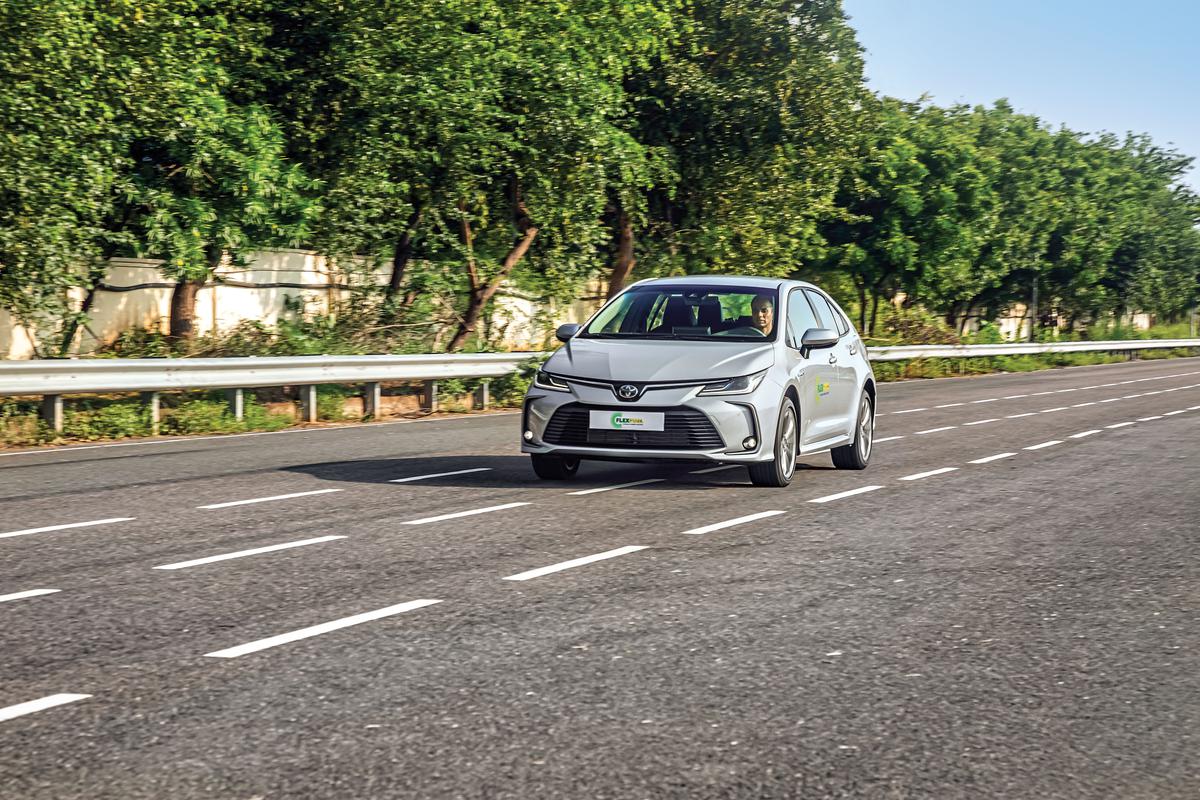
Presenting a view of Toyota Corolla’s flex fuel hybrid
The Hindu
Will this car be the answer to fuel efficiency? Read on to find out...
While the Union Minister for Road Transport and Highways, Nitin Gadkari, has been campaigning the use of flex-fuel vehicles, Toyota India has unveiled a flex-fuel Corolla hybrid.
The car, a left-hand-drive Corolla, is imported from Brazil — where the flex-fuel market is well developed — and is meant to bring attention to flex-fuel vehicles in India. While the 11th-generation Corolla was earlier sold here, there are no plans for now to introduce this current, 12th-generation model.
We were invited to a small drive at the International Centre for Automotive Technology’s (ICAT) test track in Manesar, and so here are a few brief impressions of the car’s engine and performance.
Under the hood of this Corolla is a flex-fuel-capable 1.8-litre petrol engine that makes 102hp and 142Nm of torque. It is coupled with a 72hp electric motor, which has a max torque of 163Nm, and is fed by a 1.3kWh battery that is continually charged on board. It is a typical strong hybrid system, just like in the Hyryder, which means, on a light foot, it can motor along on just electric mode. As soon as you demand some more, the engine kicks in, and while you can hear it, you do not really feel it coming in; the switching of power is seamless too.
What is different to Toyota’s SUV is the sprightly performance of the 1.8-litre engine, which is a welcome contrast to the dialled-down feel the Hyryder’s 1.5-litre engine delivers. The Corolla picks up pace quickly and acceleration is brisk all through. Out in the real world, it will deliver a strong highway performance. The gearbox is what Toyota calls an e-CVT, which essentially is a sun and planetary system, as in a traditional automatic, but it is set-up to provide infinite ratios.
Curiously, in the Hyryder — which also uses a similar set-up — the rubber band effect is present, which did not appear to be present in the Corolla. On the whole, the powertrain refinement is good and, all in all, the flex-fuel engine feels just like a regular petrol, which it essentially is. The only significant difference a flex-fuel vehicle owner will see against a regular petrol model is lower fuel efficiency, due to the lower energy density of ethanol.
That is where the Corolla’s strong hybrid system comes in. Like in the Hyryder, driven normally the car should motor along in EV mode for around 50 to 60% of the time, which more than compensates for the efficiency loss.


CERN's Large Hadron Collider discovers the Xi-cc-plus particle, enhancing understanding of quantum mechanics and baryon behavior.

Vibha Batra’s latest book, Spotless (Hachette India) is a novel in verse for young adults

In its first edition, the Madras Art Salon spotlights the works of journalist and artist Narayan Lakshman at The Botanical Club, a social space in the British Deputy High Commission, Chennai

Cholesterol enhances melanoma cell invasion by making nuclei squishier, revealing a potential treatment target in cancer progression.

The designers reinterpret the Swedish artist’s symbolic forms and colour energy through contemporary resortwear silhouettes

Discover the inspiring legacy of Bibha Chowdhuri, a pioneering woman in physics and a trailblazer in STEM history.

Discover the inspiring legacy of Bibha Chowdhuri, a pioneering woman in physics and a trailblazer in STEM history.

Ashdeen’s Spring 2026 collection features saris inspired by the designer’s Parsi gara archive

Red ochre burials, ritual markings and myths across cultures show that red repeatedly marks liminal thresholds such as puberty, sacrifice and death; anthropologists argue that the colour functions as a technology of collective ritual and value, binding communities through shared symbolic acts

India approves 23 institutions for quantum labs under the National Quantum Mission, aiming to advance quantum technology and research.

India approves 23 institutions for quantum labs under the National Quantum Mission, aiming to advance quantum technology and research.

The Gaza conflict exacerbates environmental damage, emitting millions of tonnes of CO2 and threatening climate stability in West Asia.

Chefs and cookery experts share smart kitchen hacks, hybrid cooking methods and appliance tips to help households reduce LPG use without compromising on food