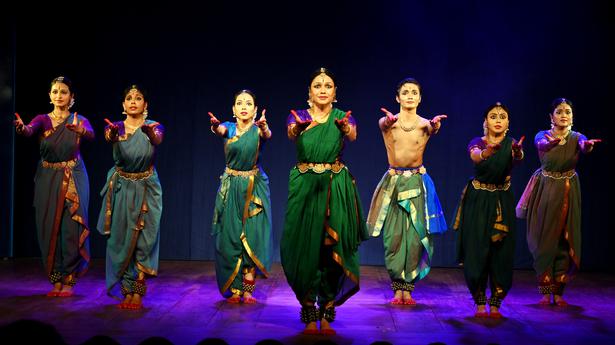
‘Pratibodhana’ by Rama Vaidyanathan explored realism and romance
The Hindu
Pratibodhana stood out for its choreography, interesting jathi patterns, and subtle abhinaya
The choreography stood out for picturesque formations, interesting jathi patterns, and subtle but beautiful abhinaya. Organised by Sanathana Natyalaya and Nrityangan at Don Bosco Hall, Mangaluru, the production appropriately began with songs from Manickavachagar’s ‘Thiruvembavai’ — ‘Annae, Ivaiyum Silavo’ and ‘Kozhi Silamba Silambum’. The friends of the nayika go to her house to wake her up — she is fast asleep, conveniently forgetting the promises she made the previous day. They remind her that she was ready to melt like the wax in the fire, just at the mention of the Lord’s name (thennaa ennaa munnam thee saer mezhugoppaay), and now is in deep slumber. They chastise her lethargy and ask her what kind of sleep is that (vaazhi eedhenna urakkamo).
Then came a shabdam presented by Shubhamani Chandrashekhar — ‘Thillai ambalam thannilae nadam seidhidum Natarajan’. The yearning of the lovelorn nayika for the lord she saw in her dreams was beautifully brought out by the graceful dancer.
Swati Tirunal’s ‘Visweswara darsan kar’ was chosen for a group presentation. It depicted the sights and sounds of Kashi, where death and life co-exist, and the mind becomes mature enough to accept things as they are. One side of the stage was filled with fervent worshippers while the other was occupied by bereaved people lamenting their dead, and getting ready for the cremation.
The fourth part of the production brought to life, a specially scripted Sanskrit poem, based on Guru Nanak’s 10 stages of life. Rama depicted these stages with her exquisite abhinaya — an infant’s love for the mother’s milk, his desire for eating, friends, love interest, earning money, keeping it safe, worrying about the departing youth, the desperation to hold on to it and finally, the escape of the breath from the body. It was presented as if an embryo was the narrator, who finally expresses a desire to never enter all these cycles once again.
The fifth and final part was a group presentation, ‘Shivoham’, where the ‘I’ merges into ‘Shiva’ and becomes ‘Him’. After all, that is the real ‘Pratibodhana’.
Sayani Chakroborty, Kavya Ganesh, Pritam Das, Reshika Shivakumar, and Vaishnavi beautifully blended into the presentation with appropriate footwork and abhinaya.
The costumes were subtle green Mangalagiri as well as bright white and red silk, depending on the mood of the piece.


South African naturalist Steve Boyes speaks on ghost elephants, ancestral tracking, and Werner Herzog’s documentary exploring Angola’s elusive highland giants

Actor-director Amol Palekar will receive META's Lifetime Achievement award for 2026 on March 25 in New Delhi.

India's artists unite against rising censorship, advocating for creative freedom and support for marginalized voices in the arts.

Written and directed by Kunal, the film also stars Sparsh Shrivastava and Vanshika Dhir

This year, Bharatnatyam artistes will present the Tyagaraja Aradhane as a dance performance

This year, Bharatnatyam artistes will present the Tyagaraja Aradhane as a dance performance

The actor, along with director Sushant Shah, speak about their upcoming series ‘Chiraiya’, Divya’s process of working on the dialect, Sushant’s approach to telling a story about women, and more

An independent video, ‘Feel the Spark’ by Raleigh Rajan with vocals by Ciera Dumas that celebrates Tamil literary giants, garnered 1.4 million views in less than 36 hours.

In ‘Jack Ryan: Ghost War’, John Krasinski is back as the savvy CIA analyst, diving headfirst into a high-stakes mission that unravels a deadly conspiracy and pits him against a rogue black-ops unit

Shriram Bharatiya Kala Kendra’s Shankarlal festival showcased rare ragas, radiant artistry, and inclusive performances, from Pt Madhup Mudgal’s serene morning ragas to Ramana Balachandran’s Saraswati veena.

Explore "Threads that Bind: The Kantha Project," an exhibition in Delhi reimagining kantha as a medium of repair and renewal.

Sean Penn skips the Oscars to meet Ukraine's Zelenskyy, who praises him as a "true friend" amid the war.

The teaser of Tamil star Suriya’s much-awaited film with director Venky Atluri, titled Vishwanath and Sons, was unveiled by the makers on Monday