‘Pranaya Vilasam’ movie review: juggling time frames to shape up a pleasant take on lost love and understanding in relationships
The Hindu
The slightly misleading title works in favour of the movie as it explores a subject with ease yet keeping its subtlety intact
The movie’s title does not flash across the screen until the halfway point. The name-board of a house where the principal characters live morphs into that title, marking a moment of revelation about a character and breaking everyone’s assumption of that person till that point. Even the movie’s trailer is an attempt at tricking us into assuming it to be a very different kind of film than it actually is.
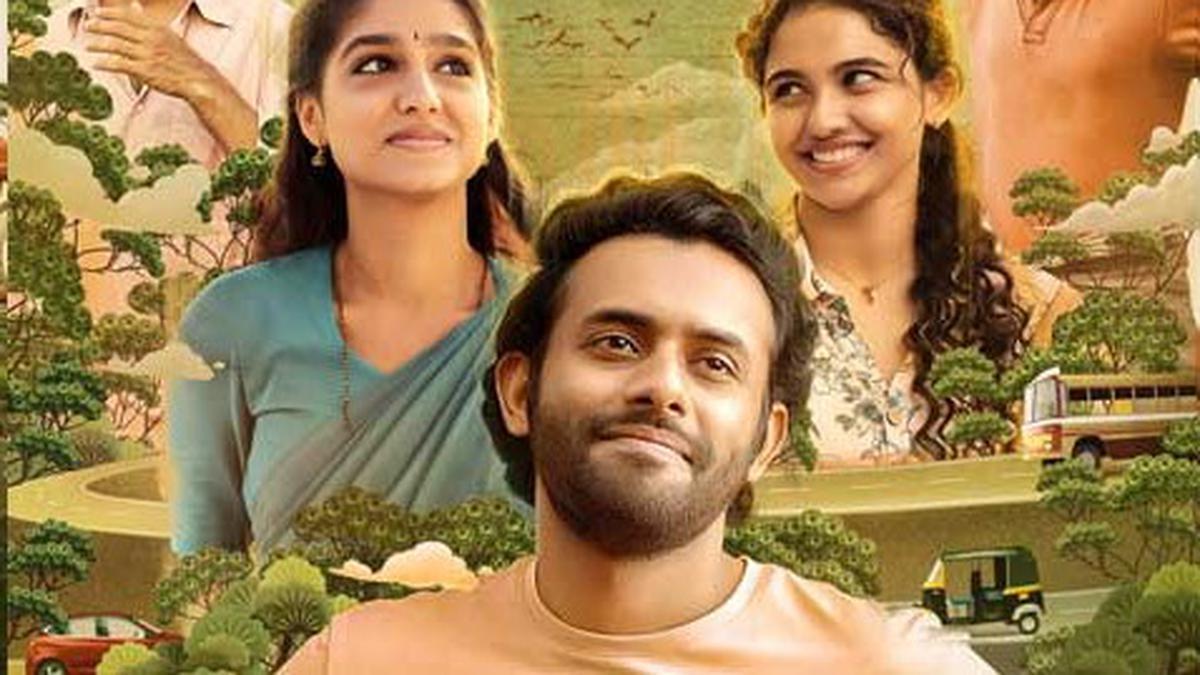
The gang of Anaswara Rajan, Arjun Ashokan, and Mamitha Baiju, whom we saw recently in the campus film Super Sharanya, comes together again but the campus stories set in two different time periods are only a part of the story.
At the heart of Nikhil Murali’s debut film is a family where the three members hardly understand each other. Rajeevan (Manoj K.U.), the father, a tough-on-the-exterior village officer as well as the son Suraj (Arjun Ashokan) are lost in their own worlds and do not have much time to spare for the mother Anusree, who is immersed in household chores. Suraj and Rajeevan are also not on talking terms, with the son nursing the hurt of being prevented from pursuing his dream of becoming a musician.
An unexpected jolt leads to the father and son taking a road trip together, in a journey to the past that forms the movie’s backbone. It is a journey for them to realise the worth of the woman, whom they did not pay enough attention to. The script is uneven when it travels between the time periods, just like Shaan Rahman’s background score, which is very much in the present yet almost overbearing in the past.
But the best written parts are the exchanges between the father and the son, which range from outright funny to poignant. It is perhaps rivalled only by the short but memorable role that Hakkim Shah gets. In the time that he has on screen, he gets to play a brash youth and a middle-aged man, whose face is a calm ocean of suppressed emotions and life-long pain. Manoj K.U., who aced the role as the father in Thinkalazhcha Nishchayam, plays a father of a different kind here and betters his previous performance.
The love story in the past, as well as the relationship between Suraj and his girlfriend, are somewhat hastily written. Yet, the movie still manages to portray the pain and nostalgia of lost love through its other better-written parts. The scriptwriters have been careful to never let things get too serious or letting emotional moments linger too long, always breaking it with some humour. To their credit, it hardly ever appears jarring. The background of political violence that is brought into the story seems more like an addition, which was made considering the fact that it was taking place in Kannur.
In the end, the slightly misleading trailers appear to have worked in Pranaya Vilasam’s favour, surprising the audience a bit with a fairly entertaining take on lost love and the need for understanding in relationships.


Disney's live-action Moana trailer reveals Dwayne Johnson as Maui, showcasing iconic moments ahead of the film's July release.

Aamir Khan’s sports comedy-drama Sitaare Zameen Par will be released on Sony LIV on April 3, the streamer announced on Monday, March 23, 2026. Directed by RS Prasanna, the film was released in theatres on June 20 last year.

Artist Kapila Nahender explores notions of belonging, growth and memories in her show Pockets of Resistance

BTS's comeback concert in Seoul drew over 100,000 fans, featuring their new album "ARIRANG" and a global livestream.

Prasads Multiplex Hyderabad unveiled one of India’s largest HDR cinema auditoriums, the PCX HDR by Barco

From staged funerals to rented fatherhood, Brendan Fraser turns rented intimacy into something disarmingly real in Hikari’s poignant Tokyo fable

Meet Nivrritii Mahesh, a Bharatanatyam dancer who dances with Cochlear implants

In a surprising turn of events, Urvashi theatre, one of Bengaluru’s iconic single screens, has re-opened, with the much-talked-about Dhurandhar: The Revenge running to a full house in the theatre. After the expiry of the 45-year lease, it seemed like curtains would come down on the king-size theatre but for now, it’s good news for fans.

The thrilling ‘Peaky Blinders’ finale is a farewell tour tailored for Tommy Shelby, while passing the baton to a new generation

BTS's comeback concert in Seoul drew over 100,000 fans, featuring their new album "ARIRANG" and a global livestream.

Khalid Rahman is reuniting with Malayalam superstar Mammootty after Unda (2019). The Thallumaala director has teamed up with the veteran for Mattancherry Mafia.

Bollywood actor Akshay Kumar paid tribute to the martial arts grandmaster and Hollywood’s action star, Chuck Norris, who passed away on Thursday, March 19, 2026.

Renowned Odissi dancer Madhumita Raut, aged 59, dies of cardiac arrest, leaving behind a legacy of artistic achievements.