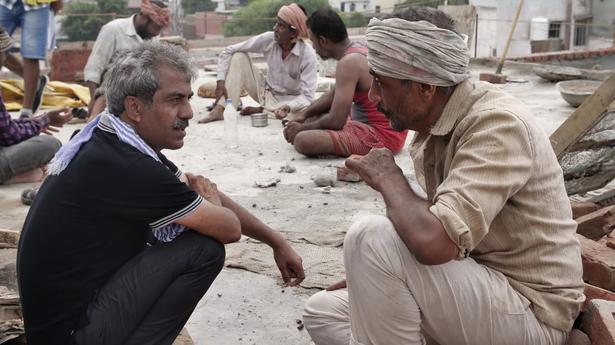
Prakash Jha: ‘Matto Ki Saikil’ represents half of the country’s population
The Hindu
Prakash Jha discusses portraying the life of a Dalit daily wager, the boycott trend in Bollywood and if the present political climate impacts films and filmmakers
One of the few products of the parallel cinema movement who continues to be relevant, Prakash Jha, is in the news again. In the mid-80s, when Hindi cinema was running away from grassroots reality, he introduced us to the world of a bonded labourer in Bihar with Damul. Now he is playing the role of a Dalit daily wager in a Mathura village in M Gani’s Matto Ki Saikil (Matto’s Bicycle).
When Gani, a self-taught filmmaker, approached Jha, who has acted in Jai Gangaajal and Saand Ki Aankh, the seasoned director thought he needed some help with production. “Somehow, he felt that I am suitable for the role, and I could not have said no to such a challenging part,” says Jha. The film was screened at the Busan International Film Festival, and Jha says that the social media response shows that the audience is waiting to watch stories from the villages of India.
Edited excerpts from an interview:
What made you agree to play the role of Matto?
I liked the purity and honesty of Ghani’s story. Matto represents pretty much half of the country’s population that doesn’t find reflection in Hindi cinema. We come up with a Do Bigha Zamin or a Damul once in a while, but largely one half of the country remains out of focus. They are the ones who build our homes, flyovers and highways, but we wake up to the existence of these lakhs and lakhs of people only when a pandemic strikes. Matto’s life revolves around an old bicycle. If it works, he would be able to get work. He has accepted socio-political discrimination and unkept promises as part of his everyday life.
How did you acquire the body language of a daily wager who rides a rickety bicycle?
I spent three months under the sun in Mathura doing everything that Ghani wanted me to. Coming from a rural background, I have had an understanding of village life. I spent hours chatting with daily wagers and smoking beedis. As my beedis were organic, they would say ye to dum na de rahin! (They are not strong enough). The training was so rigorous that contractors mistook me twice to be an actual daily wager, and picked me up from the labour chowk.


South African naturalist Steve Boyes speaks on ghost elephants, ancestral tracking, and Werner Herzog’s documentary exploring Angola’s elusive highland giants

Actor-director Amol Palekar will receive META's Lifetime Achievement award for 2026 on March 25 in New Delhi.

India's artists unite against rising censorship, advocating for creative freedom and support for marginalized voices in the arts.

Written and directed by Kunal, the film also stars Sparsh Shrivastava and Vanshika Dhir

This year, Bharatnatyam artistes will present the Tyagaraja Aradhane as a dance performance

This year, Bharatnatyam artistes will present the Tyagaraja Aradhane as a dance performance

The actor, along with director Sushant Shah, speak about their upcoming series ‘Chiraiya’, Divya’s process of working on the dialect, Sushant’s approach to telling a story about women, and more

An independent video, ‘Feel the Spark’ by Raleigh Rajan with vocals by Ciera Dumas that celebrates Tamil literary giants, garnered 1.4 million views in less than 36 hours.

In ‘Jack Ryan: Ghost War’, John Krasinski is back as the savvy CIA analyst, diving headfirst into a high-stakes mission that unravels a deadly conspiracy and pits him against a rogue black-ops unit

Shriram Bharatiya Kala Kendra’s Shankarlal festival showcased rare ragas, radiant artistry, and inclusive performances, from Pt Madhup Mudgal’s serene morning ragas to Ramana Balachandran’s Saraswati veena.

Explore "Threads that Bind: The Kantha Project," an exhibition in Delhi reimagining kantha as a medium of repair and renewal.

Sean Penn skips the Oscars to meet Ukraine's Zelenskyy, who praises him as a "true friend" amid the war.

The teaser of Tamil star Suriya’s much-awaited film with director Venky Atluri, titled Vishwanath and Sons, was unveiled by the makers on Monday