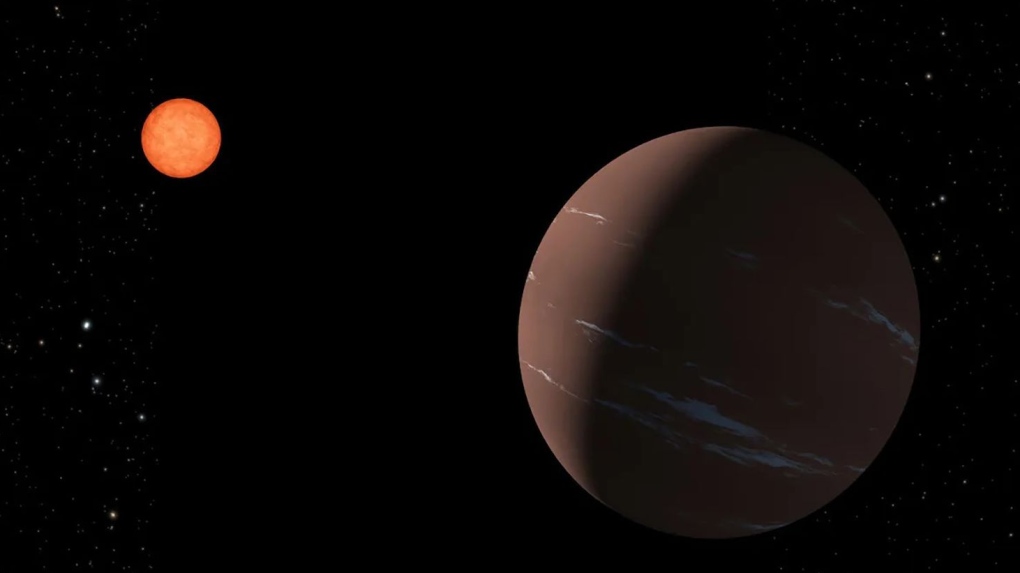
Potentially habitable 'super-Earth' spotted 137 light-years away
CTV
Astronomers have discovered a 'super-Earth,' or a world larger than our planet, orbiting a star about 137 light-years away. A second planet, thought to be the size of Earth, may also be orbiting the same star.
Astronomers have discovered a “super-Earth,” or a world larger than our planet, orbiting a star about 137 light-years away. A second planet, thought to be the size of Earth, may also be orbiting the same star.
The super-Earth exoplanet, known as TOI-715b, orbits a red dwarf star that is cooler and smaller than our sun. Astronomers spotted the planet using NASA’s TESS, or Transiting Exoplanet Survey Satellite, mission. A study detailing the discovery was published in January in the Monthly Notices of the Royal Astronomical Society.
Researchers have determined that the planet, estimated to be one and a half times as wide as our planet, takes just over 19 Earth days to complete one orbit around its star. The planet is close enough to its star to exist within the habitable zone, or the distance from a star that provides a planet with the right temperature for liquid water to exist on its surface.
The habitable zone is usually calculated based on factors such as the size, temperature and mass of a star as well as the reflectivity of a planet’s surface. But there can be large margins of error associated with these factors, calling into question whether a planet really resides in the habitable zone, said lead study author Dr. Georgina Dransfield, a postdoctoral researcher at the University of Birmingham’s School of Physics and Astronomy in the United Kingdom.
Astronomers believe that TOI-715b exists in a narrow and more optimal region around the star known as the conservative habitable zone, which is less likely to be affected by the margins of error.
“This discovery is exciting as it’s the first super-Earth from TESS to be found within the conservative habitable zone,” Dransfield said. “Additionally, as it’s relatively close by, the system is suitable for further atmospheric investigations.”
Since it launched in 2018, TESS has helped astronomers spot planets around relatively nearby stars suitable for follow-up observations with ground- and space-based observatories.


A haunting whale song discovered on decades-old audio equipment could open up a new understanding of how the huge animals communicate, according to researchers who say it’s the oldest such recording known.

Despite the delays for the NASA’s Artemis II mission around the moon and back, a space medicine researcher says the crew, which includes Canadian astronaut Jeremy Hansen, are physically ready for when the time comes to launch.

If a teen is interested in losing weight, chances are they may turn to artificial intelligence platforms to get advice.

The public downfall this week of Denmark’s Rene Redzepi, arguably the world’s top chef, has forced a reckoning in real time over when “brigade de cuisine” becomes abuse and what should happen to perpetrators who direct the creation of edible art.

A new study suggests climate change is doing something few people could ever notice: it’s making Earth’s days slightly longer.

Artificial intelligence is taking some of the discomfort out of trying to perfect your resume, but the growing use of the technology in job applications is creating new challenges for employers trying to sort through candidates and figure out who they’re really dealing with.

An expert on body image is warning of a new social media trend that is sending a negative message to boys and men.

Japan's stunning Seto Inalnd Sea offers a wonderful collection of art, history and luxury to travelers looking beyond the country's iconic sites.


Peel Public Health says nearly 16,000 students in the region could be suspended due to incomplete immunization records.

On Thursday morning, 68-year-old Mava Brydges put the weight of a household refrigerator onto her back, lowered herself toward the floor and then stood up again.

At this month’s Milan Cortina Paralympics, some athletes competed in shorts, T-shirts and tank tops. One skier lamented “tropical” conditions and a snowboarder complained that soft, slow snow put him at a disadvantage. And some worried about their safety.

Ottawa is expected to announce $552 million in funding for academic research projects this morning.