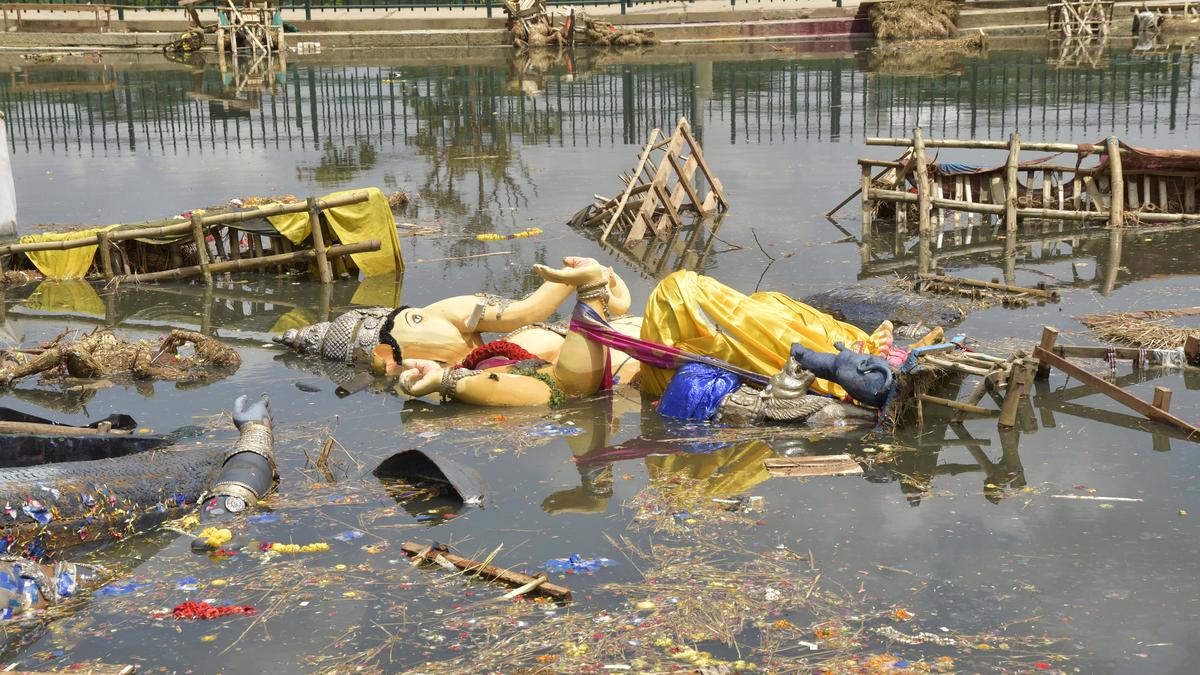
PoP Ganesh idols continue to find buyers in Bengaluru despite ban
The Hindu
PoP idol-makers allege that those who claim to make eco-friendly Ganesh idols are not really doing so. They claim that it is impossible to make a Ganesh idol larger than 3 feet tall using mud or clay.
The manufacture and sale of Ganesh idols made of Plaster of Paris (PoP) has been banned by the Karnataka State Pollution Control Board (KSPCB) since 2016 to prevent pollution of lakes. Yet, they remain a fast-selling product.
According to the owner of a popular warehouse that sells mammoth sized Ganesh idols, some of which go for ₹40,000, in Mavalli, said the ban has not been imposed strictly. “Though it has been banned, we have never been questioned or stopped by the pollution control board, or the Bruhat Bengaluru Mahanagara Palike (BBMP). The rule has not been imposed strictly anywhere. Huge idols cannot be made from clay or mud, as they are not durable, and PoP Ganeshas are what our customers who celebrate the festival on a large scale prefer. We can not really stop selling PoP Ganeshas,” he said.
He defended PoP idols saying, “We are in a confused state on what kind of Ganesh idols will cause harm to the environment, or what is more sustainable. Mud or clay idols require us to mine mud quarries or lakes. Most of the mud or clay used to make idols are not reusable, as they lose their quality. We understand that PoP can cause damage when immersed in lakes, but if they are immediately removed from lakes, they can be reused, which is a more sustainable method.”
Another vendor at Mavalli, said that PoP Ganesh idols are their only source of income. He suggests dedicating one lake for the immersion of PoP idols, like in Hyderabad and Mumbai. “Though we have not produced PoP idols this year, we continue to sell the ones we have in stock. Customers do not prefer clay or mud Ganesh idols. Even if we use eco-friendly colours or decorations, they do not find them attractive and prefer PoP idols. We agree that PoP idols can be harmful to the environment, but considering their popularity, the government can dedicate one lake to immerse PoP Ganesh idols. The government can set the rules on the size of Ganesh idols, collect a fee for immersion, and can clean up the lake once the festivity is over. There are many dedicated lakes like these in Hyderabad and Mumbai, which do not have fish or birds that are dependent on the lakes. At least one such dedicated lake in Bengaluru will help many vendors like us.”
PoP idol-makers also allege that those who claim to make eco-friendly Ganesh idols are not really doing so.
A vendor in Kumbalgodu said, “We are targeted for making PoP idols, but though other vendors claim that their idols are made of mud or clay, or are a mixture of paper and mud, it is impossible to make a Ganesh idol larger than 3 feet tall using mud or clay.”
Consumers had their reasons for opting for PoP idols.


“Judicial time is a valuable public resource. Every frivolous or misconceived invocation of constitutional jurisdiction results in diversion of time from genuinely deserving litigants,” said the Madurai Bench of the Madras High Court while imposing a cost of ₹50,000 on a man from Theni district who filed a petition with an unusual prayer: permission to conduct daily protests till the ‘World War’ ends.

The Mangaluru city police on Wednesday, arrested Pavan Acharya, 22, of Moodubelle village in Kaup Taluk in Udupi district, on the charge of posting inflammatory content on the social media.

Bengaluru corporations will present five separate budgets on March 27-28, focusing on infrastructure and community funding.

A humorous exchange in the Legislative Assembly highlights CM Siddaramaiah's choice of a Mysore silk shawl over a towel.

Karnataka's fiscal deficit is under control, better than neighboring states, says Chief Minister Siddaramaiah amid revenue challenges.

Capt. S. Divakar takes charge as MD and CEO of Dredging Corporation of India, following board approval for his appointment.

Nara Bhuvaneswari inaugurates a job mela in Kuppam, promoting job creation and welfare initiatives for local youth and women.

Walajah residents protest by hoisting black flags, threatening to boycott elections over poor civic amenities and infrastructure issues.

The Railway Ministry has decided to regularise the services of Surat-Mangaluru Junction-Surat bi-weekly Special Express along with nine other special trains.

Training held for zonal election officers in Thoothukudi

Defence Minister highlights BRO's vital role in enhancing border infrastructure, national security, and socio-economic growth in India.

Andhra University celebrates its 91st and 92nd convocations, honoring graduates and distinguished personalities for their contributions and achievements.

Coimbatore students receive earthen bowls to provide water for birds, promoting conservation on World Sparrow Day.