Pop culture and the Rubik’s Cube as a metaphor for love, life and everything in between
The Hindu
Since its invention, the Rubik’s Cube has turned up regularly in blockbuster movies and TV shows. As you might imagine, a wildly popular 3D puzzle is an easily identifiable metaphor — for life-challenges, dilemmas of the heart, the frenetic feeling that life is passing you by and you need to ‘solve’ the attitudes that are holding you back.
Sheldon Cooper from The Big Bang Theory (2007-2019) was perhaps the most recognisable geek archetype on all of television, and one of his most-depicted traits was being a video game addict. PlayStations, gaming laptops, old-fashioned handheld video games, he had ’em all.
In ‘The Monster Isolation’ (season 6, episode 17), Sheldon smuggles all manner of video games on his person because his friends are taking him to see a play he doesn’t want to — notably, the only analogue item he carries along is the humble Rubik’s Cube. We already know Sheldon is into ‘cubing’ (the pursuit of fast and elegant Rubik’s Cube solutions, professionally or otherwise). At various points during seasons five and six, we see him wearing a T-shirt with an image of a melting Rubik’s Cube — a geek-endorsement for one of the most enjoyable and popular puzzles in the world.
2024 marks 50 years since Hungarian architecture professor Ernő Rubik created the first prototype of his combination puzzle, wherein a 3x3 cube is painted with different colours for every face and you have to line them up, one colour for every face. In these five decades since, the Cube has turned up regularly in blockbuster movies and TV shows. As you might imagine, a wildly popular 3D puzzle is an easily identifiable metaphor — for life-challenges, dilemmas of the heart, the frenetic feeling that life is passing you by and you need to ‘solve’ the attitudes that are holding you back.
One of the more straightforward ways filmmakers have used the Cube is to depict a character as a rapid and intuitive learner, especially when it comes to tech-proficiency. In Tron: Legacy (2010), protagonist Sam Flynn, son of a legendary programmer, is shown playing with a Rubik’s Cube in his bedroom. Hacker (2016) introduces the child version of its protagonist by showing him solving a Cube rather quickly at the breakfast table, his bemused parents watching in the background. Snowden (2016) introduces its famous protagonist in the same way. Genius mathematician John Nash (Russell Crow) is shown to have a Cube in his room in A Beautiful Mind (2001). Even documentaries have found the Cube to be useful in this context: Bobby Fischer Against the World (2011) sees the iconic chess player solving a Rubik’s Cube at one point.
More recently, the vivid colours of the Cube were used in an interesting visual gag, in one of the most original animated films of recent times, Spider-Man: Into the Spider-Verse (2018). In this film, we see Spider-Men and Spider-Women from different realities converging to train Miles Morales, the Spider-Man in the ‘default’ reality. One of these alt-Spideys is Spider-Man Noir (Nicolas Cage), who comes from a black-and-white reality as suggested by his name. The grim, brooding Noir, tortured by the bloodshed that marks the crime-fighting life, is preoccupied by a Rubik’s Cube that he keeps on his person at all times. Towards the end, we see him having solved the puzzle — which is also the only coloured object in his reality. Of course, the process of solving the Cube also mirrors Noir’s existential crisis as the story progresses.
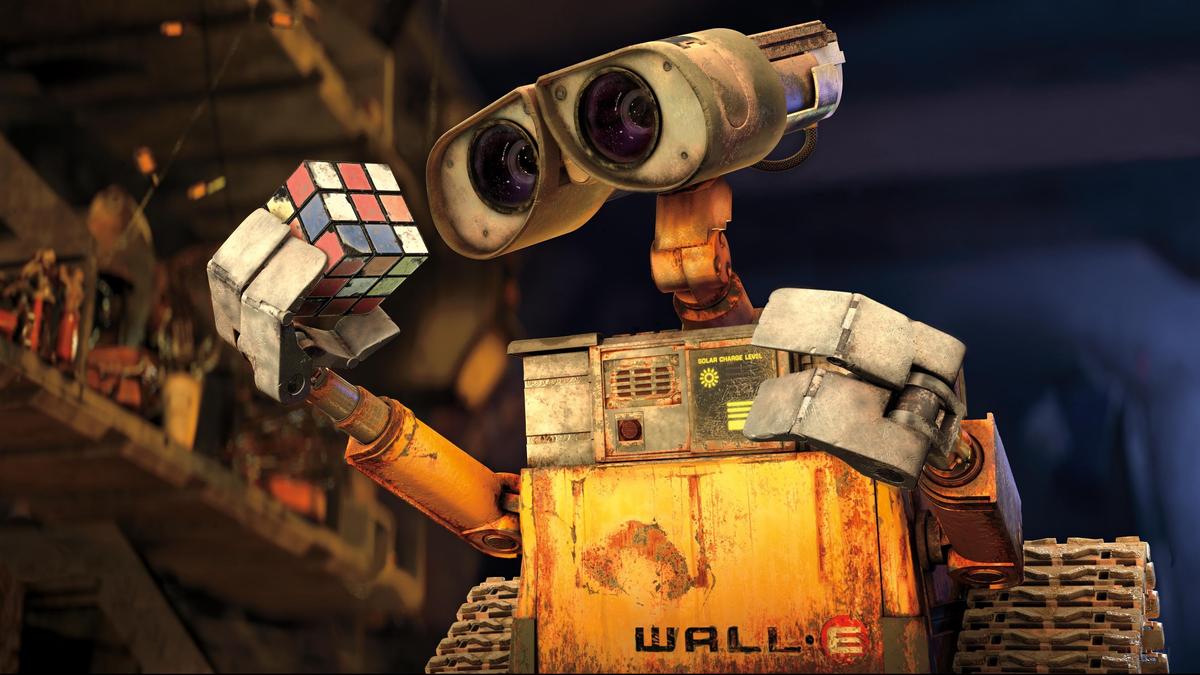
The Spidey scene reminded me of the versatility of this simple and sweet device. WALL-E (2008) famously used the Cube as a romantic gesture between the robot protagonists WALL-E and EVE. The Jennifer Lopez music video for ‘Ain’t Your Mama’ (2016) showed the singer playing women from every decade starting with the 1950s, with the video being structured as a mini-history of second-wave feminism. She is shown to excel at tasks that men around her are struggling with, and in one moment she takes a Rubik’s Cube from a waffling man and solves it on the spot.
My favourite usage of the Cube, however, and perhaps the most iconic of them all, is from the Will Smith classic The Pursuit of Happyness (2006). In 1981, Smith’s penniless salesman protagonist Chris Gardner meets hotshot stockbroker Jay Twistle (Brian Howe) in a taxi. Twistle heads Dean Witter Reynolds, a large brokerage and securities firm of the 70s and 80s. This is Gardner’s one shot at entering the world of finance and he impresses Twistle by solving a Rubik’s Cube during the cab ride (in a previous scene, we saw him practising in his bedroom). Gardner is asked to join the firm as an intern stockbroker. The producers of the film hired 22-year-old Tyson Mao to train Smith for this scene. Mao is a Taiwanese-American ‘speedsolver’ and one of the founders of the World Cube Association.


The thrilling ‘Peaky Blinders’ finale is a farewell tour tailored for Tommy Shelby, while passing the baton to a new generation

BTS's comeback concert in Seoul drew over 100,000 fans, featuring their new album "ARIRANG" and a global livestream.

Khalid Rahman is reuniting with Malayalam superstar Mammootty after Unda (2019). The Thallumaala director has teamed up with the veteran for Mattancherry Mafia.

Bollywood actor Akshay Kumar paid tribute to the martial arts grandmaster and Hollywood’s action star, Chuck Norris, who passed away on Thursday, March 19, 2026.

Renowned Odissi dancer Madhumita Raut, aged 59, dies of cardiac arrest, leaving behind a legacy of artistic achievements.

Chuck Norris, iconic martial arts master and actor, dies at 86, leaving behind a legendary legacy and internet memes.

South African naturalist Steve Boyes speaks on ghost elephants, ancestral tracking, and Werner Herzog’s documentary exploring Angola’s elusive highland giants

Actor-director Amol Palekar will receive META's Lifetime Achievement award for 2026 on March 25 in New Delhi.

India's artists unite against rising censorship, advocating for creative freedom and support for marginalized voices in the arts.

Written and directed by Kunal, the film also stars Sparsh Shrivastava and Vanshika Dhir

This year, Bharatnatyam artistes will present the Tyagaraja Aradhane as a dance performance

This year, Bharatnatyam artistes will present the Tyagaraja Aradhane as a dance performance

The actor, along with director Sushant Shah, speak about their upcoming series ‘Chiraiya’, Divya’s process of working on the dialect, Sushant’s approach to telling a story about women, and more