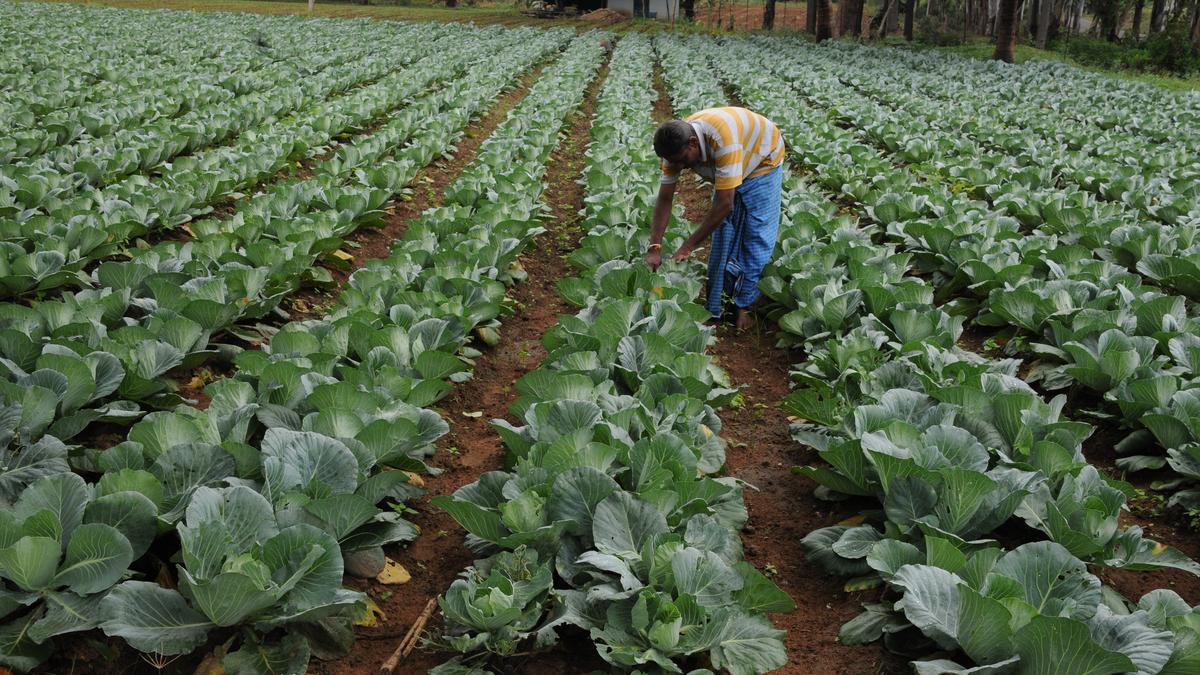
Poor procurement price of cabbage leaves farmers in Erode’s Talavadi Hills in distress
The Hindu
The drop in the procurement price of cabbage to less than ₹5 a kg in Talavadi Hills, Erode district, has upset many farmers as they fear that the crop is no longer profitable.
The drop in the procurement price of cabbage to less than ₹5 a kg in Talavadi Hills, Erode district, has upset many farmers as they fear that the crop is no longer profitable.
Favourable climate prevails throughout the year atop the hills, and the 90-day crop is widely cultivated by farmers on their small holdings ranging from half an acre to two acres. Fully-grown cabbages are procured by traders directly from the farmers and transported to markets in Erode, Coimbatore and Kerala.
An official at the Department of Horticulture and Plantation Crops said the cabbage area under cultivation in the Talavadi block had risen from 78 hectares in 2018-19 to 427 hectares in 2022-23 and, as of December 2023, was presently 298 hectares.
Farmers incur a cultivation cost of ₹80,000 per acre and their profit is ensured only if the cabbage is procured at minimum of ₹6 a kg. “Traders were procuring cabbage even for ₹1 a kg over the past few years and I have incurred a huge loss,” said M. Channanjamurthy of Gumatapuram, who has turned to maize in the past two years, giving up on cabbage. He said the average procurement price was less than ₹6 a kg during the last season forcing many farmers to drop the cultivation of cabbage.
Farmers pointed out that the maximum procurement price had been ₹26 a kg in October 2020. “But after COVID-19, surplus production, low demand, pest attacks on crops, an increase in cultivation costs and a drop in procurement prices, has caused distress to farmers. We cannot afford to incur such huge losses regularly,” said S. Manickam, another farmer in Talavadi. “The average price has been ₹10 to ₹12 a kg in the past few years. But it dropped to less than ₹5 a kg last year,” he added.
The farmer said that since traders did not come to buy their produce last year, many ploughed all of the mature cabbage heads while a few farmers used the cabbage as fodder for cattle. Another farmer, Muthu Mathappan of Neithalapuram, pointed out that an increase in spending towards fertilisers and pesticides, along with a drop in yield, was also affecting them.
S. Kannaiyan, president of the Talavadi Farmers’ Association, stressed the need to supply quality saplings and for integrated pest management, as whitefly insects cause extensive damage to the leaves. “Excessive pesticides are used and the Department should provide technical support to the farmers,” he told The Hindu.


The government plans to amend the FCRA, introducing new regulations for NGO asset management and accountability for key functionaries.

The draft policy for “Responsible Digital Use Among Students”, released on Monday by the Department of Health and Family Welfare, has recommended that parents set structured routines with clear screen-time rules and prioritise privacy, safety, and open conversation with children on digital well-being.

Police Observer Sushant Kumar Saxena conducts surprise inspection at Shencottai police station, reviewing warrants and security arrangements ahead of elections.

Andhra Pradesh government to launch key projects in April, focusing on industrial growth and infrastructure development, says Nara Lokesh.

Lok Sabha refers the Corporate Laws (Amendment) Bill to a JPC amid opposition concerns over CSR provisions dilution.

SHG members in Kanniyakumari use snakes and ladders to raise election awareness and boost voter turnout.

Government accelerates consultations for early implementation of the Women’s Reservation Act to ensure women’s representation in 2029 elections.

CM A. Revanth Reddy distributes ₹1 crore insurance cheques to families of deceased Electricity department employees, enhancing financial security for workers.

The Bengaluru Traffic Police (BTP) registered 634 cases of drunk driving during a week-long special enforcement drive conducted across the city between March 16 and March 22.

GHMC intensifies action against property tax defaulters, seizing properties and offering a One Time Settlement scheme for payments.

CCB arrests three drug peddlers in Mangaluru, seizing ₹2.5 lakh worth of MDMA and other valuables.

TVK's 28 candidates in Puducherry include former BJP MLAs, a sitting Independent, and a retired police IG.

BRS submits notice on private member bill to Speaker