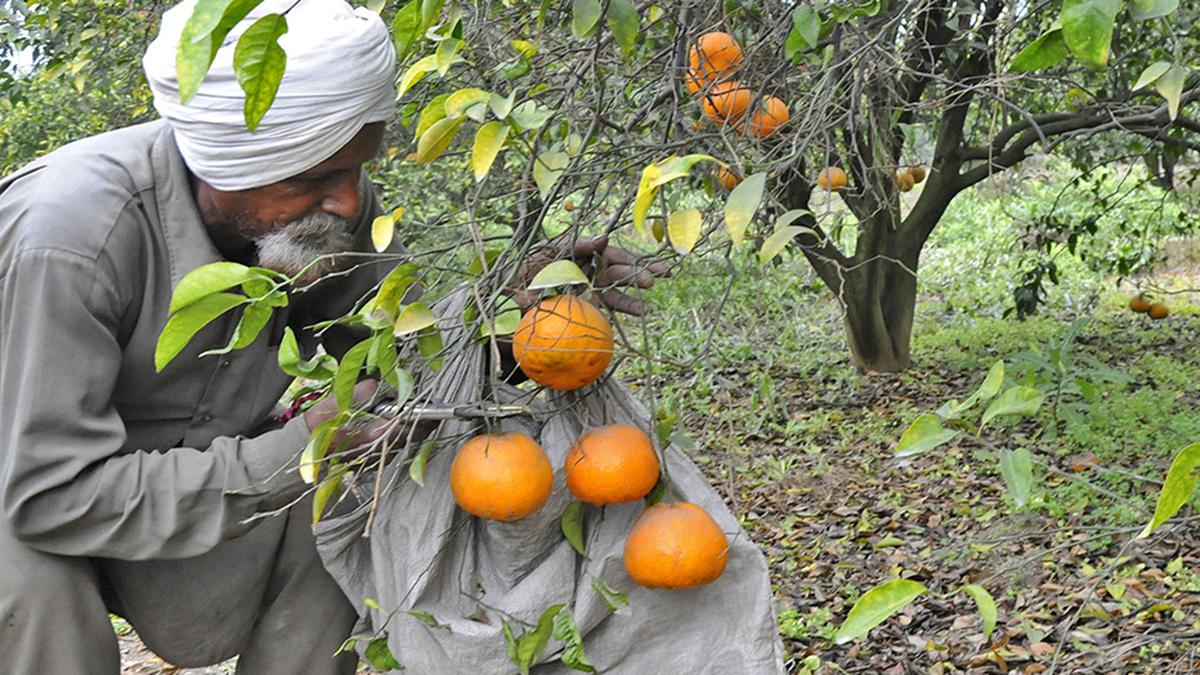
Poor demand, bountiful output plunge kinnow price, leave farmers in distress
The Hindu
Poor demand, abundant production, and early plucking of the produce this winter have left growers of kinnow, a citrus mandarin fruit in Punjab, grappling for a fair price for their season’s harvest.
Poor demand, abundant production, and early plucking of the produce this winter have left growers of kinnow, a citrus mandarin fruit in Punjab, grappling for a fair price for their season’s harvest.
Production of kinnow, a hybrid between King (Citrus Nobilis) and Willo Leaf (Citrus Deliciosa) mandarins, is likely to see a jump from last year’s 12 Lakh Metric Tonne (LMT) to 13.50 LMT this season in Punjab, a major producer of kinnow in the country.
Growers in the State are worried over the drop in kinnow price in the ongoing season compared to last year. At the same time, the officials are optimistic of kinnows fetching a better price in the coming days following a dip in temperature in the region, which would enhance quality of the fruit.
In Fazilka district’s Abohar, a key kinnow-producing region in Punjab, Sudhir Bishnoi of Bishanpura village is anxious as he fears substantial loss this season. “We are getting significantly lower prices for the fruit when compared to last year. There is almost a 50% drop in the price for the grower. I have so far sold half of my produce between ₹7 and ₹8 per kg while last year it fetched around ₹15-₹16,” Mr. Bishnoi, who owns an orchard spread over four acres, told The Hindu.
“Interestingly, while we are getting lower prices for the produce, the fruit is being sold in the retail market for almost the same price as last year, which is around ₹32-₹35 per kg. This indicates that middlemen are reaping the profit while growers and the consumers are suffering,” added Mr. Bishnoi. He demanded that the State intervene and said when kinnow prices fall drastically, as they have this year, the State should purchase the produce from the grower.
“Government intervention is all the more important in the wake of the government’s big talks about promoting crop diversification. If the government is serious about promoting crop diversification in the State, then a mechanism for assured price and purchase of the produce has to be put in place,” he said.
In Punjab, harvesting of kinnow usually begins in December and continues till February-end. According to State government data, the total area under kinnow in Punjab is around 47,000 hectares this season. Apart from Fazilka, kinnow is also grown in Hoshiarpur, Muktsar, Bathinda and a few other districts.


Coal Minister urges State leaders to maintain stable coal prices amid rising global costs, assuring ample domestic supply.

Mahanagar Gas ensures reliable PNG and CNG supply in Maharashtra and Karnataka, offering customer benefits to encourage adoption.

OpenAI Chief Executive Sam Altman said on Monday he has stepped down from the board of directors of Helion Energy, the fusion startup he has backed since 2015

Nikhil Kamath and Quant MF back Swan Defence's oversubscribed ₹500 crore Offer for Sale, reflecting strong investor interest in defence stocks.

HDFC Bank appoints law firms to investigate allegations by former Chairman Atanu Chakraborty following his resignation.

Airlines are cancelling numerous flights amid escalating West Asia conflicts, leaving tens of thousands of passengers stranded worldwide.

The rupee declines 20 paise to 93.73 against the dollar as global oil prices rise and investor uncertainty persists.

Siemens said on Monday that the Iran war has led to customers holding back on new investments as prices increase for raw materials and energy.

OpenAI said its close ties with Microsoft could be a potential risk to its business, telling investors that the software company is responsible for “a substantial portion of our financing and compute,” CNBC reported

LPG crisis: Alternative solutions are being considered, with ammonia cylinders being increasingly used for industrial applications amid delays in commercial LPG deliveries.

India monitors U.S. military pause on Iran as oil prices dip; External Affairs Minister engages with GCC nations for support.

India monitors U.S.-Iran tensions as Trump pauses attacks, leading to a significant drop in oil prices.

Union Minister Ashwini Vaishnaw launches three initiatives to enhance India's creative economy through AI training, citizen platforms, and advanced tech access.