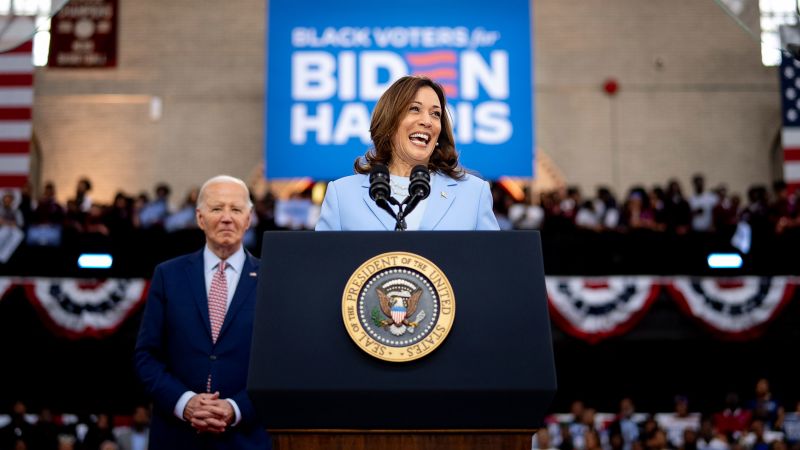
Polling suggests Harris might be able to outperform Biden against Trump among these groups
CNN
Polling conducted before Biden’s announcement provides some early indications of how a Harris for President campaign might try to improve on his standing in the race.
It’s just one day after President Joe Biden announced that he would end his reelection campaign and endorsed Vice President Kamala Harris to be the Democratic nominee taking on former President Donald Trump in this year’s presidential race. That’s far too soon for polling to capture the dynamics of a fast-evolving campaign, but polling conducted before Biden’s announcement provides some early indications of how a Harris for President campaign might try to improve on Biden’s standing in the race. CNN’s polling in late June tested Biden’s support against Trump in the wake of the presidential debate, and it also looked at how Harris would fare in a hypothetical matchup with the former president. Overall, Harris held 45% support to Trump’s 47% among registered voters nationwide, a result with no clear leader, within the poll’s margin of sampling error. Biden trailed Trump by 6 points in the same poll. Harris outperformed Biden against Trump among women – notably among women of color and suburban women – and political independents, and she held an advantage over Trump among voters who said they weren’t fully locked in to their presidential choices. The data also suggests Harris fared somewhat better than Biden among younger voters, a particular point of concern for Democrats during the campaign so far. Here’s a look at some of the key numbers: Women: Harris held the support of 50% of women registered voters to Trump’s 43%, while Biden only held the support of 44% of women to Trump’s 47%. Among suburban women, a key segment of Biden’s coalition in 2020, Harris held 55% support to Trump’s 39%, while Biden stood at 49% to Trump’s 43%. Men broke for Trump by about 10 points regardless of whether the Democrat was Biden or Harris.


Any attempt by the United States to take control of Cuba would be met with “impregnable resistance,” Cuban President Miguel Díaz-Canel said Tuesday, as power returned to some parts of the island following a nationwide grid collapse.

Deputy Attorney General Todd Blanche defended the Justice Department’s handling of the Jeffrey Epstein files and asserted it does not have new evidence to prosecute anyone for crimes related to the convicted sex offender, in an interview released Tuesday.

TSA workers face reality of working without pay as passengers unaware of the shutdown see long lines
More than a third of the security screeners at Hartsfield-Jackson Atlanta International Airport didn’t show up to work Tuesday, the airport’s general manager said, causing passengers to have to wait in line for up to two hours.

Any attempt by the United States to take control of Cuba would be met with “impregnable resistance,” Cuban President Miguel Díaz-Canel said Tuesday, as power returned to some parts of the island following a nationwide grid collapse.

Many assume JB Pritzker’s run for president is just a year away. His effort to engineer a victory for his lieutenant governor, Juliana Stratton, in Illinois’ Senate primary was also a victory for him and a political operation with national ambitions.

Lt. Gov. Juliana Stratton’s win in the Senate Democratic primary was also a win for Gov. JB Pritzker, while big-spending groups like AIPAC got mixed results in Tuesday’s contests.

United Farm Workers is not participating in annual celebratory events this month of its co-founder Cesar Chavez over what it calls serious allegations the union did not specify

Illinois Lt. Gov. Juliana Stratton will win the Democratic primary for an open Senate seat, CNN projects, a stunning rise for a little-known state officer now on a glide path to Washington.

President Donald Trump promised his endorsement was forthcoming in the GOP Texas Senate runoff and said he wanted whoever he didn’t pick to drop out. But now — preoccupied with the Iran war and a doomed voting bill — he’s missed a critical deadline.

The Senate has kicked off extended debate on the “SAVE America Act” — one of President Donald Trump’s top legislative priorities.

Organized crime in Latin America is proving difficult to defeat with the kind of decapitation strategy apparently favored by US President Donald Trump.

The conservative movement’s internal debate over the Iran war entered a new phase on Tuesday, with the first resignation of a prominent Trump appointee who criticized the war.

Arizona’s attorney general has filed the first-ever criminal charges in the US against a major prediction market company, accusing Kalshi of running an illegal gambling operation in violation of state law.