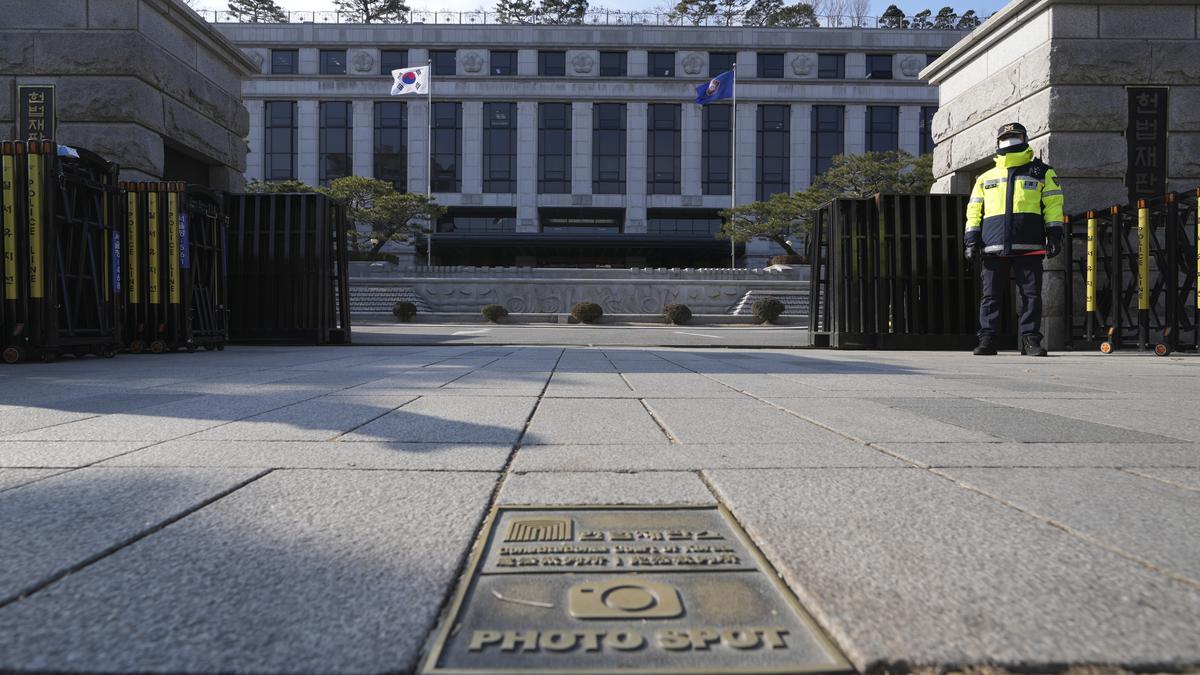
Political strife erupts over South Korean court as it is set to determine fate of impeached Yoon
The Hindu
South Korea's acting leader reassures stability after President's impeachment, as rival parties clash over court ruling mechanics.
South Korea’s acting leader vowed Tuesday (December 17, 2024) to convey to the world that things are back to normal following parliament’s impeachment of conservative President Yoon Suk Yeol, but rival parties began squabbling over the mechanics of a court ruling to determine whether to formally unseat or reinstate him.
The country’s liberal opposition-controlled parliament voted to impeach Mr. Yoon last Saturday (December 14, 2024) over his short-lived December 3 martial law imposition, suspending his presidential powers until the Constitutional Court determines whether to uphold or overturn the decision. If Mr. Yoon is dismissed, a national election must be held to pick his successor within two months.
Prime Minister Han Duck-soo, who became acting leader, has taken steps to reassure the US and other countries and stabilise markets. Presiding over a Cabinet Council meeting on Tuesday (December 17, 2024), Mr. Han said he will “continuously do my utmost to inform the international society that the Republic of Korea is fast regaining stability and maintain confidence with partners.”
But the country’s intense political strife appears to be far from over, as the rival parties began bickering over whether to fill three vacant justices’ seats at the Constitutional Court.
To formally end Mr. Yoon’s presidency, the nine-member court panel needs support from at least six justices. But since three seats remain vacant following retirements, a unanimous decision in favour of Mr. Yoon’s impeachment is required to throw him out of office for good.
Three of the court’s nine justices are directly appointed by the president. Three others are nominated by the Supreme Court head and another three by the National Assembly, and their formal appointments by the president has widely been a formality. The three seats that are currently open are to be nominated by the National Assembly – two by the Democratic Party and the other by Mr. Yoon’s ruling People Power Party.
The court can rule on Mr. Yoon’s case only with the current six justices. But the main liberal opposition Democratic Party, which led the impeachment efforts against Mr. Yoon, has said it would speed up the process of restoring the court’s nine-justice system to promote fairness and public confidence in its ruling.


Iranian missile strikes on Israeli towns cause widespread damage and injuries, marking a significant escalation in the ongoing conflict.

As Gor makes first trip as U.S. Special envoy to South Asia, Delhi watches strategic signals closely
Sergio Gor's inaugural trip as U.S. Special Envoy to South Asia signals strategic U.S. engagement amid regional tensions.

Slovenians vote in a tight election between liberal and populist candidates, impacting the country's future domestic and foreign policies.

Netanyahu asserts U.S.-Israel alliance fights Iranian threats, emphasizing global security after missile strikes on Israeli and European targets.

Israeli settlers attack Palestinian villages in the West Bank, causing injuries and destruction amid ongoing settlement expansion.

Britain asserts no evidence of Iran planning missile strikes on Europe, despite Israeli claims of missile capabilities.

UNESCO reports over half of countries have banned phones in schools due to concerns about attention, cyberbullying, and social media impact.

Analysis reveals a U.S.-operated Patriot missile likely caused a pre-dawn explosion in Bahrain, injuring numerous civilians.

Sri Lanka raises fuel prices by 25% amid ongoing West Asia conflict, impacting petrol and diesel costs significantly.

Iran strikes near Israeli nuclear research center as Trump threatens attacks on Iranian power plants
Iran's missile strikes near Israel's nuclear site escalate tensions as Trump threatens retaliation against Iranian power plants.

Saudi Arabia intercepts one of three ballistic missiles targeting Riyadh amid ongoing regional tensions and threats from Iran.

Iran's death toll exceeds 1,500 amid escalating war, with heavy airstrikes and shifting U.S. and Israel strategies reported.

Iran's military threatens to target U.S. energy and desalination infrastructure in response to American threats over the Strait of Hormuz.