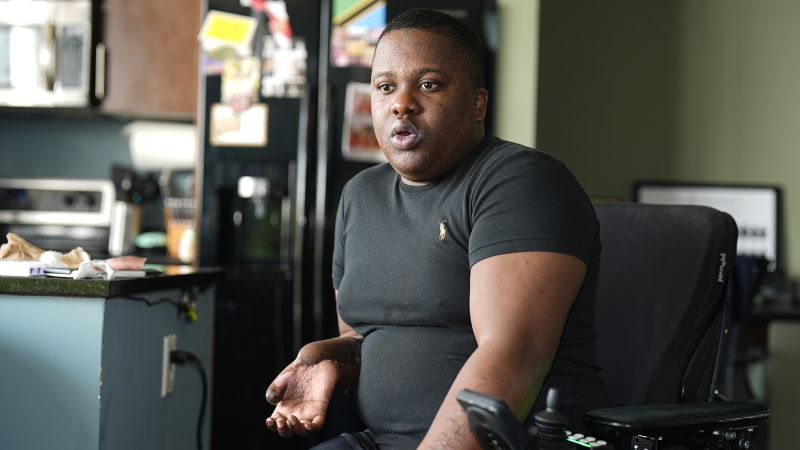
Police recruit who lost both legs in ‘barbaric hazing ritual’ sues Denver, paramedics and officers
CNN
A police recruit who had to have both of his legs amputated after losing consciousness and repeatedly collapsing during fight training at Denver’s police academy is suing those who allegedly forced him to continue the “barbaric hazing ritual” after paramedics ignored warning signs.
A police recruit who had to have both of his legs amputated after losing consciousness and repeatedly collapsing during fight training at Denver’s police academy is suing those who allegedly forced him to continue the “barbaric hazing ritual” after paramedics ignored warning signs. Victor Moses, 29, alleges in a lawsuit filed Tuesday that aggressive officers knocked him down multiple times in the second round of “fight day” last year, with one of them shoving him off the mat and causing him to hit his head on the floor. He said he was pressured to continue, with officers picking him up and setting him back on his feet, before paramedics standing by were asked to check him out, the lawsuit said. Moses told them he had the sickle cell trait, which puts him at an increased risk of medical complications from high-intensity exercise. He also said he had very low blood pressure and complained that his legs were cramping, according to the lawsuit. The symptoms are danger signs for people with his condition. Nevertheless, paramedics cleared Moses to return to training, which the suit alleges was a decision made to support the police. The type of training described in the lawsuit is common in the United States and helps prepare recruits for scenarios they could face on patrol, said Ian Adams, an assistant professor of criminology and criminal justice at the University of South Carolina. Minor injuries are common and occasionally recruits die, often because of an underlying medical condition, he said. Both the Denver Police Department and Denver Health, the public hospital that employed the paramedics, declined to comment on the allegations, saying they could not address pending litigation.


Facing deadly Iranian drone attacks across the Middle East, the US military has been rushing defensive systems into the region while adjusting to a threat that has come to dominates modern battlefields and carries echoes of a weapon that haunted service members during the 20 years of the war on terror.

In his early days in Congress, Markwayne Mullin tried pairing his suit jacket and tie with a pair of jeans on the House floor. Then-House Speaker John Boehner reprimanded the young Republican for breaking the dress code.

As President Donald Trump rachets up the pressure on Cuba’s communist-run government and threatens a US “takeover” of the island, he frequently repeats a central promise: that decades after they left, Cuban exiles will soon be able to return to their homeland.

The first two weeks of the Iran crisis have demonstrated military dominance by the US and Israel, with asymmetrical responses from Iran. How this plays out over the coming weeks will determine the outcome.

Utah mother Kouri Richins was found guilty of murder and all other charges in the 2022 death of her husband, Eric Richins, who died of a lethal dose of fentanyl.

The Virginia man accused of planting two pipe bombs in Washington, DC, the night before the 2021 US Capitol riot asked a federal judge on Monday to dismiss his case, arguing that President Donald Trump’s expansive pardon of January 6 rioters applies to him.

President Donald Trump has repeatedly taken aim at Democratic rival and possible 2028 presidential candidate Gavin Newsom. But lately, he’s become fixated on saying the California governor cannot be president due to his “learning disability.”

Cuba’s electrical grid suffered a total collapse on Monday, the country’s power operator said, marking the latest nationwide blackout in recent years, and the first since the US effectively shut off the flow of oil to the island of roughly 10 million people.

Top Border Patrol official Gregory Bovino, who led controversial immigration sweeps in Democratic-led cities, has told people he plans to retire at the end of the month, according to two sources familiar with the discussions.

President Donald Trump’s handpicked Kennedy Center board of trustees voted Monday to close the storied performing arts institution for two years for renovations.

Florida GOP congressman Rep. Neal Dunn was thrust into the spotlight after Trump said he had a heart problem and underwent surgery

White House chief of staff Susie Wiles has been diagnosed with early stage breast cancer, President Donald Trump announced Monday.

An Afghan man who served alongside US special forces and fled his native country after its takeover by the Taliban died over the weekend shortly after being detained by immigration authorities, according to his family and an advocacy group.