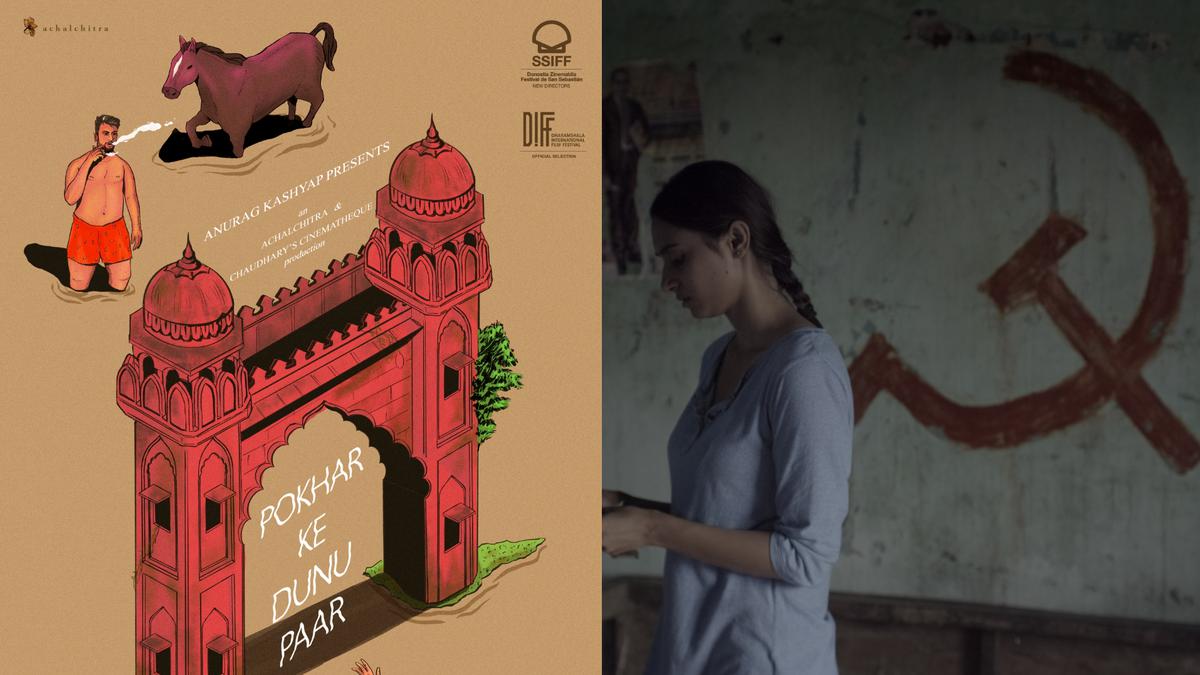
‘Pokhar Ke Dunu Paar’ asks, can love endure a pandemic?
The Hindu
Director Parth Saurabh on his moving debut feature, taking inspiration from Fellini and Charlie Kaufman, and why the film is like a ‘long apology letter’ from him to his partner
The Darbhanga indie is now a flourishing mini-genre. The city in Bihar—known for its hospitals, heritage sites, musical traditions and mango orchards (and where the writer of this piece was co-incidentally born)—has been the setting of two intimate, evocative films of recent years: Achal Mishra’s Dhuin (2022) and Gamak Ghar (2019). Rendered in highly naturalistic Maithili, with unshowy performances, these films offer gentle yet moving ruminations on migration and home—and the kind of quiet economic desperation sweeping small-town India.
Adding to this fascinating list is Parth Saurabh’s Pokhar Ke Dunu Paar. Currently streaming on MUBI, the 104-minute film is a love story—of sorts. Two years before the pandemic, Sumit (Abhinav Jha) and Priyanka (Tanaya Khan Jha) ran away from their homes in Darbhanga to build a new life in Delhi. But the lockdown has forced them to return, and, with nowhere else to turn, they are holed up inside the CPI party office in an old part of town. It’s meant as a temporary arrangement, even if Priyanka—disillusioned by Sumit’s drinking and general lack of industry—is beginning to suspect otherwise.
Saurabh grew up in Darbhanga and later completed his Engineering from IIT Kanpur. He shifted tracks by studying direction at Whistling Woods International in Mumbai (He met his partner, filmmaker Nisheeta Keni, at film school). His first feature script, a Stalker-like story about a mystical, wish-fulfilling room in a remote village, was selected for the NFDC Screenwriters Lab in 2017. But the money wasn’t forthcoming, and some years later, the pandemic happened. Pokhar Ke Dunu Paar—’On Either Sides of the Pond’—emerged from Saurabh’s experiences and observations during those difficult, draining years.
“I went back to Darbhanga in June after the first lockdown in 2020,” he recalls. “I saw a lot more young people around than usual. Most of them were migrants in their 20s who had returned. Everybody was jobless... they were just roaming around, doing drugs. That affected me a lot.”
In the film, as Sumit boozes and marks time with his pals, while also subsisting on their favours, Priyanka attempts to re-establish contact with her father. As Saurabh wrote, he had two famous films in mind as guiding frameworks—Federico Fellini’s I Vitelloni (1953) and Charlie Kaufman’s I’m Thinking of Ending Things (2020). The former is one of cinema’s great poems of youthful insouciance and indirection in a small town; the latter observes a crumbling relationship from the perspective of its female protagonist. Saurabh filtered these influences through real-life conversations he had with his wife and his sister. “As a male, I have a very idealised view of small-town life. But for women, it can be very constrictive.”
He consciously avoided giving his protagonists surnames. “I knew that it was an inter-caste relationship but I did not want to spell it out. You can assume it just by the context of their predicament and I did not have anything more to add to that.”
Saurabh had worked in various capacities on Gamak Ghar and Dhuin. Pokhar Ke Dunu Paar takes a few of its creative cues from its predecessors: a boxed-in aspect ratio, minimal camera movements, conversations allowed to unscroll and meander at a leisurely pace. Abhinav Jha, who’s actually from Giridih in Jharkhand, stars in all three films. But where the Darbhanga of Achal Mishra’s cinema is almost ruefully nostalgic—a postcard view of one’s childhood home, buffeted by modernity and change—the city that Saurabh and cinematographer Pradeep Vignavelu evoke is a drenched, dripping, forbidding place. There are images that strike the eye: a stray horse grazing the streets, a rundown bus with ‘ABVP’ scrawled on it.


Rampant encroachments in Tiruchi threaten pedestrian safety and traffic flow, undermining smart pavement initiatives and exacerbating congestion.

Discover Kerala's electoral history in 'Vottarivu,' a 201-page booklet released ahead of the 2026 Assembly elections.

Experts at a floriculture conference in Shivamogga stress the need to reduce greenhouse gas emissions and enhance soil carbon levels.

First randomisation of EVMs and VVPATs for Tiruchi and Perambalur districts completed with political party representatives present.

Puducherry elections see ongoing DMK-Congress rift over seat-sharing, leading to candidate conflicts on nomination day.

Einstein College and Sri Sarada College in Tirunelveli celebrated significant events, honoring academic excellence and cultural heritage.

Priyanka Gandhi criticises PM Modi's West Asia remarks, urging for a comprehensive Parliament discussion on the matter.

Learn who can vote by postal ballot in the upcoming Tamil Nadu Assembly election, including seniors and persons with disabilities.

Decomposed body of a missing 25-year-old man discovered in Dindigul stone quarry, prompting calls for investigation and quarry closure.

SVEEP activities launched in The Nilgiris aim to boost voter turnout at 13 polling booths with low participation rates.

Learn who can vote by postal ballot in the upcoming Tamil Nadu Assembly election, including seniors and persons with disabilities.

Shorts News:Watch: UDF linked to communal forces in Kerala: CPI(M) leader A Vijayaraghavan

Karnataka government postpones Deendayal Upadhyaya event at KSOU Mysuru due to protocol violations and lack of government involvement.