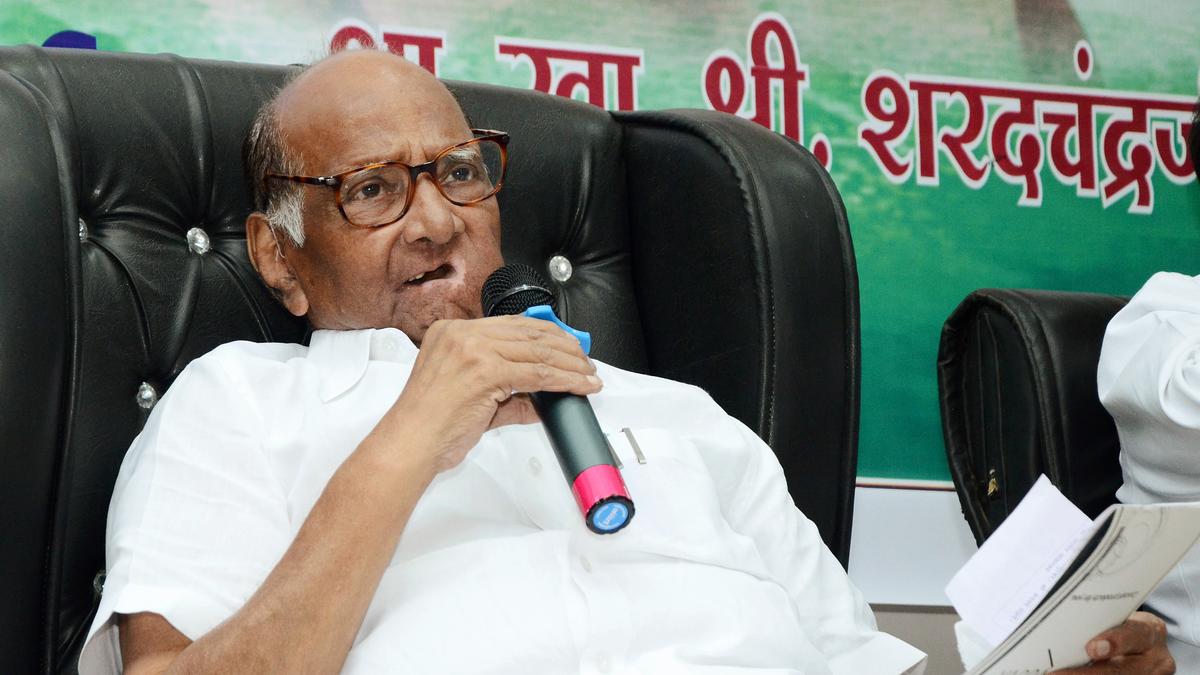
PM must seriously look into concerns of opposition leaders on misuse of Central agencies: Sharad Pawar
The Hindu
NCP chief says he sensed ‘a desire for political change’ among the people of Maharashtra as he toured the State
Nationalist Congress Party (NCP) chief Sharad Pawar on Monday urged Prime Minister Narendra Modi to take seriously the concerns expressed by opposition leaders over the alleged misuse of Central agencies.
Speaking to reporters in Pune, Mr. Pawar, whose party is allied to the Congress and the Uddhav Balasaheb Thackeray (UBT)-led Shiv Sena faction in the Maha Vikas Aghadi (MVA) coalition, further remarked that he sensed “a desire for political change” among the people of Maharashtra, which is currently helmed by Chief Minister Eknath Shinde’s Shiv Sena and the Bharatiya Janata Party (BJP).
Last week, nine leaders from eight political parties had written to Mr. Modi criticising the arrest of former Delhi Deputy Chief Minister Manish Sisodia in the excise policy case, while alleging that the “misuse” of Central agencies implied that the country had “transitioned from being a democracy to an autocracy”.
“I was the first to sign the letter to PM Modi. We want the Prime Minister to take our concerns seriously,” the NCP chief said.
Commenting on Mr. Sisodia’s arrest by the Central Bureau of Investigation (CBI) in connection with the now-scrapped liquor policy, Mr. Pawar said, “Mr. Sisodia worked well for the education sector and was praised by many, but today he’s being arrested.”
Opposition leaders who were the signatories to the letter included Mr. Pawar’s MVA ally, Shiv Sena (UBT) chief Uddhav Thackeray, Telangana CM K. Chandrashekhar Rao, Trinamool Congress head Mamata Banerjee, National Conference (NC) chief Farooq Abdullah, Delhi Chief Minister Arvind Kejriwal, Punjab Chief Minister Bhagwant Mann, Rashtriya Janata Dal (RJD) leader Tejashwi Yadav, and Samajwadi Party (SP) chief Akhilesh Yadav.
The leaders have alleged that the timing of the cases against opposition leaders or their arrests in some cases “coincided with elections”, which clearly implied that the actions thus taken were “politically motivated”.


U.S.-Israeli war on Iran LIVE: Iran faces deadline of US President Donald Trump warning to open Strait of Hormuz. Follow The Hindu for more LIVE updates on March 23 2026 on Iran-Israel war.

KPCC chief Sunny Joseph emphasizes UDF's focus on Sabarimala and corruption while expressing confidence in winning Kerala's upcoming Assembly elections.

A military plane crash in Colombia leaves 125 aboard, with at least 48 survivors rescued amid ongoing recovery efforts.

‘Symposium’, a new platform to promote lifelong learning and counter misinformation among youth, was launched in Hyderabad.

By using TB as an entry point, integrated healthcare delivery can optimise and improve public health efficiency

Residents of Chettichavadi express concerns over deteriorating groundwater quality due to long-standing garbage dumping issues in Salem West.

Community Health Officers in Vijayawada protest for reduced workload and continued incentives amid growing dissatisfaction over salary changes.

Telangana faces 13,929 healthcare vacancies, primarily in doctors and nurses, as recruitment efforts aim to address the shortage.

For most patients with TB who are severely underweight, nutritional support is an essential and not optional part of treatment

Family of custodial death victims demands harsh punishment for nine convicted policemen to prevent future abuses of power.

Rajinikanth refutes TVK leader's claims about DMK threats preventing his political entry, expressing gratitude to supportive political figures.

CM announces Cabinet Sub-Committee on Musi rejuvenation; rehabilitation for all displaced

Ramanathapuram identifies 145 polling stations as sensitive, ensuring security with paramilitary forces ahead of assembly elections, says DEO.