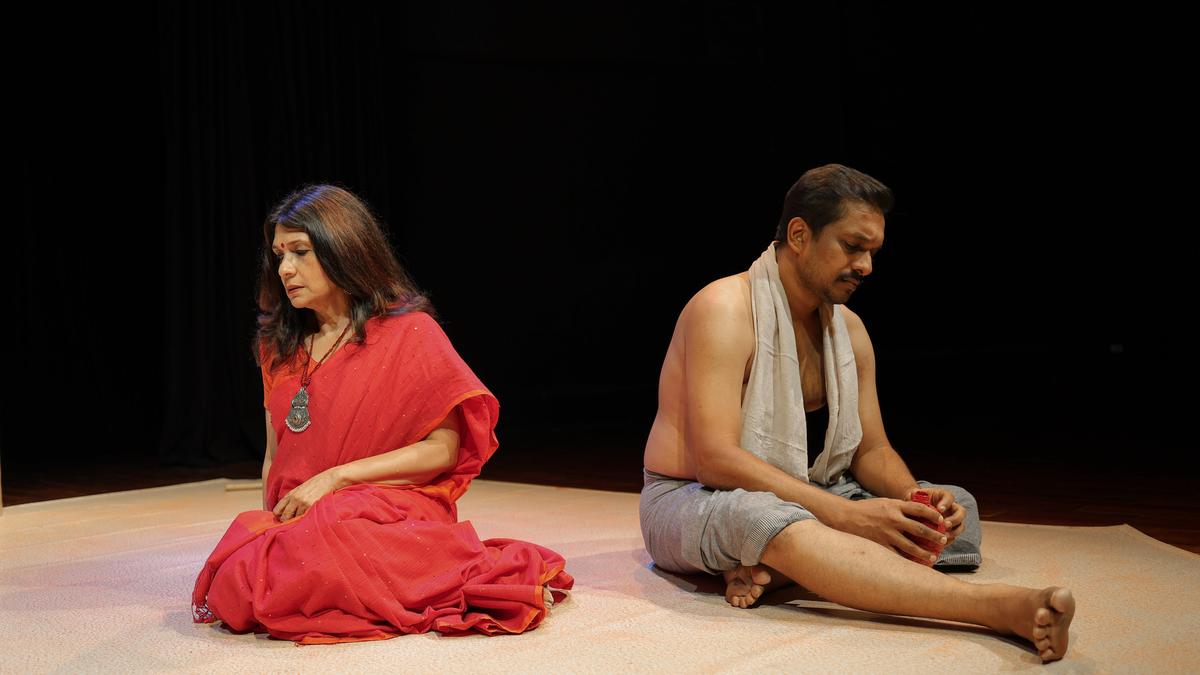
Play preview: Girish Karnad’s ‘Bali: The Sacrifice’ explores violence, belief, and morality
The Hindu
Girish Karnad’s ‘Bali: The Sacrifice’, directed by Arundhati Raja, will be staged in Jagriti Theatre, Bengaluru
In Girish Karnad’s Bali: The Sacrifice (the English adaptation of his 1980 Kannada play Hittina Hunja), a king is torn between his love for his Jain queen, who refuses to harm life, and his duty to his mother, who demands sacrificial rites. This gripping drama explores the complexities of faith, morality, and the power of love.
The 90-minute English play’s exploration of violence and conflicting ideologies resonated with Arundhati Raja, the director. As a tribute to the legendary Karnad, she reimagined the play for her theatre company, Jagriti Theatre, in 2021.
“The play is based, as Girish Karnad’s plays are, on an ancient epic, which he then wields into a skilled, dramatic script. This drew me to Bali and two other Girish Karnad plays I directed, The Dreams of Tipu Sultan and Yayati,” says Arundhati, “I have always strived, however, to highlight the underlying issues he presents, through his dialogue and plot rather than through a traditional approach in design and performance.”
Arundhati delves into the complexities of conflict beyond mere religious differences. She perceives the conflict between the king’s mother and the queen as a catalyst rooted in the patriarchal expectation of a male heir. This expectation, she argues, is a pervasive form of violence, often overlooked in favour of physical manifestations.
“The question here for me is: What constitutes violence? Is it violence only if there is bloodshed or physical abuse? Is the constant pressure on a woman to produce an heir a form of violence? Or on a man to discard an infertile wife for another who, hopefully, is fertile? Or the demeaning of a lowly mahout, loved for his voice but taunted for his looks?” she asks.
Arundhati also acknowledges the rich literary heritage that inspired Karnad’s play. Karnad himself noted that the play’s origins can be traced back to a thirteenth-century Kannada epic, Yashodhara Charite, and even further to similar stories from the first century. This historical context underscores the enduring power of legends and multi-faceted characters in Indian culture.
The play’s connection to these ancient narratives highlights how timeless themes of love, loss, and power continue to resonate with audiences today. “I make no special attempt to make anything relevant. It is all in the script as is. The saying ‘Theatre is a mirror to the audience’ holds true in a Karnad play,” says Arundhati.


South African naturalist Steve Boyes speaks on ghost elephants, ancestral tracking, and Werner Herzog’s documentary exploring Angola’s elusive highland giants

Actor-director Amol Palekar will receive META's Lifetime Achievement award for 2026 on March 25 in New Delhi.

India's artists unite against rising censorship, advocating for creative freedom and support for marginalized voices in the arts.

Written and directed by Kunal, the film also stars Sparsh Shrivastava and Vanshika Dhir

This year, Bharatnatyam artistes will present the Tyagaraja Aradhane as a dance performance

This year, Bharatnatyam artistes will present the Tyagaraja Aradhane as a dance performance

The actor, along with director Sushant Shah, speak about their upcoming series ‘Chiraiya’, Divya’s process of working on the dialect, Sushant’s approach to telling a story about women, and more

An independent video, ‘Feel the Spark’ by Raleigh Rajan with vocals by Ciera Dumas that celebrates Tamil literary giants, garnered 1.4 million views in less than 36 hours.

In ‘Jack Ryan: Ghost War’, John Krasinski is back as the savvy CIA analyst, diving headfirst into a high-stakes mission that unravels a deadly conspiracy and pits him against a rogue black-ops unit

Shriram Bharatiya Kala Kendra’s Shankarlal festival showcased rare ragas, radiant artistry, and inclusive performances, from Pt Madhup Mudgal’s serene morning ragas to Ramana Balachandran’s Saraswati veena.

Explore "Threads that Bind: The Kantha Project," an exhibition in Delhi reimagining kantha as a medium of repair and renewal.

Sean Penn skips the Oscars to meet Ukraine's Zelenskyy, who praises him as a "true friend" amid the war.

The teaser of Tamil star Suriya’s much-awaited film with director Venky Atluri, titled Vishwanath and Sons, was unveiled by the makers on Monday