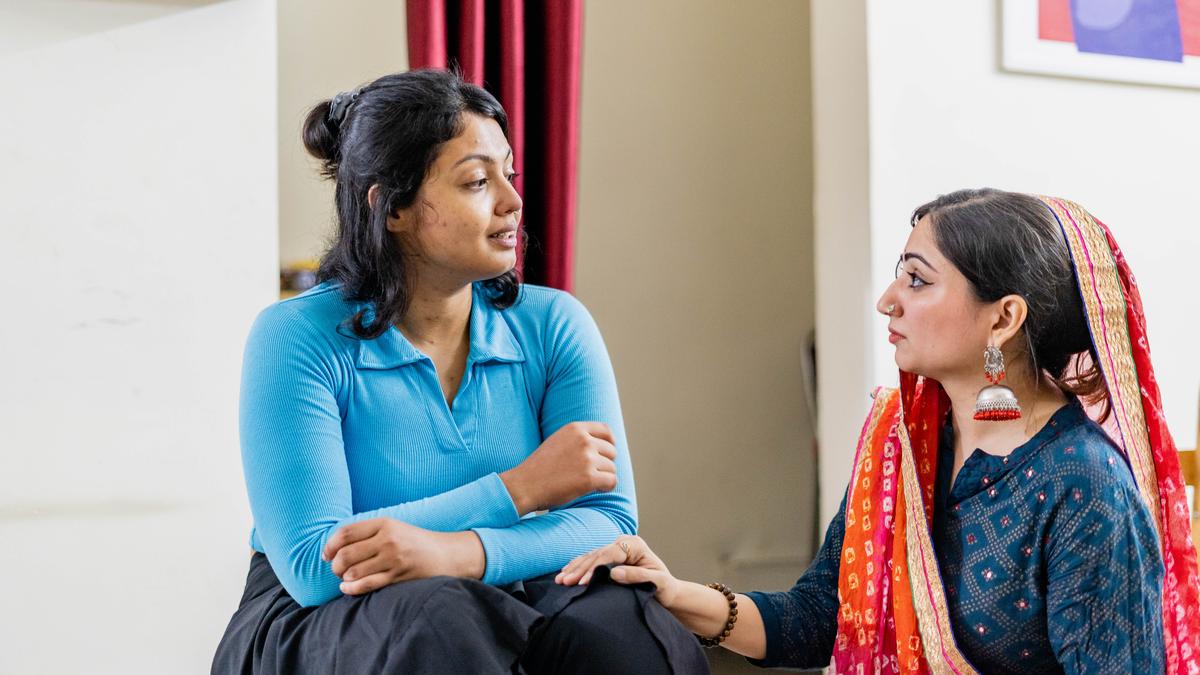
Play preview: ‘Aparajita’ narrates the timeless struggle of women amid societal scrutiny
The Hindu
‘Aparajita’ delves into the timeless struggle of women against moral judgment through the stories of Mirabai and Jahnavi
Indian society has long been a crucible for women, casting judgmental eyes on those who dare to deviate from prescribed norms. From the annals of history to the present day, the relentless scrutiny of women’s choices has been constant. Dramarsis’ new production, Aparajita (which means undefeated), delves into this timeless struggle through the lives of two extraordinary women: Mirabai, a medieval princess, and Jahnavi, a contemporary woman navigating a complex world.
Separated by centuries, these women are united by their defiance. Mirabai’s unwavering devotion to Krishna and Jahnavi’s secret life as a dancer challenge societal expectations profoundly. First-time director, Aritra Biswas, says, “The play aims to highlight the enduring nature of societal judgment. Mirabai is ostracised for her devotion, while Jahnavi fears a similar fate for her secret life. It’s a stark realisation that little has changed.”
The story, written by Gopichand Katragadda, underwent a transformation under the guidance of Dramarsis before it was stage-ready. “The original story didn’t include Mirabai as a central character,” says Aritra, “We decided to bring her to the forefront and run her story parallel to Jahnavi’s.” This creative choice transports the audience on a visual and auditory journey through time, from the medieval era to modern India.
The play draws poignant parallels between Mirabai’s and Jahnavi’s experiences. “We’ve incorporated some of the legendary tales of Mirabai’s persecution into the play,” says the director. From facing assassination attempts to enduring social ostracism, Mirabai’s journey is a stark contrast to Jahnavi’s, where the fear of judgment often overshadows reality.”
However, the play also acknowledges the nuances of societal reactions, as Aritra explains, “We’re not portraying everyone as judgmental. It’s a more nuanced portrayal.”
Both characters are presented as complex individuals. Jahnavi, a seemingly conventional medical student, harbours a secret life that defies societal expectations. Mirabai, a devout queen, challenges religious orthodoxy with her unconventional views of Krishna. As Aritra points out, “We see a similar dynamic with Mirabai. Despite being a queen and a devout devotee, her unconventional view of Krishna was seen as scandalous.”
The play also explores into the complexities of Jahnavi’s relationships as she navigates her dual life. From the reactions of her friends and family to the dynamics within her professional world as a dancer, the play offers a nuanced portrayal of the impact of societal judgment on personal connections.


‘Follower’ dives into the heated border dispute between Karnataka and Maharashtra in Belagavi while tackling the messy world of social media and its impact on friendships

India's NavIC satellite system faces setbacks, limiting its security capabilities amid concerns of reliance on foreign navigation systems

Harish Rana's last rites held, family donates his organs

Telangana's Rythu Bandhu budget allocation for FY 2026-27 is expected to decline, affecting agricultural support for farmers.

In Surendranagar, Gujarat, where only a handful of families continue to practise tangaliya weaving, we visit artisanal communities working with brands like Jaypore to revive the intricate craft for contemporary wardrobes

Madras High Court allows police to arrest YouTuber 'Savukku' Shankar if needed, dismissing claims of solitary confinement.

Lula leads Brazil's largest-ever business delegation to India, aiming for trade deals and global governance reforms amidst geopolitical challenges.

AIADMK reveals its first candidate list for Tamil Nadu Assembly election, featuring familiar names and few surprises.

A study reveals antibiotic resistance causes 87% of India's typhoid economic burden, significantly impacting children and families.

How Dikshitar was inspired by Vaduvur Rama to come up with a composition in a raganga raga

Lok Sabha passes Finance Bill 2026 with amendments, completing its budgetary approval before Rajya Sabha's consideration.

Karnataka government to consult legal experts on pursuing action against Adani Group's ACC Ltd. over ₹850 crore in disputed dues.

The FCRA amendment bill aims to create an authority for managing NGO assets after license loss, addressing misuse of foreign funds.