Pig War: The war that wasn’t
The Hindu
Tensions escalate between the U.S. and Canada over a pig, leading to a near-war conflict in 1859.
In 1859, a boundary dispute on the U.S.-Canada border almost escalated into a full-scale conflict, all because of a pig. Imagine, two countries—already on edge from tense diplomatic relations—teetering on the brink of war over the fate of a single animal.
The incident took place on the San Juan Islands, a disputed territory in the Pacific Northwest, where the U.S. and British territories met. This was during a time when the two nations were already in the midst of navigating competing claims over the region, setting the stage for a truly unusual diplomatic standoff.
In 1846, the Oregon Treaty was signed, dividing the territory along the 49th parallel. However, the treaty did not explicitly mention the San Juan Islands, leaving their ownership ambiguous. This lack of clarity led both the United States and the United Kingdom to interpret the boundary differently, with each claiming the islands as their own. This unresolved issue sowed the seeds of tension, escalating disputes over sovereignty and setting the stage for the conflict that would follow.
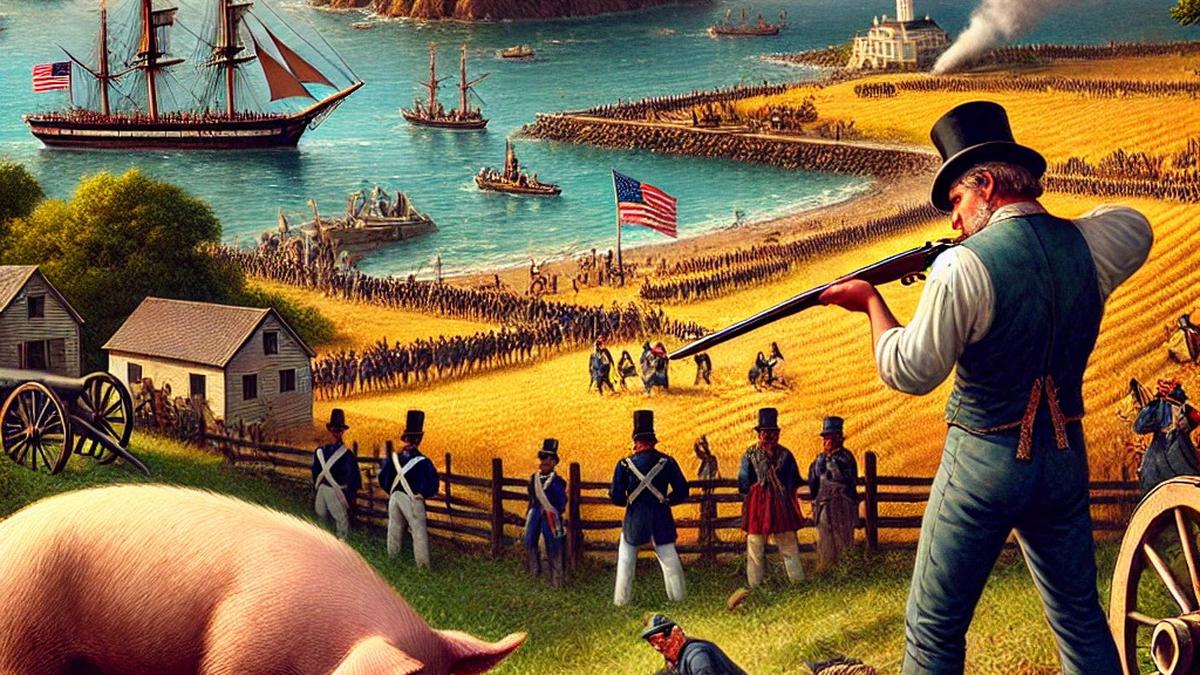
The flashpoint of the conflict came on June 15, 1859, when American farmer Lyman Cutlar shot a pig that had wandered onto his property and was eating his crops. The pig belonged to Charles Griffin, a British subject managing the Hudson’s Bay Company’s Belle Vue Sheep Farm. While anecdotal accounts suggest a humorous exchange between the two, the deeper issue lay in 19th-century farm norms, which held Cutlar responsible for keeping free-ranging livestock off his land. Seeking to make amends, Cutlar offered reparations, but Griffin demanded an exorbitant $100 for the pig, intensifying the dispute.
Beyond this incident, tensions between American settlers and the Hudson’s Bay Company, which represented British interests, were already high. Disputes over land use and governance had created a simmering conflict that the pig’s death brought to a boil, turning a local disagreement into an international standoff.
British authorities on Vancouver Island backed Griffin, seeing this as an opportunity to assert their claim to the San Juan Islands. American settlers supported Cutlar, viewing the incident as symbolic of their rights to the land. Calls for justice and sovereignty over the islands transformed a minor agricultural dispute into a brewing international crisis.
This seemingly trivial incident exposed the underlying tensions between the two nations, bringing the boundary dispute to the forefront and setting the stage for military involvement.


Telangana MP urges Centre to expedite ₹1,270 crore dues transfer from Andhra Pradesh for financial fairness and development.

A Karnataka man was detained with ₹62.5 lakh in cash during election checks on NH 544, claiming it was from a property sale.

Telangana Government issued 16 notifications to fill 31,798 vacancies, with 67,763 total recruitments since Congress took power.

Supreme Court directs Tarun Butolia's family to seek safety assessment from Delhi Police after fatal Uttam Nagar clash.

CM Stalin asserts unity in the DMK-led alliance, dismissing division attempts and emphasizing collaborative efforts for the upcoming elections.

Rahul Gandhi to skip Kerala rally due to Sonia Gandhi’s ill health; Kharge to attend Kozhikode event
Rahul Gandhi will miss the Kerala rally due to Sonia Gandhi's health; Congress president Kharge to attend instead.

Thunderstorms with lightning and gusty winds forecasted for 20 Telangana districts on March 26

TGSRTC reduces Metro AC and Deluxe bus fares by 30% in Hyderabad to encourage public transport amid the fuel crisis.

Supreme Court criticises Haryana Police for mishandling a four-year-old rape case, mandates swift action and oversight with a Special Investigation Team.

On World Theatre Day 2026, artists in Hyderabad call for affordable venues as rising costs and infrastructure gaps challenge the city’s theatre ecosystem.

Madhapur police seize 31 illegally transported commercial gas cylinders, ensuring public safety and compliance with regulatory norms.

Punjab AAP MLA Harmeet Singh Pathanmajra arrested in Gwalior after evading police in a rape case for over six months.

Bose Krishnamachari resigned from the Kochi Biennale Foundation amid sexual harassment allegations, confirmed by the foundation's chairperson.