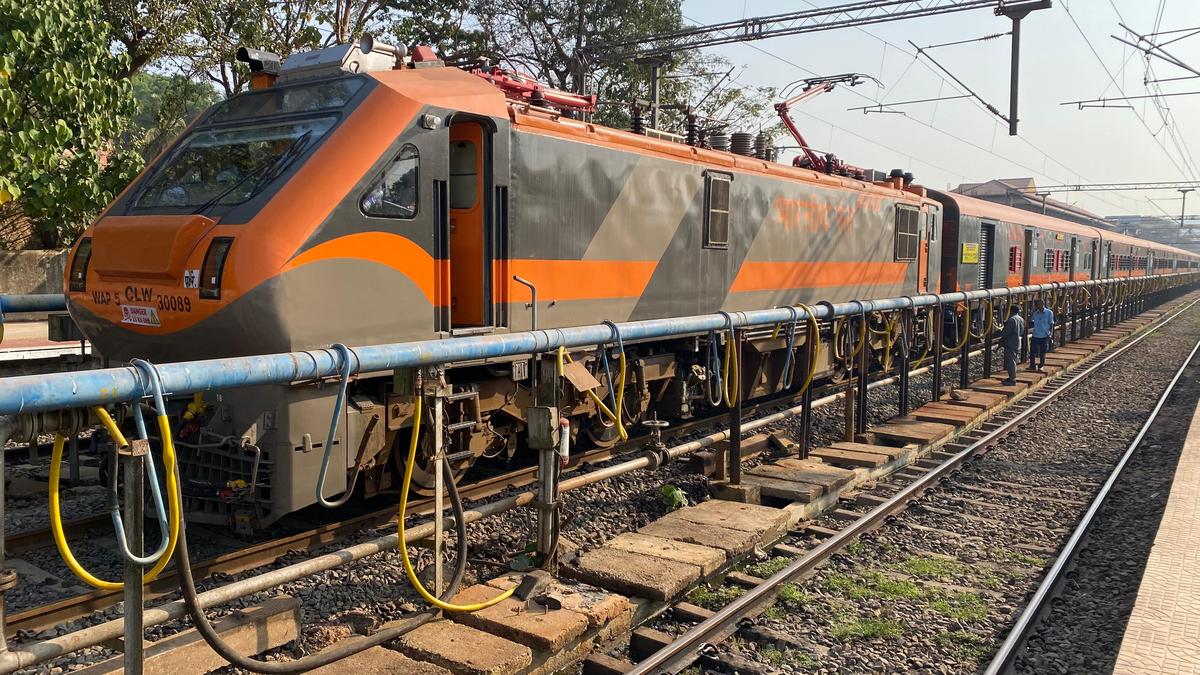
Patrons question longer travel time on Nagercoil-Mangaluru Amrit Bharat Express, demand extension to Goa
The Hindu
Rail patrons demand faster travel times and route extensions for the Nagercoil-Mangaluru Amrit Bharat Express to better serve passengers.
Rail patrons welcomed the introduction of a new Amrit Bharat Express between Nagercoil and Mangaluru Junction, but complained that the train takes 17.2 hours to traverse a distance of about 700 km, which translates to an average speed of around 40 km per hour.
Besides demanding speeding up of the service, they urged the Railway Ministry to extend the train to Kanniyakumari at the southern end, and to Subrahmanya Road/Vasco-da-Gama on the northern end to maximise the benefits of this common man’s premium service to a larger section of patrons.
Kanniyakumari District Railway Users’ Association Secretary P. Edward Jeni said the timetable of Train No. 16329/330 Nagercoil Junction-Mangaluru Junction Amrit Bharat Weekly express is not convenient for overnight travel needs, as it primarily operates during the day.
Departing from Nagerocil at 11.40 a.m. on Tuesdays, Train 16329 reaches Mangaluru Junction at 5 a.m. on Wednesdays, with a huge slack between Kasargod and Mangaluru Junction. It leaves Kasargod at 1.57 a.m. on Wednesdays to reach Mangaluru Junction at 5 a.m., which is roughly 3 hours as against the normal 35-40 minutes by any express train.
The service has 21 stops but is slower than the Nagercoil-Mangaluru Central Parasuram Express that has 54 stops, Mr. Jeni pointed out.
Stating that Indian Railways appears to have a clear disconnect between passenger needs and planning, Mr. Jeni sought extension of the train to Kanniyakumari (on Nagercoil side) and to Vasco-da-Gama/Madgaon (on Mangaluru side).


The Clamorous reed warbler is as loud as they come, but in the urban environment, it is outshouted. Weed clearing in urban habitats brings down its home, the bulrushes. Bulrushes in wetlands are not encroachments, but ‘legal homes’ to birds in the crake and rail family and warblers, so government line agencies ought to tread on them thoughtfully

Uttar Pradesh ATS arrests a dental student for alleged connections to an ISIS online module, probing extremist recruitment activities.

Rajinikanth refutes TVK leader's claims about DMK threats preventing his political entry, expressing gratitude to supportive political figures.

Tamil Nadu CM Stalin celebrates the Union government's approval for archaeological excavations, crediting DMK's persistent advocacy for the win.

Dilip Ghosh will contest Kharagpur Sadar in the 2026 West Bengal polls, aiming for increased BJP votes.

A hotel fire in Pahalgam leads to one death from a reversing fire tender; multiple LPG blasts hinder firefighting efforts.

The Clamorous reed warbler is as loud as they come, but in the urban environment, it is outshouted. Weed clearing in urban habitats brings down its home, the bulrushes. Bulrushes in wetlands are not encroachments, but ‘legal homes’ to birds in the crake and rail family and warblers, so government line agencies ought to tread on them thoughtfully

The people of at least one State will heave a sigh of relief now that the schedule for five Assembly elections — all in April — has been announced.

Four charred bodies discovered in a car near Tirunelveli; police investigate potential murder or suicide.

Five insurgents linked to PREPAK and KYKL arrested near India-Myanmar border; explosives and arms recovered in separate operation.

A.P. DGP pays tribute to Potti Sriramulu on his 125th birth anniversary, honouring his sacrifice for a separate Andhra Pradesh.

Discover the cultural and health significance of neem and jaggery during Ugadi, explained by author Ratna Rajaiah.

A minor fire at Thiruvananthapuram government hospital led to patient evacuations; no casualties reported, situation now under control.