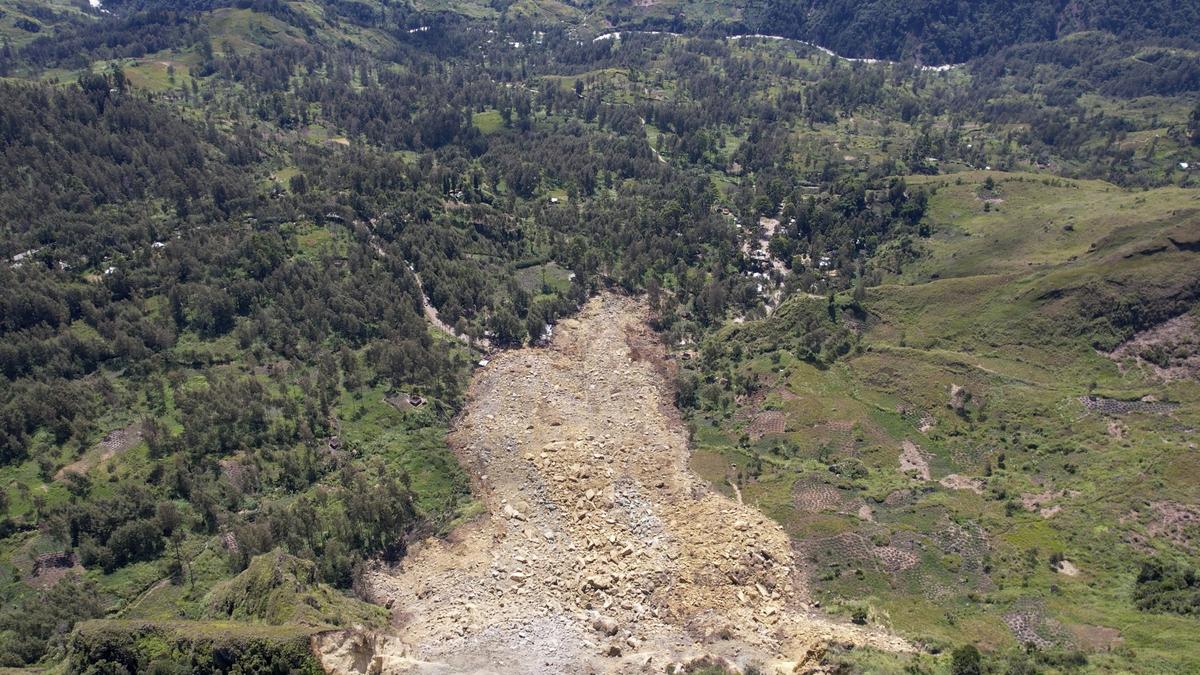
Papua New Guinea's prime minister visits the site of a landslide estimated to have killed hundreds
The Hindu
The United Nations estimates that 670 villagers died in the disaster, which immediately displaced 1,650 survivors. Papua New Guinea’s government has told the United Nations it thinks more than 2,000 people were buried.
Papua New Guinea's prime minister on May 31 visited the site of a major landslide, which is estimated to have buried hundreds of villagers in the South Pacific island nation's mountainous interior a week ago and left the ground too unstable for heavy earthmoving machines to help clear up the mess.
James Marape told hundreds who had gathered near the devastated Yambali village that the list of governments and world leaders who had sent their condolences included the United States, China, India, France, Malaysia and the Czech Republic. First on the list was U.K. King Charles III, Papua New Guinea's constitutional head of state.
“My people are simple people. I want to say thank you for them to the global friends of PNG,” Mr. Marape said.
The first mechanized excavator arrived at the scene on Sunday, but it hasn't been permitted to start removing the boulders, rocks and splintered trees that have buried a 150-to-200-meter (500-to-650-foot) stretch of the Enga province's main highway.
The nation's military had expected up to 10 excavators and bulldozers to be on the scene this week to help villagers who have used spades and farming tools to painstakingly retrieve bodies from the rubble, but have so far only found seven.
The United Nations estimates that 670 villagers died in the disaster, which immediately displaced 1,650 survivors. Papua New Guinea's government has told the United Nations it thinks more than 2,000 people were buried.
Mr. Marape said that geotechnical reports in recent days found the area remains unstable.


Alandur faces unresolved civic infrastructure issues, including lack of water and drainage, despite recent development efforts ahead of TN Election 2026.

Delhi's fiscal deficit surged by 62% in 2025-26, reflecting revenue declines and raising concerns about the city's economic health.

Kerala Assembly Elections 2026: Anvar and Firos face multiple namesake rivals in their constituencies amid a crowded candidate field.

Kamal Haasan announces support for DMK in 2026 elections, emphasizing the need for 'Dravidian Model 2.0' for Tamil Nadu's welfare.

DMK finalises seat-sharing for the 2026 Tamil Nadu Assembly elections, contesting 175 seats with allies DMDK and VCK.

Parliament may adjourn early for Assembly elections, allowing MPs to campaign in key election-bound states.

Indian vessels can freely sail through the Strait of Hormuz without needing permission, confirms a senior government official.

The Hindu Morning Digest gives a select list of stories to start the day. Read the top news today on March 25, 2026

An IndiGo flight at Vijayawada airport was grounded due to a tyre burst, but all 79 occupants are safe.

Tamil Nadu Assembly election 2026: TMC(M) gets five seats in NDA, to contest on BJP's 'Lotus' symbol
TMC(M) secures five NDA seats, to contest Assembly elections using BJP's 'Lotus' symbol in Tamil Nadu.

The Karnataka government will discuss with officials the possibility of creating a portal for unemployed youth to share their details and access job opportunities in micro, small and medium enterprises (MSMEs), Minister for Small Industries and Public Enterprises Sharanabasappa Darshanapur said in the Legislative Council on Tuesday.

AIADMK's 2026 manifesto promises free rations, women's benefits, education reforms, and economic growth initiatives for Tamil Nadu.

U.S.-Israel war on Iran LIVE: Follow The Hindu for updates on the West Asia conflict on March 24, 2026