Over 2,000 rescued from bonded labour since 2016, struggle without a rehabilitation package
The Hindu
Those who were freed from bonded labour in the State from 2016, 2,252 of them, have alleged they are yet to get rehabilitation packages from the State government owing to new norms introduced in 2017, and are planning to hold a massive protest in the city on February 7.
Those who were freed from bonded labour in the State from 2016, 2,252 of them, have alleged they are yet to get rehabilitation packages from the State government owing to new norms introduced in 2017, and are planning to hold a massive protest in the city on February 7.
Those rescued from bonded labour will get compensation in the range of ₹1 lakh to ₹3 lakh under a Central scheme. However, if an FIR is registered in the case, those freed from bonded labour will get an immediate ex-gratia of ₹30,000 and the remaining amount only after the case is settled in the court.
Norms of the Union government allows for a ‘summary trial’ by the district magistrate within 24 hours from the date of identification or rescue of the bonded labourers even if no FIR has been lodged. Only in case of other offences being made out against the employer is filing of FIRs required, explained Kiran Kamal Prasad, founder of Jeevika, an organisation fighting against bonded labour. As per these rules, 61,610 individuals rescued from bonded labour have got their rehabilitation package since 2001 to 2016.
However, as per the new Standard Operating Procedures (SOPs) issued by the State government in 2017, officials have to file FIRs against employers when an individual is rescued from bonded labour in every case. This has essentially delayed rehabilitation package for those rescued from bonded labour till the trial in the case is concluded in a court. “This disregards the main objective of the Bonded Labour System (Abolition) Act, 1976,” said Mr. Prasad.
In many cases, as those freed from bonded labour wait for their rehabilitation, employers who held them earlier are pressurising them, threatening them to withdraw cases. Such cases have been reported from many districts, including Chickballapur, Mandya, Mysuru, and Belagavi, those rescued from bonded labour say.
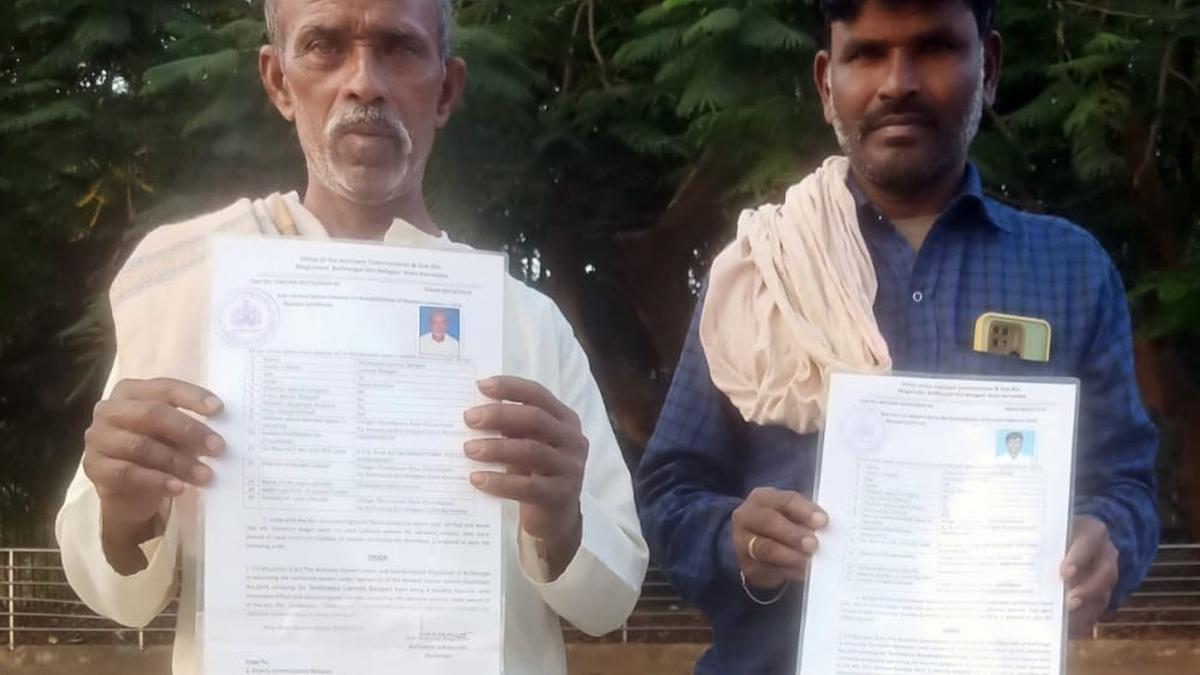
Thimmanna Hanumanta Bisiholgi, a freed bonded labourer from Chunchanur village, Ramadurga taluk, Belagavi district, said that he, his father, and his grandfather were bonded labourers. “In 2016, the government freed me and gave me a release certificate. Also, a case has been registered against the employer. As the case is still in court, I have not received any rehabilitation package from the government. Even as no one else is giving me work in the village, the previous employer threatened me and got my signature on an affidavit stating that I was not working in his house and submitted it to the court,” he said.
Siddappa Laxman Bangari, another person freed from bonded labour in the same village, said that despite meeting officials at the DC’s office requesting them for a rehabilitation package, it had not yielded any results. “They say that since the case is pending in the court, rehabilitation is not possible until the final verdict. It is difficult to live like this,” he said.


Perundurai's industrial growth faces challenges of pollution, water scarcity, and healthcare, impacting residents ahead of the 2026 elections.

The Travancore Devaswom Board asserts that courts should respect community beliefs in its Supreme Court submission on Sabarimala's entry issue.

Karnataka cancels Deendayal Upadhyay event at KSOU due to protocol violations, citing inconsistency with university objectives.

Illegal pickle unit busted in Hyderabad, one arrested; unhygienic stock worth ₹3 lakh seized

Karnataka has entered a state of demographic transition where a large working-age population will no longer be enough to drive economic growth, and future gains will depend on how productively people are employed, the ‘State of Working India 2026’ report said.

Key demands in Sulur Assembly constituency include reviving the powerloom sector, addressing farmers' needs, and protecting River Noyyal.

Kodihalli urges Karnataka CM to allocate ₹10,000 crore revolving fund for seamless procurement of farm products under MSP scheme.

Kerala's political parties continue to marginalize women candidates, highlighting a troubling disconnect between gender demographics and representation.

The High Court of Karnataka on Tuesday ordered the issue of a notice to the State government on a PIL petition, which had complained about disturbances caused to people residing in the localities around the National Public School situated in Rajajinagar 5th block due to use of loudspeakers with high volume in the school and parking of school buses in residential areas.

China is extensively mapping ocean floors to enhance submarine warfare capabilities against the U.S. and allies across key oceans.

AIADMK's 2026 manifesto promises free rations, women's benefits, education reforms, and economic growth initiatives for Tamil Nadu.

The vehicle towing drive will soon resume in the city to ease traffic congestion. The Bengaluru Traffic Police (BTP), in coordination with the Greater Bengaluru Authority (GBA), is set to relaunch the vehicle towing drive across the city shortly to tackle traffic congestion and illegal parking.

Panic buying, not shortage, is leading to long queues at Hyderabad petrol pumps.