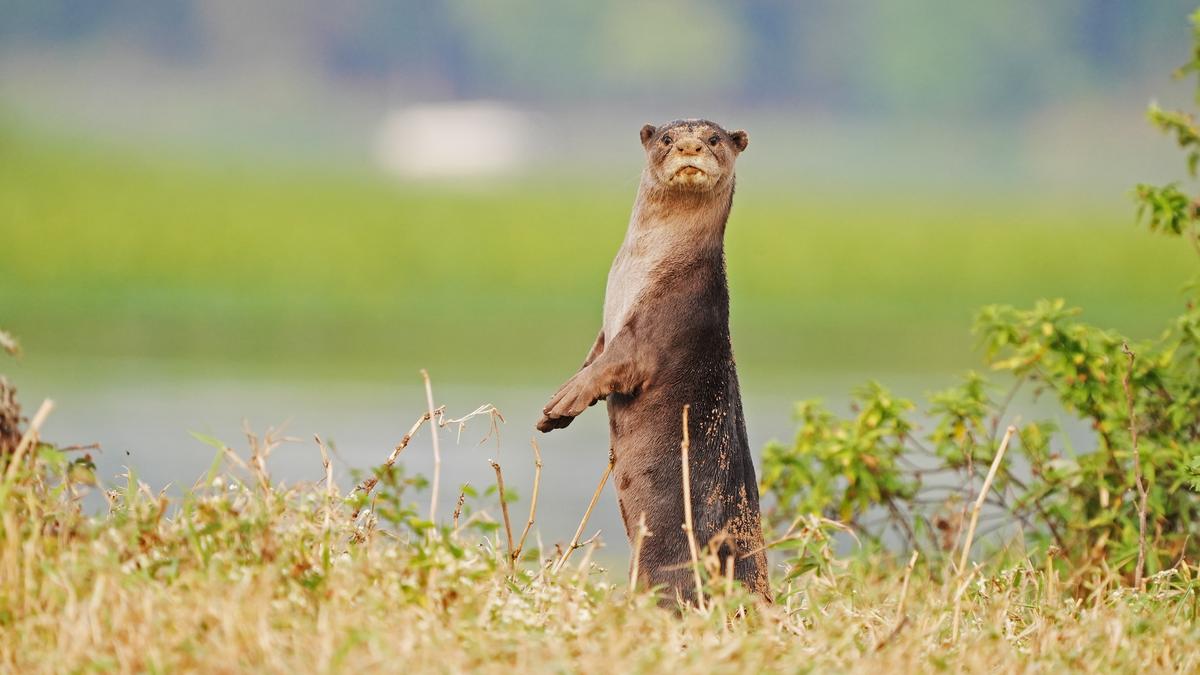
‘Otters and fishermen have been living together ever since man took to fishing’
The Hindu
Meet Maya and her family, the four-footed stars of My Otter Diary, a new documentary on smooth-coated otters along the Cauvery
Sugandhi Gadadhar still remembers her first encounter with a smooth-coated otter while on a family vacation alongside the Cauvery many years ago. As a child, the Bengaluru-based National Geographic explorer, photographer, and wildlife filmmaker often went to play on its banks. “It was one of those occasions when this thing (the otter) suddenly popped up from the water,” she says. “The memory of that stuck in my mind for years.”
Later, when filming other wildlife, she returned to that memory, “this mirage-like thing” she found herself unable to shake off. “I wanted to learn more about otters,” says Sugandhi, who has just released a documentary, My Otter Diary, co-created with her partner, wildlife filmmaker Raghunath “Rana” Belur. “That is when we started looking for otters to study in the wild.”
The fact that otters are not so easily spotted “because they are so shy and sensitive” lent to the challenge, she says; especially since “there were not too many documentaries focusing only on otters in India,” chimes in Rana. He adds that most of the studies around these carnivorous, semi-aquatic mammals were set in the region around the Chambal in central and northern India and in Goa. “There were surveys done along the Cauvery, but not too many had studied the behaviour, in terms of one family,” he says.
My Otter Diary does precisely that, offering insights into otter behaviour, the threats and challenges they face and the complex relationship they share with the humans who inhabit the same patches of the river they do by following a female otter, Maya, and her family. “That is what interested us: just spending time with them to understand what they do, how they behave, what their relations are and how they are feeling,” explains Rana. “Rather than going around the river or going to multiple places and looking at them, we just thought of looking at one family’s point of view.”
Rana and Sugandhi, the co-founders of Aranya Parva Creations, a production company specialising in natural history documentaries, began thinking about otters back in 2018. They had been making a short film on bears for the Karnataka Forest Department, shooting along the Tungabhadra river, close to Hampi and the Daroji Sloth Bear Sanctuary, recalls Rana. Since the Tungabhadra Otter Conservation Reserve, India’s first otter conservation reserve, was created in this area, they started exploring for otters here, but they soon had to give up on this idea due to “different logistical reasons,” says Rana. “So, we started looking at different places, one of which was along the Cauvery.”
It also helped that they already knew people who had studied or worked along this stretch, one of whom was the wildlife biologist Nisarg Prakash, who has conducted surveys and written about the otters along the Cauvery. Through Nisarg, they met Shivanna “Shivu”, a fisherman who lives and works along the river Cauvery, who, with Sugandhi herself and the many otters, is a crucial character in the documentary. “We also needed to navigate the river and were looking for someone who could take us boating,” he says. Once they started boating with Shivu, they began enjoying his company and his wry sense of humour, so they asked him to work with them, explains Rana. “He would wait for us in the mornings and take us out daily. ”
In 2020, after spending nearly two years traversing the Cauvery, looking for signs of otters, they found Maya and her family. “It was around the time of the pandemic, so we actually took a house in a local village there and stayed in that village for the next five years, instead of travelling up and down,” says Rana.


Carlos Alcaraz aims to end his Australian Open title drought and achieve a career Grand Slam, starting his campaign against Adam Walton.

Maharashtra civic poll results LIVE: Follow the Hindu's updates as vote counting begins for corporators across 29 Maharashtra civic bodies including Mumbai's BMC.

Karnataka secures ₹4.71 lakh crore investments in 11 months, showcasing industrial growth and commitment ahead of Davos Forum.

UN Secretary-General António Guterres condemns nations violating international law, highlighting the dangers of concentrated power and wealth.

Gopalkrishna Gandhi pays tribute to the timeless Geeta Doctor, a cherished figure in Chennai's cultural landscape, who recently passed away.

Drones spotted along the India-Pakistan border in J&K's Poonch and Samba, prompting heightened security measures.

Explore Ravi Shankar Etteth's The Little Book of Goodbyes, a poignant reflection on love, loss, and cultural heritage.

Violence erupts in West Bengal as locals vandalize BDO offices during SIR hearings, prompting police intervention and arrests.

Lakshya Sen stands as India's sole contender in the India Open 2026 after top players face unexpected defeats.

Bird poop disrupts India Open match, raising concerns about venue readiness for upcoming World Championships amid ongoing criticisms.

Young Mumbai voters face confusion over alliances in civic polls, prioritizing an educated mayor amid shifting political dynamics.

Shorts News:Watch: U.S. seizes another Venezuela-linked oil tanker

Punjab CM Bhagwant Mann visits Akal Takht to clarify remarks on Sikh traditions, submitting documents and seeking investigation into complaints.