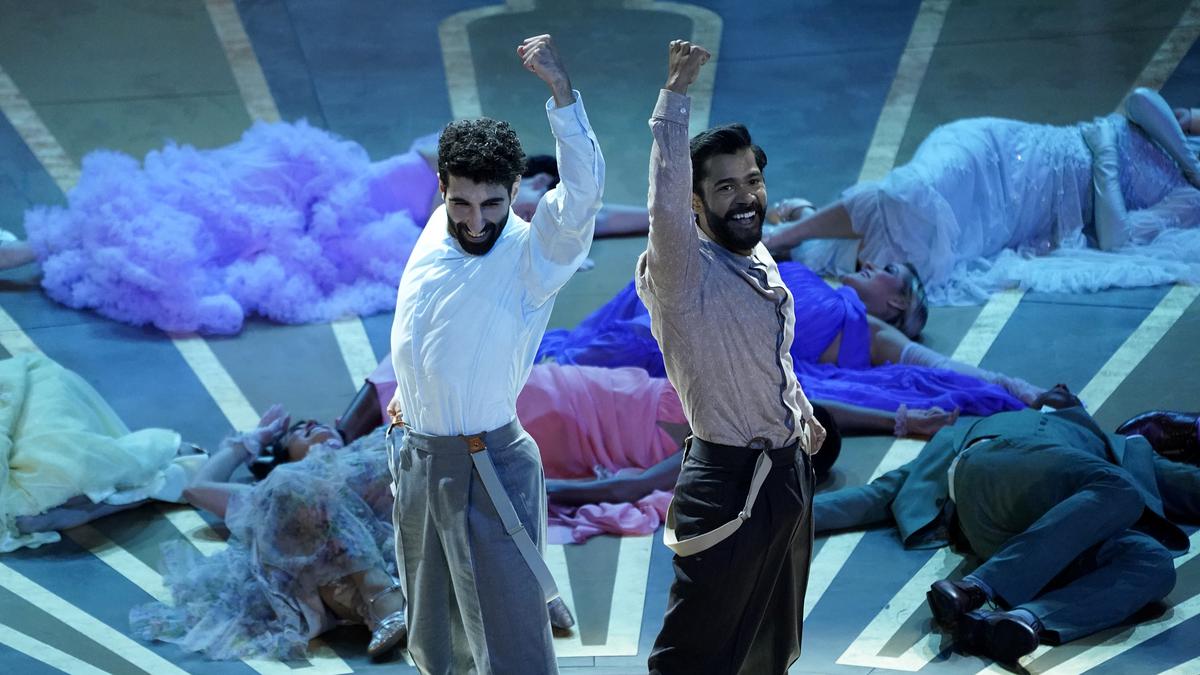
Oscars face flak for excluding South Asians in ‘Naatu Naatu’ performance, show producer responds
The Hindu
Artists and commentators have pointed up the exclusion of Indian and South Asian dancers in the live rendition of ‘Naatu Naatu’ at the 95th Oscars ceremony
‘Naatu Naatu’s historic reception at the 95th Academy Awards has now been marked by a controversy.
The anthemic song from SS Rajamouli’s global blockbuster RRR is the first from an Indian production to win Best Original Song at the Oscars.
However, before and after the Oscars telecast on March 12, many raised objections to the exclusion of South Asian origin dancers and choreographers in the live rendition of ‘Naatu Naatu’ at the Oscars ceremony.
Composed by MM Keeravani and penned by Chandrabose, ‘Naatu Naatu’ is a thumping dance number performed by Ram Charan and Jr. NTR in RRR.
The Telugu-language song has been noted for its energetic beats and strong anti-colonialist lyrics.
‘Naatu Naatu’, which also won the Golden Globe for best original song earlier this year, was conducted live at the 95th Academy Awards ceremony by Keeravani and sung by its original singers Rahul Sipligunj and Kaala Bhairava. The track was presented onstage by Indian star Deepika Padukone, who called it a ‘total banger’. However, the dance performance that accompanied the piece was choreographed by US-based duo Tabitha and Napoleon D’umo, together known as Nappytabs.
Also Read |M.M. Keeravani on ‘Naatu Naatu’ Oscars win: It’s just the beginning of everything


An independent video, ‘Feel the Spark’ by Raleigh Rajan with vocals by Ciera Dumas that celebrates Tamil literary giants, garnered 1.4 million views in less than 36 hours.

In ‘Jack Ryan: Ghost War’, John Krasinski is back as the savvy CIA analyst, diving headfirst into a high-stakes mission that unravels a deadly conspiracy and pits him against a rogue black-ops unit

Shriram Bharatiya Kala Kendra’s Shankarlal festival showcased rare ragas, radiant artistry, and inclusive performances, from Pt Madhup Mudgal’s serene morning ragas to Ramana Balachandran’s Saraswati veena.

Explore "Threads that Bind: The Kantha Project," an exhibition in Delhi reimagining kantha as a medium of repair and renewal.

Sean Penn skips the Oscars to meet Ukraine's Zelenskyy, who praises him as a "true friend" amid the war.

The teaser of Tamil star Suriya’s much-awaited film with director Venky Atluri, titled Vishwanath and Sons, was unveiled by the makers on Monday

A 'Golden' moment for a K-pop track at the Oscars.

Parvathi Nayar’s new exhibition, The Primordial, in Mumbai, traces oceans, pepper and climate change
Opened on March 12, the exhibition marks the artist’s first solo show in Mumbai in nearly two decades. Known for her intricate graphite drawings and multidisciplinary practice spanning installation, photography, video, and climate change, her artistic journey has long engaged with the themes of ecology, climate change and the natural world. In this ongoing exhibition, these strands converge through a series of works centred on water, salt, and pepper — materials that carry natural and historic weight across centuries.

Explore the highlights and key winners of the 98th Academy Awards, featuring memorable moments and historic achievements from Oscars 2026.

Spring season celebrated at Ramakrishna Mission Institute, Kolkata, with ‘Evening of Basant’

The Spirit of the Land, a solo show by artist Shivakumar Sunagar, is a vista of Nature-inspired emotions

Tal Fry is all set for an exciting new performance season

Netflix is making a bold move by snagging InterPositive, the AI filmmaking company founded by Ben Affleck, in a deal that could hit $600 million