One year in, California’s fast food wage hike brings higher pay, debatable job numbers
CNN
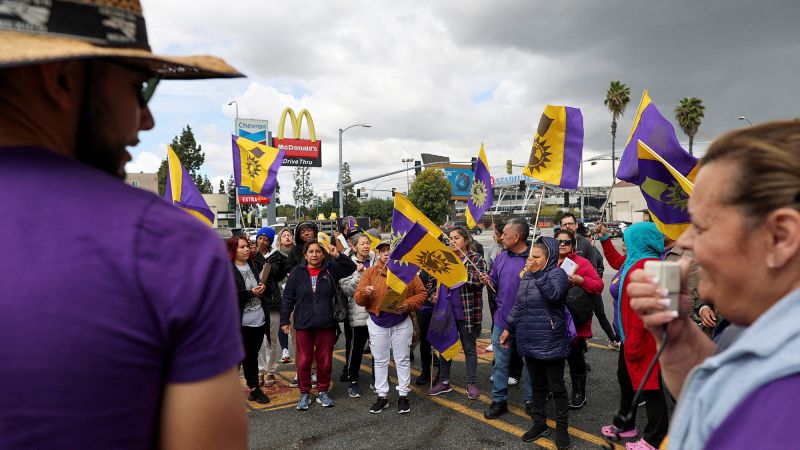
The results have been mixed after California raised the minimum wage for fast food workers to $20 per hour in 2024. Economists are divided over the effect on employment, while workers earn more but many complain about reduced hours.
Edgar Recinos no longer has to choose between paying rent and buying groceries. As a cook at a Wingstop restaurant in Los Angeles, Recinos got a significant wage bump last year — one of half a million fast food workers taking part in a great labor experiment. California passed the Fast Food Accountability and Standards Recovery (FAST) Act in April of 2024 amid vocal support and fierce opposition. The first-of-its-kind policy increased the starting wage for California fast food workers to $20 per hour, which is higher than the overall state minimum wage. It also established a statewide council that sets wage and safety standards at fast food restaurants with more than 60 locations nationwide, like McDonald’s, Jack in the Box, Burger King and Subway. But one year later, the initial impact is a mixed bag. Economists are divided over the effect on employment. Workers do earn more, but many complain their hours have been cut. Fast food restaurant owners tell CNN they have been trimming employee hours and instituting hiring freezes to offset the cost of higher wages. Recinos, like many, says his regular hours have been cut. When he doesn’t get to fill in to make up the time, he finds himself “in the same situation before the (wage) increase.” As of March, employment at California’s limited-service restaurants fell 3.1% from the year before, according to the St. Louis Federal Reserve using seasonally adjusted data from the Bureau of Labor Statistics. That’s more than 22,600 jobs lost at fast food restaurants that both did and did not fall under the policy.


“Today is a difficult day,” CBS executives wrote to staff, explaining the cuts as a tough but necessary reallocation of newsroom resources.

President Donald Trump has repeatedly promised that Americans will get larger tax refunds this year thanks to his “big, beautiful bill.”

President Donald Trump has repeatedly promised that Americans will get larger tax refunds this year thanks to his “big, beautiful bill.”

Oil prices edged lower on Friday after a tumultuous day that saw the international benchmark surge above $119 a barrel as the Middle East conflict deepened energy supply fears.

The war in Iran has delivered what economists call a “black swan” event — an unforeseen shock so destructive, no one is immune to it.

The war in Iran is driving up the cost of buying a home in America.

Eight state attorneys general have filed an antitrust lawsuit to block Nexstar’s pending acquisition of Tegna, which would strengthen the right-leaning Nexstar and shrink the number of station owners in the US.

The Iran war has driven oil prices to their highest levels in years. Now, a wave of attacks in the past 24 hours on energy production sites across the Middle East have turned the spotlight on another crucial fossil fuel: liquefied natural gas, or LNG.

Oil and natural gas prices spiked Thursday, as Iran ramped up strikes on energy infrastructure across the Middle East and attacked one of the world’s most important liquefied natural gas (LNG) facilities in Qatar.

In normal times, the Federal Reserve would more or less ignore an oil price shock like the one we’re in now.

Property brokerage Compass on Wednesday dropped its lawsuit against Zillow, ending a legal clash over how home listings can be marketed online.

Fed officials didn’t make any rate moves at their March meeting and released an updated forecast for the path of the American economy as the war in Iran stretches on.

Fed officials are set to announce their latest rate decision Wednesday afternoon, along with a new forecast for the path of the American economy as the war in Iran stretches on.