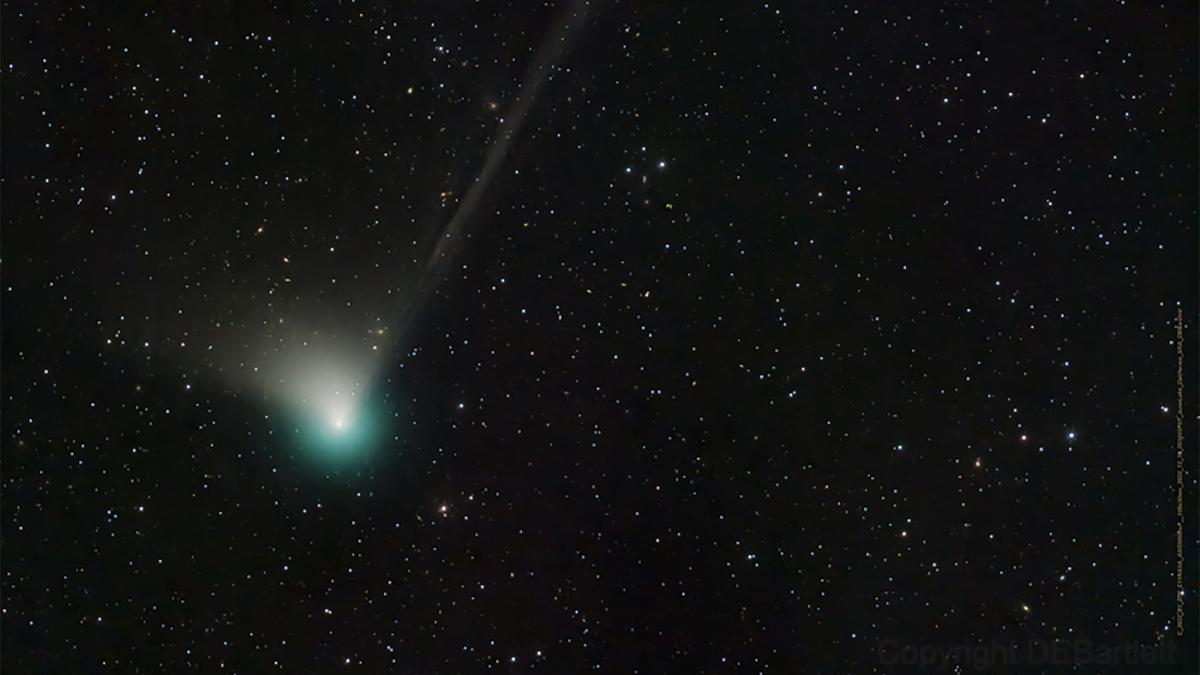
Once in 50,000-year comet may be visible to the naked eye
The Hindu
After travelling from the icy reaches of our Solar System it will come closest to the Sun on January 12 and pass nearest to Earth on February 1.
A newly discovered comet could be visible to the naked eye as it shoots past Earth and the Sun in the coming weeks for the first time in 50,000 years, astronomers have said.
The comet is called C/2022 E3 (ZTF) after the Zwicky Transient Facility, which first spotted it passing Jupiter in March last year.
After travelling from the icy reaches of our Solar System it will come closest to the Sun on January 12 and pass nearest to Earth on February 1.
It will be easy to spot with a good pair of binoculars and likely even with the naked eye, provided the sky is not too illuminated by city lights or the Moon.
The comet "will be brightest when it is closest to the Earth", Thomas Prince, a physics professor at the California Institute of Technology who works at the Zwicky Transient Facility, told AFP.
Made of ice and dust and emitting a greenish aura, the comet is estimated to have a diameter of around a kilometre, said Nicolas Biver, an astrophysicist at the Paris Observatory.
That makes it significantly smaller than NEOWISE, the last comet visible with an unaided eye, which passed Earth in March 2020, and Hale-Bopp, which swept by in 1997 with a potentially life-ending diameter of around 60 kilometres.


Inside Copenhagen’s Alchemist: Chef Rasmus Munk on food, provocation and his India-inspired dishes

Explore the debate surrounding a potential dark matter discovery, highlighting skepticism and the need for rigorous validation in astronomy.

Discover how ice cores from the Pamir Mountains could unlock secrets to protect the world's glaciers from climate change.

Discover why spicy food causes a runny nose and how capsaicin triggers a protective response in our bodies.

In October this year, India announced its intention to build Maitri II, the country’s newest research station in Antarctica and India’s fourth, about 40 forty-odd years after the first permanent research station in Antarctica, Dakshin Gangotri, was established. The Hindu talks to Dr Harsh K Gupta, who led the team that established it

Study reveals rising artemisinin resistance in Africa, echoing Asia's past, urging urgent action to prevent widespread crisis.

Michelin launches The Grappe, a new wine distinction, recognizing excellence with one to three grapes, starting with the Burgundy and Bordeaux regions

A groundbreaking experiment transforms skin cells into egg-like cells, offering hope for infertility treatments amidst ethical considerations.

Discover Niraba, a collaboration merging Odisha's sabai grass weaving and dhokra craft into contemporary furniture and lighting design.

How do you create a Christmas tree with crochet? Take notes from crochet artist Sheena Pereira, who co-founded Goa-based Crochet Collective with crocheter Sharmila Majumdar in 2025. Their artwork takes centre stage at the Where We Gather exhibit, which is part of Festivals of Goa, an ongoing exhibition hosted by the Museum of Goa. The collective’s multi-hued, 18-foot crochet Christmas tree has been put together by 25 women from across the State. “I’ve always thought of doing an installation with crochet. So, we thought of doing something throughout the year that would culminate at the year end; something that would resonate with Christmas message — peace, hope, joy, love,” explains Sheena.

Max Born made many contributions to quantum theory. This said, he was awarded the Nobel Prize for physics in 1954 for establishing the statistical interpretation of the ____________. Fill in the blank with the name of an object central to quantum theory but whose exact nature is still not fully understood.

Join the Moms of Kochi for the Purple Carnival, a vibrant lifestyle exhibition featuring stalls, competitions, and entertainment on December 13-14.

Human-rating emerges as a crucial process ensuring that space systems like LVM-3 can safely carry humans by adding redundancy, robust abort capabilities, and rigorous testing