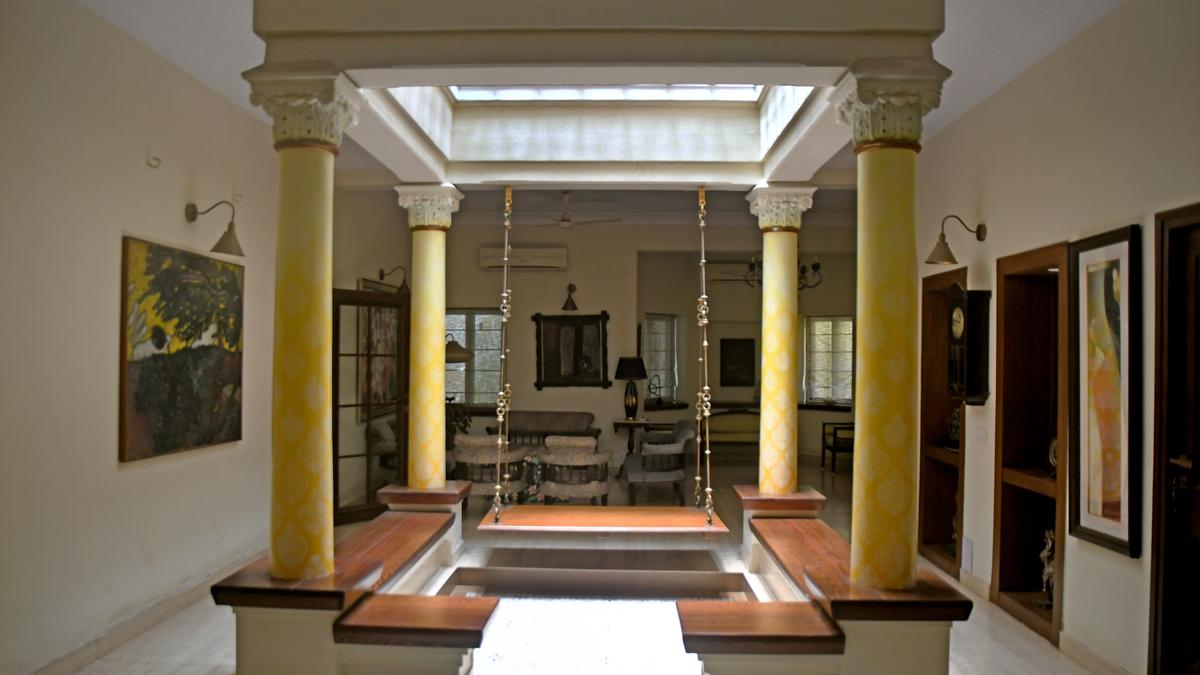
Once a beehive of political activity, Lloyd’s Corner is emblematic of old world charm
The Hindu
Lloyd’s Corner, which was once a beehive of political activity, is emblematic of old world charm. Its owner, A.V. Raman opened its doors to freedom fighters such as Rajendra Prasad, Vitthalbhai Patel, Seth Jamnalal Bajaj and Shankerlal Banker
On the morning of April 26, 1923, on what we would today consider a reasonably cool day (the maximum temperature was around 24 degrees Celsius), the property known as ‘Lloyd’s Corner’ came into existence. It was then about a little less than half an acre and was situated at the junction of Royapettah High Road and Lloyd’s Road in Chennai. The proud owner was A.V. Raman, son of a farmer from Thanjavur. He had recently returned from London after graduating in Health and Sanitary Engineering, a hitherto unheard-of science. Raman was a municipal engineer employed with the Madras Corporation, having been so appointed at the instance of his friend and colleague C. Rajagopalachari (Rajaji) with whom he had earlier served in Salem when the latter was the municipal chairman.
The main Madras Tramway ran along Royapettah High Road and on a diagonal, Balaji Nagar (now Masilamani Road) was also a developing residential area with some lawyers of eminence, apart from Telugu leader Puram Prakasa Rao, living there. Sundaram, wife of A.V. Raman, has mentioned to me that from the left of Lloyd’s Road running up to the beach were rice fields, interspersed with coconut and banana plantations, and that on a clear day you could see the Bay of Bengal (about less than a kilometre as the crow flies).
The four minarets and turrets atop Lloyd’s Corner (LC) are unusual and striking in architecture. The atrium (the traditional mittham) as well as the huge Nagalingam tree at the entrance gave it a charm. The seedling for this tree was planted by A.V. Raman sometime in the early 1930s, a gift from his friend G.A. Natesan, a prominent printer and Congressman. Natesan himself received two seedlings as a personal gift from Motilal Nehru from his ancestral home, Anand Bhavan, in Allahabad. He planted one of them in his house, ‘Mangala Vilas’, in what is now Nageswara Rao Park. The other still adorns LC.
The extent of LC got truncated with the periodic sale of land parcels by A.V. Raman, who needed the funds to keep his pet project going — an English magazine called People’s Health, which addressed the issues of sanitation and health for Madras city. He also needed the money for sustaining himself (he was placed under suspension for helping Rajaji and other freedom fighters from the Congress) and to pay back the mortgage on the property. LC finally became a shade short of four grounds (as it remains today) after A.V. Raman gave up 1.5 grounds to his neighbour and tenant. He also sold another 1.5 grounds, without taking the full price, to his son V.P. Raman’s DMK friend, a struggling Tamil film actor called Marathur Gopala Menon Ramachandran, whom he took a liking to, and felt that he would pay back when he made it big. The eternally grateful actor did so within a few years and his success is best remembered by his acronym MGR, a man who went on to capture the heart of Tamil Nadu and beyond.
The history of LC is replete with anecdotes of interesting events prior to and after Independence. One worthy of narration happened some years after Gandhiji announced the Non-cooperation movement. Several leaders of the freedom struggle had to go underground briefly as warrants for their arrest and deportation were being prepared. On Gandhiji’s advice, they were asked to travel to distant places, as much for protection as also for getting a feel of India. When requested by Rajaji, despite being a government servant, A.V. Raman had no hesitation in throwing open LC to give them accommodation. His wife Sundaram would recall Dr. Rajendra Prasad, Vitthalbhai Patel (the elder brother of Sardar Patel), Seth Jamnalal Bajaj (Gandhian and founder of the industrial house, Bajaj), Shankerlal Banker (one of Gandhiji’s earliest associates and his close confidant at Sabarmati) and several others staying at LC at the same time, for almost a month or so. They feasted on her simple rasam, sambar rice and filter coffee with relish.
LC was a beehive of activity even after A.V. Raman retired and was sick. The frequent visitors included Rajaji, Kamaraj, Ramnath Goenka, Chief Justice Rajamannar and Justice Anantharamakrishnan and the hall was abuzz with intellectual debates on matters of public importance.
A.V. Raman’s son V.P. Raman, later to become one of the most celebrated lawyers in the period from the 1960s to 1980s, gave LC a new twist — a Dravidian touch. He became a member of a fledgling political party started by an idealist from Kancheepuram called Annadurai. The Dravida Munnetra Kazhagam became his life blood. So LC became the meeting place for the party leaders (he had become a member of its executive committee) like Anna, Karunanidhi, E.V.K. Sampath, Chezhiyan, Mathiazhagan, Nedunchezhiyan, MGR and N.V. Natarajan. Adjourning for dinner after the meeting to Café Amin on Royapettah High Road was highly looked forward to. The famous meeting at LC of Rajaji and Annadurai and the consequent alliance between the DMK and the Swatantra Party, leading up to the DMK forming the government in 1967, is also a part of history.


Perundurai's industrial growth faces challenges of pollution, water scarcity, and healthcare, impacting residents ahead of the 2026 elections.

The Travancore Devaswom Board asserts that courts should respect community beliefs in its Supreme Court submission on Sabarimala's entry issue.

Karnataka cancels Deendayal Upadhyay event at KSOU due to protocol violations, citing inconsistency with university objectives.

Illegal pickle unit busted in Hyderabad, one arrested; unhygienic stock worth ₹3 lakh seized

Karnataka has entered a state of demographic transition where a large working-age population will no longer be enough to drive economic growth, and future gains will depend on how productively people are employed, the ‘State of Working India 2026’ report said.

Key demands in Sulur Assembly constituency include reviving the powerloom sector, addressing farmers' needs, and protecting River Noyyal.

Kodihalli urges Karnataka CM to allocate ₹10,000 crore revolving fund for seamless procurement of farm products under MSP scheme.

Kerala's political parties continue to marginalize women candidates, highlighting a troubling disconnect between gender demographics and representation.

The High Court of Karnataka on Tuesday ordered the issue of a notice to the State government on a PIL petition, which had complained about disturbances caused to people residing in the localities around the National Public School situated in Rajajinagar 5th block due to use of loudspeakers with high volume in the school and parking of school buses in residential areas.

China is extensively mapping ocean floors to enhance submarine warfare capabilities against the U.S. and allies across key oceans.

AIADMK's 2026 manifesto promises free rations, women's benefits, education reforms, and economic growth initiatives for Tamil Nadu.

The vehicle towing drive will soon resume in the city to ease traffic congestion. The Bengaluru Traffic Police (BTP), in coordination with the Greater Bengaluru Authority (GBA), is set to relaunch the vehicle towing drive across the city shortly to tackle traffic congestion and illegal parking.

Panic buying, not shortage, is leading to long queues at Hyderabad petrol pumps.