On Ukraine’s surprise incursion into Kursk
The Hindu
Ukraine launches surprise incursion into Russia's Kursk region, altering battle dynamics and creating leverage for future negotiations.
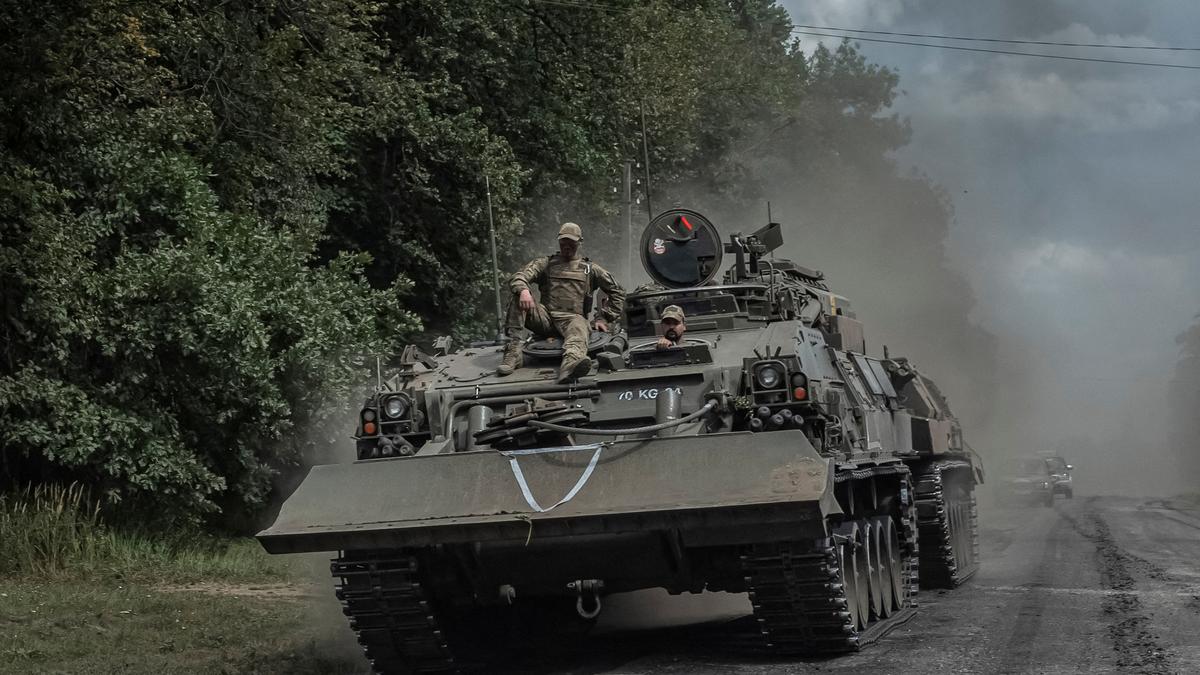
In the early hours of August 6, the regional government of Kursk, a federal subject of Russia that borders Ukraine to the west, sent an alarm on its Telegram channel asking residents to run for shelter from incoming missile attacks. Hours later, the channel posted images of dilapidated residential buildings, with a message from Alexey Smirnov, the Acting Governor of the region, “Tonight, the city of Sudzha was shelled from the Ukrainian side. Several residential buildings were severely damaged.” Ukraine had launched a surprise incursion into Russia’s southwestern province of Kursk, in the first ground invasion of the country or the erstwhile Soviet Union since World War II.
Though the Russian Ministry of Defence was quick to claim that it had repelled several raids by Ukrainian forces, equipped with almost a battalion’s worth of tanks and armoured vehicles, geolocated footage by the Washington DC-based Institute of Study of War (ISW) showed otherwise. In its August 7 update, the ISW said that the armoured vehicles had advanced to positions about 10 kilometres from the international border with Sumy of Ukraine. Russia’s line of fortification was clearly breached.
The attack, executed with great operational security, caught Moscow off-guard and raised questions of an intelligence failure. On August 7, Russian President Vladimir Putin accused Kyiv of a “large-scale provocation” even as the Chief of the General Staff Army General Valery Gerasimov tried to down play the situation by stating that it was “largely under control”.
The Ukrainian forces continued their rapid advancement into Kursk in the subsequent days, seizing villages and capturing conscripts as they pushed forward. On August 16, they destroyed two bridges across the Seim. Another was struck on August 19.
As of August 19, according to Ukraine President Volodymyr Zelenskyy, his forces were in control of 92 settlements in Kursk and 1,250 square kilometres of Russian territory. Mr. Smirnov, apprising Mr. Putin of the situation on August 22, said that 1,33,190 people have been evacuated from these territories.
For Ukraine, the prolonged war, which has now dragged on for two-and-a-half years, took a turn for the worse in May this year as Russian forces began an offensive in Kharkiv — its second-largest city. Already losing ground in the east, where Moscow has continued its aggression since the beginning of the war, Kyiv now saw the battle lines stretching and was clearly on the back foot. The August 6 offensive was, in a way, its last attempt to alter battle dynamics.
Strategically, the surprise incursion serves several purposes for Kyiv. It could be seen as a diversion tactic employed to force Russia to shift its forces from the ongoing offensive in the east or Kharkiv. The geographical significance of planning the attack on Kursk is also to be noted, as a ground invasion there would disrupt the movement of the Russian forces to Kharkiv, which is southeast of Sumy.


Saudi Arabia expels Iranian military staff amid escalating tensions and ongoing missile attacks during the U.S.-Israeli war on Iran.

Russia claims control of Potapivka village in Ukraine's Sumy region amid ongoing military efforts to establish a buffer zone.

Iranian missile strikes on Israeli towns cause widespread damage and injuries, marking a significant escalation in the ongoing conflict.

As Gor makes first trip as U.S. Special envoy to South Asia, Delhi watches strategic signals closely
Sergio Gor's inaugural trip as U.S. Special Envoy to South Asia signals strategic U.S. engagement amid regional tensions.

Slovenians vote in a tight election between liberal and populist candidates, impacting the country's future domestic and foreign policies.

Netanyahu asserts U.S.-Israel alliance fights Iranian threats, emphasizing global security after missile strikes on Israeli and European targets.

Israeli settlers attack Palestinian villages in the West Bank, causing injuries and destruction amid ongoing settlement expansion.

Britain asserts no evidence of Iran planning missile strikes on Europe, despite Israeli claims of missile capabilities.

UNESCO reports over half of countries have banned phones in schools due to concerns about attention, cyberbullying, and social media impact.

Analysis reveals a U.S.-operated Patriot missile likely caused a pre-dawn explosion in Bahrain, injuring numerous civilians.

Sri Lanka raises fuel prices by 25% amid ongoing West Asia conflict, impacting petrol and diesel costs significantly.

Iran strikes near Israeli nuclear research center as Trump threatens attacks on Iranian power plants
Iran's missile strikes near Israel's nuclear site escalate tensions as Trump threatens retaliation against Iranian power plants.

Saudi Arabia intercepts one of three ballistic missiles targeting Riyadh amid ongoing regional tensions and threats from Iran.