On the politics of faith: analysing the sensibilities behind the Kanwar Yatra Premium
The Hindu
Kanwar Yatra in Delhi marked by violence, survey reveals demographics, motivations, and expectations of devotees
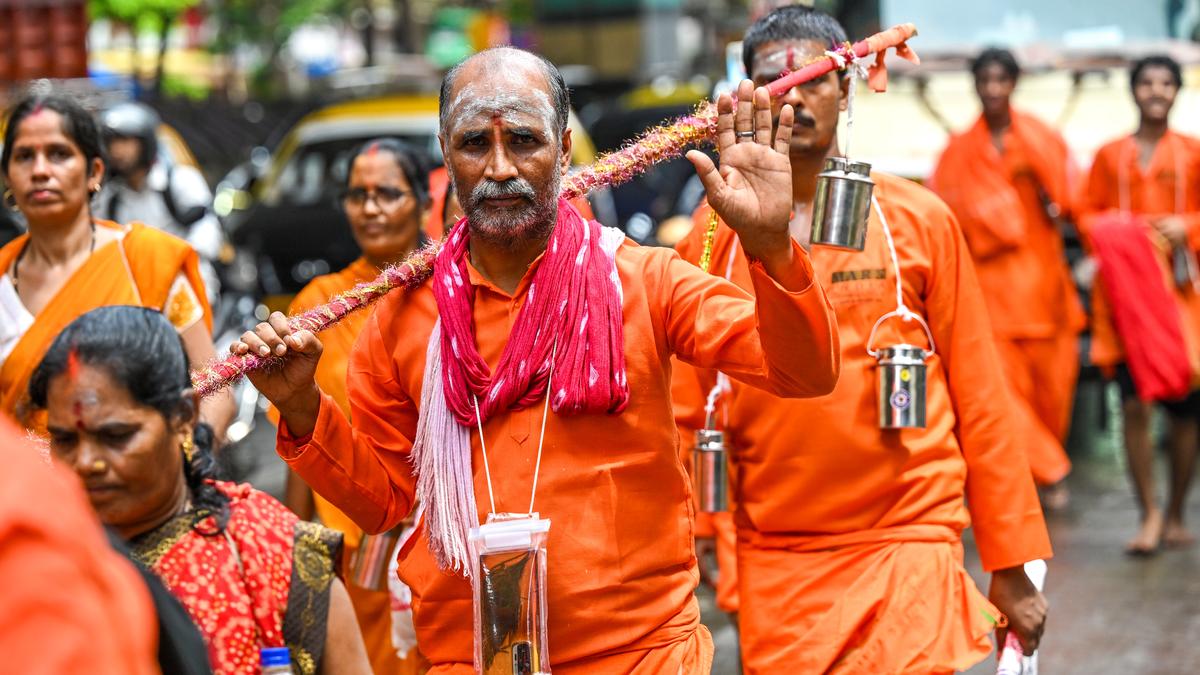
In the month of August, streets and highways across Delhi were filled with the vibrant saffron clad figures of Kanwariyas, carrying bamboo poles and pitchers filled with water from the sacred river of Ganga. The Kanwar Yatra, a pilgrimage undertaken annually by lakhs of Shiva devotees, has largely been a peaceful event. However, this year was marked by significant escalation in violence, vandalism and physical assault by Kanwariyas across various States, with at least 11 such reported incidents. These include the attack on a Sikh school bus in Haryana’s Fatehabad, the assault of a Muslim man in Uttar Pradesh’s Meerut and the forced entry into a female bathing area at a religious place in Rajasthan’s Jhunjhunu, amongst others.
The Lokniti-CSDS conducted a survey of 1,029 Kanwariyas to explore their backgrounds, and experiences during their religious pilgrimage.
While the pilgrimage is open to all, men make up the majority of the Kanwariyas. 95% of the surveyed participants were men, and only 5% were women. Female pilgrims face unique challenges. One in every five respondents (22%) believe that women should not participate in this Yatra, citing concerns about women’s safety (62%), health issues and menstruation (13%). About one in 10 also reported that women distract and slow the pace of the journey.
Kanwariyas come from diverse backgrounds. Surprisingly, devotees with a graduate degree are twice as likely to join the pilgrimage compared to those without formal education (16% vs 8%). The majority of participants hail from lower- and middle-class backgrounds (27%), with their involvement slightly higher than that of both the most underprivileged (23%) and the more affluent groups (22%). The Yatra saw significant participation from marginalised communities, with Dalits and OBCs making up 22% and 21% of the interviewed devotees, respectively. Upper-caste devotees also form a significant portion, with about one-third devotees belonging to this group.
Walking remains the most popular mode of travel, with about eight in 10 devotees covering the route by foot. Others use cycles or motorcycles, truck/tempos, shared vehicles or a car.
Social connections are integral to the pilgrimage. Over half of the devotees were accompanied by their friends (57%), whereas another quarter journeyed with their families. Only 16% were travelling alone.
The Yatra can also be financially demanding. While 90% are able to manage their expenses, the rest reach out to their family or friends for assistance. About one-third (30%) indicated that bearing the financial expense is difficult for them.


Telangana faces 13,929 healthcare vacancies, primarily in doctors and nurses, as recruitment efforts aim to address the shortage.

For most patients with TB who are severely underweight, nutritional support is an essential and not optional part of treatment

Family of custodial death victims demands harsh punishment for nine convicted policemen to prevent future abuses of power.

Rajinikanth refutes TVK leader's claims about DMK threats preventing his political entry, expressing gratitude to supportive political figures.

CM announces Cabinet Sub-Committee on Musi rejuvenation; rehabilitation for all displaced

Ramanathapuram identifies 145 polling stations as sensitive, ensuring security with paramilitary forces ahead of assembly elections, says DEO.

BJP Puducherry president V. P Ramalingam files nomination for Raj Bhavan, joined by Union Minister Mandaviya and Khushbu Sundar.

History-sheeter 'Thoppai' Ganesh shot dead by police in Chennai after attacking officers during attempted escape.

The government plans to amend the FCRA, introducing new regulations for NGO asset management and accountability for key functionaries.

The draft policy for “Responsible Digital Use Among Students”, released on Monday by the Department of Health and Family Welfare, has recommended that parents set structured routines with clear screen-time rules and prioritise privacy, safety, and open conversation with children on digital well-being.

Police Observer Sushant Kumar Saxena conducts surprise inspection at Shencottai police station, reviewing warrants and security arrangements ahead of elections.

Andhra Pradesh government to launch key projects in April, focusing on industrial growth and infrastructure development, says Nara Lokesh.

Lok Sabha refers the Corporate Laws (Amendment) Bill to a JPC amid opposition concerns over CSR provisions dilution.