On the controversy over lateral entry into the civil services | Explained Premium
The Hindu
UPSC withdraws lateral recruitment ad, sparking debate on merit vs. spoils system in Indian bureaucracy.
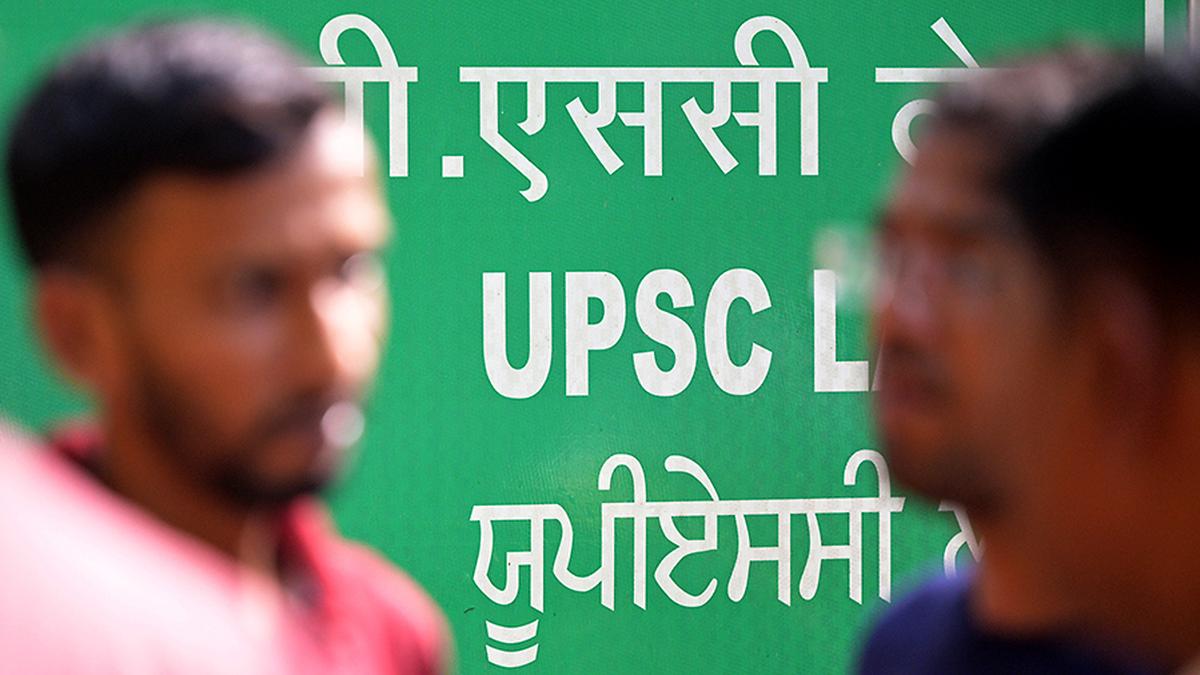
The story so far: The Union Public Service Commission (UPSC) had withdrawn its advertisement pertaining to lateral recruitment for 45 posts of Joint Secretaries (JS), Directors and Deputy Secretaries (DS) in the government. This follows objections raised by coalition partners and the Opposition as well as the intervention of the Prime Minister’s Office (PMO) about the need for reservation in such lateral recruitment.
Merit system entails appointments to government posts after a rigorous selection process by an independent authority. In India, this commenced in the year 1858 when the British introduced the Indian Civil Service (ICS) to select officers for administering the country. After independence, the UPSC conducts exams to select officers for IAS, IPS and other central services. The merit system is aimed at building career bureaucrats who are expected to function without any political leanings and provide independent advice to the incumbent political executive.
The spoils system on the other hand works on the adage ‘to the victor belong the spoils.’ It is a system where the incumbent political executive appoints its supporters to various posts in the government. It has its origins in the U.S., and continued until 1883 when it was replaced largely by a merit system. At present, out of more than 2.8 million federal government posts, only around 4,000 senior posts are directly appointed by the President.
IAS and other central service officers with more than 15 years of experience are generally posted as JS to head various departments. It is a cutting-edge post where the officers prepare cabinet notes, handle parliamentary questions, liaise with officers of other ministries and State governments.
Lateral entry is when executives from the private sector, public sector undertakings and academia are appointed to senior and middle management positions in the government. There have been instances of lateral entrants who were technocrats being appointed at secretary level posts since independence. Notable examples include former Prime Minister Manmohan Singh, economist Montek Singh Ahluwalia, agriculture scientist M.S. Swaminathan etc. The Second Administrative Reforms Commission (2005) and the NITI Aayog in 2017 had also recommended lateral entrants to bring specialised knowledge and skills into governance.
Lateral entry brings with it certain tangible benefits. First, it brings much needed specialisation for niche areas of governance like emerging technologies, semiconductors, climate change, digital economy, cyber security etc. Second, it results in infusion of fresh ideas from experts to reinvigorate the system. Third, it also has the potential of making career bureaucrats more responsive thereby bringing in a positive change.
However, it has its own set of significant limitations. The domain expertise and specialisation of IAS officers is their field experience that is hard to match by outside entrants. There can be coordination issues with career bureaucrats. It may also result in opaqueness and conflicts of interests while hiring recruits from private sector.


Perundurai's industrial growth faces challenges of pollution, water scarcity, and healthcare, impacting residents ahead of the 2026 elections.

The Travancore Devaswom Board asserts that courts should respect community beliefs in its Supreme Court submission on Sabarimala's entry issue.

Karnataka cancels Deendayal Upadhyay event at KSOU due to protocol violations, citing inconsistency with university objectives.

Illegal pickle unit busted in Hyderabad, one arrested; unhygienic stock worth ₹3 lakh seized

Karnataka has entered a state of demographic transition where a large working-age population will no longer be enough to drive economic growth, and future gains will depend on how productively people are employed, the ‘State of Working India 2026’ report said.

Key demands in Sulur Assembly constituency include reviving the powerloom sector, addressing farmers' needs, and protecting River Noyyal.

Kodihalli urges Karnataka CM to allocate ₹10,000 crore revolving fund for seamless procurement of farm products under MSP scheme.

Kerala's political parties continue to marginalize women candidates, highlighting a troubling disconnect between gender demographics and representation.

The High Court of Karnataka on Tuesday ordered the issue of a notice to the State government on a PIL petition, which had complained about disturbances caused to people residing in the localities around the National Public School situated in Rajajinagar 5th block due to use of loudspeakers with high volume in the school and parking of school buses in residential areas.

China is extensively mapping ocean floors to enhance submarine warfare capabilities against the U.S. and allies across key oceans.

AIADMK's 2026 manifesto promises free rations, women's benefits, education reforms, and economic growth initiatives for Tamil Nadu.

The vehicle towing drive will soon resume in the city to ease traffic congestion. The Bengaluru Traffic Police (BTP), in coordination with the Greater Bengaluru Authority (GBA), is set to relaunch the vehicle towing drive across the city shortly to tackle traffic congestion and illegal parking.

Panic buying, not shortage, is leading to long queues at Hyderabad petrol pumps.