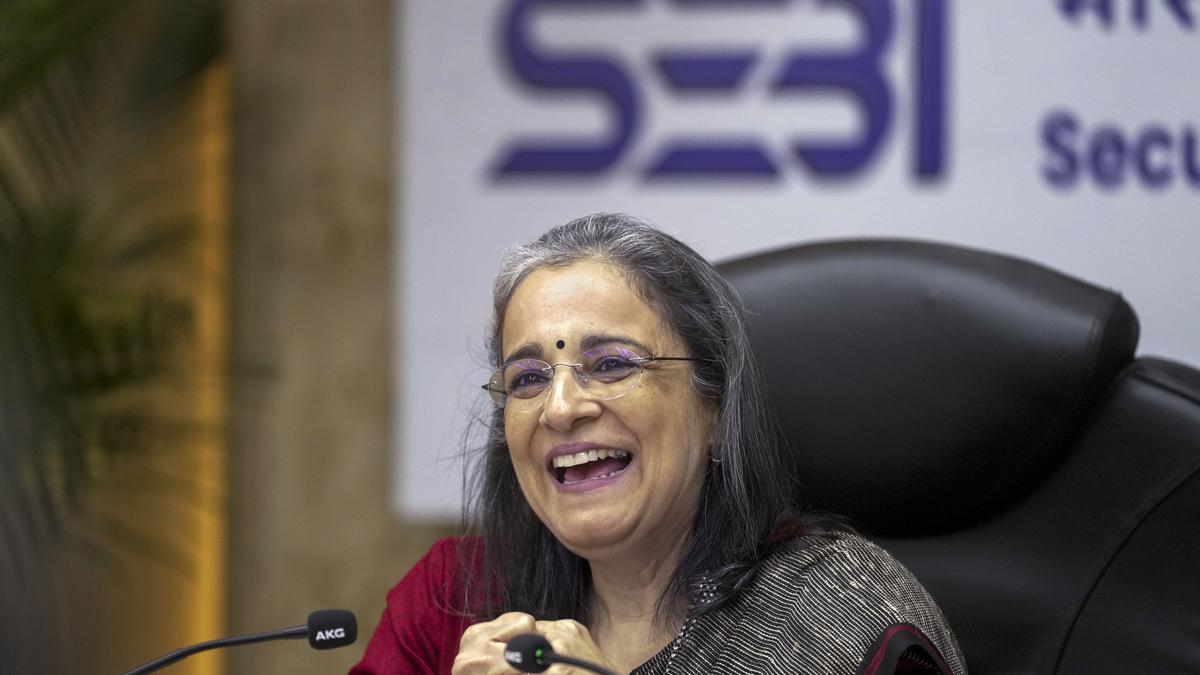
On SEBI chairperson’s conflicts of interests
The Hindu
Hindenburg report reveals conflicts of interest at SEBI, raising doubts on regulator's integrity, requiring immediate clarification and investigation.
It has been over two weeks since a Hindenburg Research report revealed serious conflicts of interests vis-a-vis the chairperson of the Securities and Exchange Board of India (SEBI). Two separate responses to the report were issued on August 11 — an unsigned statement from SEBI and a joint statement issued by Madhabi and Dhaval Buch. These statements in effect confirmed the veracity of Hindenburg’s revelations, casting more doubts over the regulator’s integrity. As the appointing authority of SEBI’s whole-time members, the Central government owes explanations to all stakeholders.
The first conflict of interest revealed by Hindenburg relates to an investment worth $8,72,762 (over ₹5.6 crore at the 2015 exchange rate) made by Madhabi and Dhaval Buch in Bermuda based Global Dynamic Opportunities Fund [GDOF Cell 90 (IPEplus Fund 1)] through Mumbai-headquartered IIFL Wealth & Asset Management Limited (now renamed 360 One).
Madhabi and Dhaval Buch’s joint statement confirms the investment made in 2015 and clarifies that it was driven by the fund’s Chief Investment Officer (CIO), Anil Ahuja, who was “Dhaval’s childhood friend from school and IIT Delhi and, being an ex-employee of Citibank, J.P. Morgan and 3i Group plc, had many decades of a strong investing career”. The statement says that the investment was redeemed in 2018 when Anil Ahuja left his position as CIO of the fund. The joint statement, however, fails to mention that Anil Ahuja also served as a director of Adani Enterprises Limited when that investment was made, and remained in that position until May 31, 2017. An email revealed by Hindenburg shows that it was Madhabi Buch who sent the redemption request to GDOF on behalf of Dhaval Buch on February 25, 2018, when she was already a whole-time member of SEBI (appointed on April 5, 2017).
Also read: Why is SEBI’s credibility under a cloud? | Explained
Therefore, two obvious questions arise: first, was Madhabi Buch’s investment in an offshore fund operated by a director of Adani Enterprises disclosed to the Central government prior to her appointment as a whole-time member of SEBI? Second, did her shareholding in the offshore fund after her appointment in April 2017, till its redemption in February 2018, have the approval of the Board? The Central government must clarify this.
The Hindenburg revelations are of vital consequence to the ongoing SEBI investigation into the Adani group companies as well as the Supreme Court order of January 3, 2024. While ruling that the investigation into the Adani group companies did not warrant a transfer from SEBI to a Special Investigation Team (SIT) or the CBI, the Supreme Court had held that the “threshold for such a transfer of investigation has not been demonstrated to exist”. The Supreme Court appointed Expert Committee had elaborated in its report on how the SEBI (Foreign Portfolio Investors) Regulations, 2014 were diluted in 2018 and 2019 to enable the concealment of “ultimate beneficial owners” of offshore funds. The Expert Committee demonstrated that these regulatory amendments made it difficult to establish the ultimate beneficial owners of the 13 offshore funds that were suspected by SEBI for being fronts of the Adani promoter group.
The funds under the SEBI investigation include the Emerging India Focus Funds and EM Resurgent Fund, which were managed by IIFL Wealth & Asset Management Limited (360 One), as revealed by the Organized Crime and Corruption Reporting Project (OCCRP). Was the Expert Committee made aware of Madhabi Buch’s investment in such an opaque offshore fund through IIFL Wealth & Asset Management Limited (360 One), which was also managed by a director of Adani Enterprises, even after joining SEBI as a whole-time member? This evident conflict of interest remained unreported in the Expert Committee report as well as the top court order.


The Thane police have arrested two co-founders of cryptocurrency exchange platform CoinDCX in connection with an alleged fraud of Rs 71.6 lakh, officials said

Meta Chief Executive Mark Zuckerberg is building a CEO agent to help him do his job, the Wall Street Journal reported

Insurance penetration and density are often misunderstood and do not reveal how many families are insured or whether they would be financially secure if the main earning member were to die. The real issue is not reach but adequacy, as households may have life insurance but not enough cover to replace lost income, leaving them financially vulnerable.

Five top firms lose ₹1 lakh crore in market value, with HDFC Bank experiencing the largest decline of ₹56,124.48 crore.

L&T confirms 95% of its West Asia project sites are safe, while addressing logistics challenges amid ongoing regional conflicts.

Mines Ministry to auction 19 critical mineral blocks on March 23, expanding strategic resources for clean energy and technology sectors.

Mines Ministry to auction 19 critical mineral blocks on March 23, expanding strategic resources for clean energy and technology sectors.

Five top firms lose ₹1 lakh crore in market value, with HDFC Bank experiencing the largest decline of ₹56,124.48 crore.

HDFC Bank terminates three senior officials over client onboarding issues at its DIFC branch amid ethical concerns following chairman's resignation.

Air India CEO warns of potential flight cuts and reduced travel demand due to rising fuel costs amid ongoing Gulf conflict.

Options are widely used by retail traders to speculate on the value of the stock for immediate gains and such behaviour in large scale can distort the market

India achieves 1 billion tonne coal production for the second consecutive year, ensuring stable energy supply and economic growth.

Generic drugmakers in India launch affordable Semaglutide versions, targeting a $1 billion diabetes and weight loss market.