Oldest mosquito fossil comes with a bloodsucking surprise
The Hindu
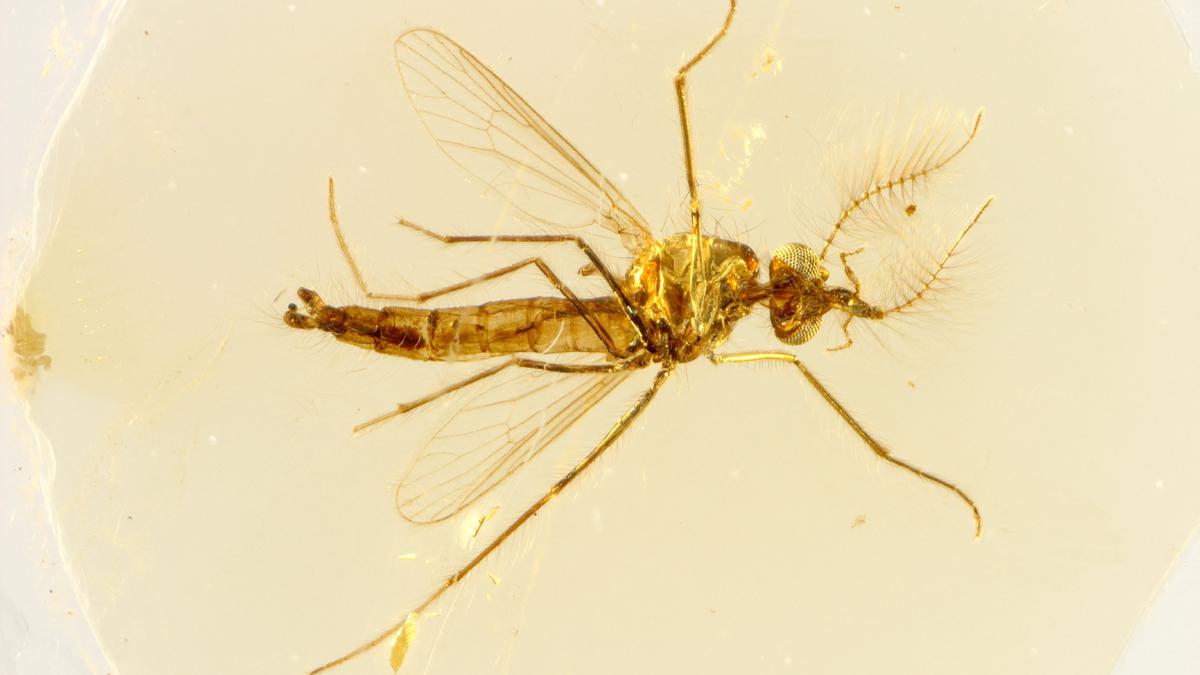
Researchers have discovered the oldest-known fossils of mosquitoes - two males entombed in pieces of amber dating to 130 million years ago during the Cretaceous Period and found near the town of Hammana in Lebanon. The male mosquitoes possessed elongated piercing-sucking mouthparts seen now only in females.
Hundreds of thousands of people worldwide are killed annually by malaria and other diseases spread through the bite of mosquitoes, insects that date back to the age of dinosaurs. All of these bites are inflicted by females, which possess specialized mouth anatomy that their male counterparts lack.
But it has not always been that way. Researchers said they have discovered the oldest-known fossils of mosquitoes - two males entombed in pieces of amber dating to 130 million years ago during the Cretaceous Period and found near the town of Hammana in Lebanon. To their surprise, the male mosquitoes possessed elongated piercing-sucking mouthparts seen now only in females.
"Clearly they were hematophagous," meaning blood-eaters, said palaeontologist Dany Azar of the Chinese Academy of Sciences' Nanjing Institute of Geology and Paleontology and Lebanese University, lead author of the study published this week in the journal Current Biology. "So this discovery is a major one in the evolutionary history of mosquitoes."
The two fossilized mosquitoes, both representing the same extinct species, are similar in size and appearance to modern mosquitoes, though the mouthparts used for obtaining blood are shorter than in today's female mosquitoes.
"Mosquitoes are the most notorious blood-feeders on humans and most terrestrial vertebrates, and they transmit a certain number of parasites and diseases to their hosts," Azar said.
"Only fertilized female mosquitoes will suck blood, because they need proteins to make their eggs develop. Males and unfertilized females will eat some nectar from plants. And some males do not feed at all," Azar added.
Some flying insects - tsetse flies, for instance - have hematophagous males. But not modern mosquitoes.


Set between the Siwalik hills and the plains, Butwal offers travellers a mix of regional cuisine, pilgrimage trails to Lumbini and the comfort of Hyatt’s new hospitality landmark

Explore 2026's wallpaper trends in India, highlighting botanicals and handmade designs that enhance modern homes with nature-inspired aesthetics.

Mercedes-Benz CLA 250+ with EQ Technology review: design, performance, range and features explained. Discover how the new electric CLA combines advanced AI, long range, fast charging and futuristic styling for the next generation of luxury EVs.

AI tool for sparrow conservation

BTS’s comeback with ‘Arirang’ marks a major global music event. When does the album release, and where can you watch their concert live stream? We have all the details

The 2026 U.S. cholesterol guidelines urge starting screening and treatment at 30 to prevent cardiovascular disease effectively.

Olam Festival 2026 in Thiruvananthapuram returns March 27-29 with 120+ vendors, music, art, and cultural zones.

A few storytellers in Thiruvananthapuram share their journeys, challenges, and evolving methods on World Storytelling Day, inspiring young minds.

76-year-old Kurian Jacob from Kerala triumphs with seven medals, including five golds, at the Open Masters Games in Abu Dhabi.

Explore the nature of the human mind as an emergent property of brain activity and complex neural interactions.

CERN's Large Hadron Collider discovers the Xi-cc-plus particle, enhancing understanding of quantum mechanics and baryon behavior.

Vibha Batra’s latest book, Spotless (Hachette India) is a novel in verse for young adults

In its first edition, the Madras Art Salon spotlights the works of journalist and artist Narayan Lakshman at The Botanical Club, a social space in the British Deputy High Commission, Chennai