Okanagan stakeholders strategize on regional response to invasive species of mussels
Global News
The Quagga and Zebra mussels were first introduced in the Great Lakes in 1988 and made their way west about 10 years ago.
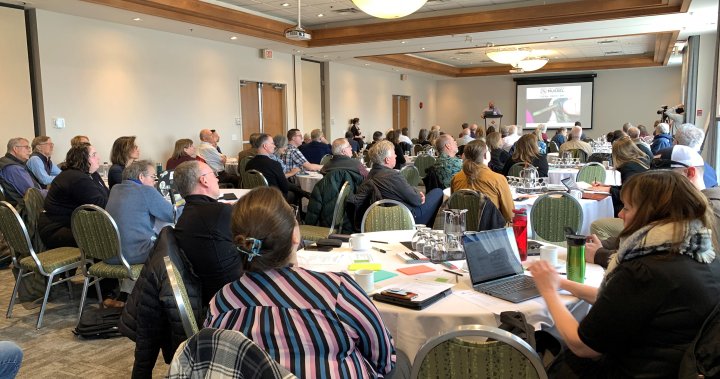
Close to 100 stakeholders came together Friday morning in Kelowna to discuss more ways to prevent an invasive and damaging species of mussels from entering waterways in the region.
“This is the first time that we’ve engaged the broader community and a whole bunch of stakeholders from industry, from chambers of commerce, from tourism associations, from marinas, First Nations and local governments to get in the room together to really broaden the knowledge about the the risk to the Okanagan,” said James Littley, deputy administrator with the Okanagan Basin Water Board (OBWB).
The Quagga and Zebra mussels were first introduced in the Great Lakes in 1988 and made their way west about 10 years ago.
“Since then, they’ve been expanding and spreading throughout North America, ” Littley said. “Up until about 10 years ago, they weren’t in the west and people at the time thought, you know, they can’t really get across the continental divide. They’re not going to get across the mountains. But people drive their boats across North America and they did spread into California and Nevada.”
And now they are said to be the closest they have ever been to B.C. and the Okanagan.
“They were discovered last September in the Snake River in Idaho,” Littley said. “That’s actually water that flows into the Columbia River just like the Okanagan river does. So they’re in our broader shared water system now, and they’re only a day’s drive, less than a day’s drive from the Okanagan.”
The invasive mussels have the potential to cause millions of dollars in economic and environmental damage.
“Our infrastructure, our water intakes would get clogged with these mussels. Our drinking water costs would go up. We might have to spend hundreds of millions of dollars on new water filtration plants, for example, it will collapse our fisheries, it will destroy the ecosystems in the lake.” Littley said. “The risk is very high. Our water is the perfect type of water chemistry that you need for these invasive species to come in and thrive and we are also a prime boating destination.”


As part of its Safer Municipalities Act last year, Ontario began the process of creating a provincial offence for people using illegal drugs in public.

Speaking in Berlin on Wednesday, Barrot said the European Union is attracting more candidate countries, suggesting 'maybe Canada at some point' will sign up.

A post-mortem examination has now determined that the 72-year-old died as a result of blunt force traumatic injuries after falling from a 'height,' the report stated.

The Stratford Warriors issued a statement on its website decrying the 'inappropriate and unacceptable language' directed at a London Nationals player during Monday's game.

It was just before 1 a.m. on Tuesday when York Regional Police say they responded to reports of a shooting at a home around Carville Woods Circle and Crimson Forest Drive.

Both provinces scaled back or dropped their previous goals of having all new vehicle sales be zero emissions in 2035, but Ford says they should go further.

Four people face 20 charges after a Sunday traffic stop led to the seizure of weapons, fentanyl and counterfeit U.S. cash, police say.

Premier Scott Moe has not said how large the deficit will be but says the province's economy is strong enough to weather global uncertainty.

The federal government is appealing a January ruling from the Federal Court of Appeal that upheld the use of the emergencies law breached Charter rights.

The province announced the move on Tuesday afternoon, suggesting it would drive local tourism and economic growth by boosting attendance at some festivals.

Hundreds of organizations across the province are calling on the government to scrap its proposed constitution. Critics say the process has been flawed from the start.

Canada's privacy commissioner said the agency agreed to measures to ensure international sports bodies only use highly sensitive personal information for anti-doping purposes.

Defence Minister David McGuinty said the Canadian Armed Forces 'are not involved in the prosecution of this war' while underscoring that position is not going to change.