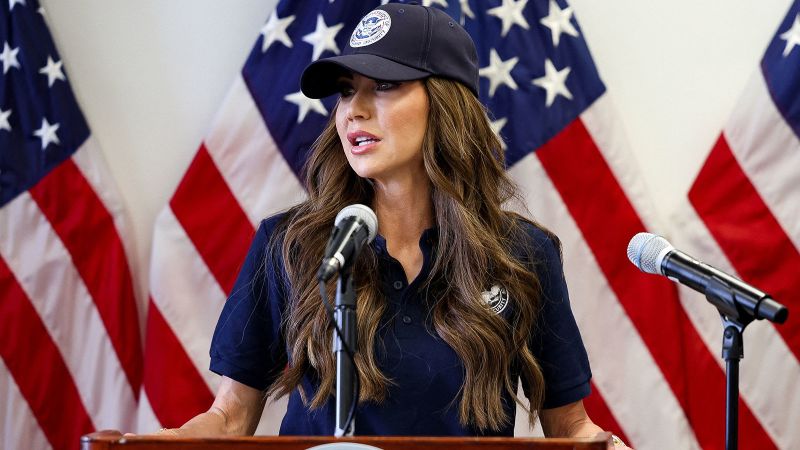
Noem demands more control over FEMA and Homeland Security funding, which could slow disaster response
CNN
Homeland Security Secretary Kristi Noem is tightening her grip on her department’s purse strings, ordering that every contract and grant over $100,000 must now cross her desk for approval, according to a memo exclusively obtained by CNN.
Homeland Security Secretary Kristi Noem is tightening her grip on her department’s purse strings, ordering that every contract and grant over $100,000 must now cross her desk for approval, according to a memo exclusively obtained by CNN. The sweeping directive issued last week adds an extra layer of review for billions of dollars in funding across the Department of Homeland Security, which includes agencies such as US Customs and Border Protection, the Coast Guard, Secret Service and Federal Emergency Management Agency. It’s the latest in a string of moves the Trump administration has billed as rooting out waste and fraud but that could have wide-ranging implications for federal agencies, particularly DHS as it is charged with multiple mission sets including emergency response. Officials inside FEMA warn the new approval process could severely disrupt the distribution of emergency funds during natural disasters. With hurricane season already underway, multiple sources told CNN that Noem’s policy threatens to bog down FEMA’s rapid-response efforts – and could choke off critical aid when every second counts. One FEMA official directly involved in disaster response called the policy “a dramatic and unprecedented overreach” and contends that Noem “is effectively preventing the department from functioning.” “This will hurt nonprofits, states, and small towns. Massive delays feel inevitable,” said the official who asked not to be named to speak candidly.


President Donald Trump has said ICE agents will head to US airports tomorrow amid a partial government shutdown. Follow for live updates

Cuba is working to restore the electricity supply after another island-wide blackout left more than 10 million people without power.

President Donald Trump said Sunday border czar Tom Homan will be in charge of deploying Immigration and Customs Enforcement agents to airports on Monday, with Homan telling CNN the agents will help with security at entrances and exits to ease the Transportation Security Administration’s workload.

Donald Trump wants us to believe that a deal with Cuba is close at hand. After this past week, I am not so sure.

President Donald Trump has said ICE agents will head to US airports tomorrow amid a partial government shutdown. Follow for live updates

President Donald Trump said Sunday border czar Tom Homan will be in charge of deploying Immigration and Customs Enforcement agents to airports on Monday, with Homan telling CNN the agents will assist with security at entrances and exits to ease TSA workload amid a partial government shutdown.

Janet Mills and her allies are counting on a gender gap to narrow Platner’s wide lead ahead of the June 9 primary to decide who will face incumbent Republican Sen. Susan Collins. They are betting that the unfiltered style that has brought Platner widespread attention as someone who could help Democrats reach young men will backfire with women.

Why do people “pledge allegiance” to a “state” that is no longer a state? And what spurs someone to not just attack innocent people, but to then make a statement of loyalty while doing so?

A Supreme Court case examining state deadlines for election ballots sent in the mail is just the tip of the spear in President Donald Trump’s war on mail-in voting.

As a shrinking number of Transportation Security Administration agents work to keep hourslong security lines moving despite not being paid, President Donald Trump stepped into the fray Saturday, announcing he will send Immigration and Customs Enforcement officers to airports by Monday if Congress doesn’t agree to a plan to end the partial government shutdown.

Donald Trump wants us to believe that a deal with Cuba is close at hand. After this past week, I am not so sure.

The search for missing 84-year-old Nancy Guthrie, mother of “Today” show host Savannah Guthrie, has stretched into another anguished week, with mounting pressure on investigators and a family grappling with uncertainty.

Cuba’s Ministry of Energy announced Saturday evening that entire island has suffered another electrical blackout, leaving more than 10 million people without power.