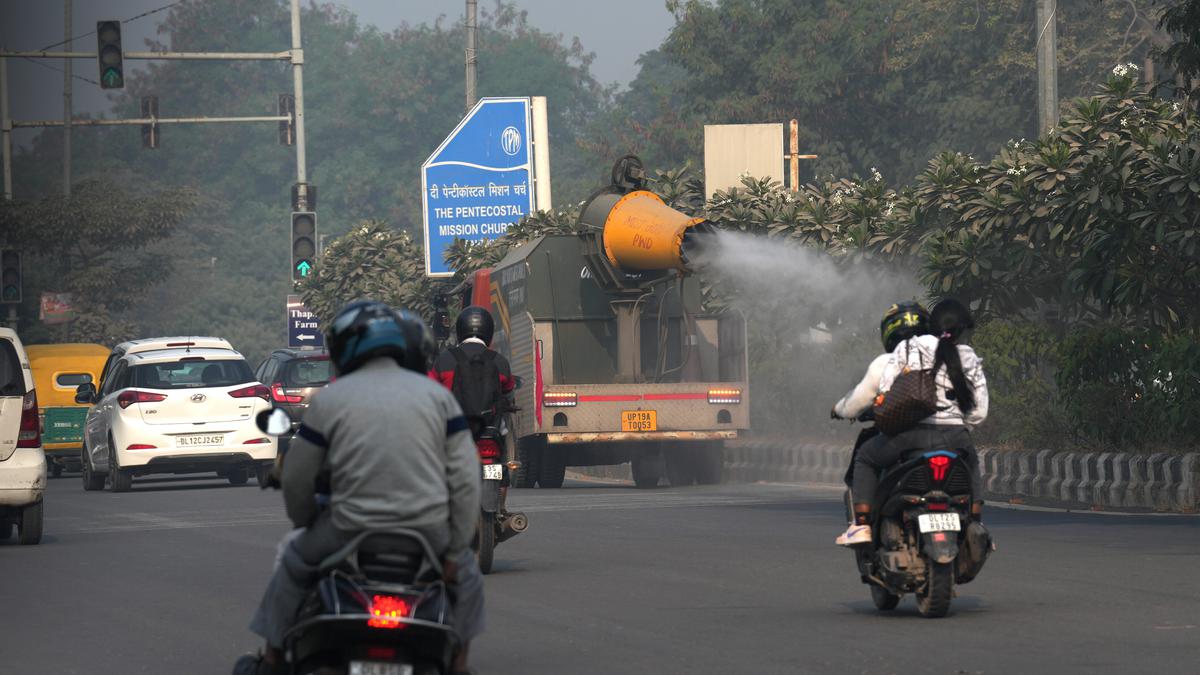
No relief from high pollution levels in city, AQI dips to very poor category
The Hindu
The air quality across the city worsened on Wednesday morning and was recorded in the very poor category.
The air quality across the city worsened on Wednesday morning and was recorded in the very poor category.
The city's Air Quality Index stood at 394 at 9:05 a.m. on Wednesday, up from 365 on Tuesday. The minimum temperature was recorded at 10.6 degrees Celsius, a notch below normal, while the relative humidity was recorded at 76 per cent at 8:30 a.m.
Delhi has been witnessing a steep increase in AQI levels after a marginal improvement on Sunday. The city's AQI stood at 348 at 4 pm on Monday, deteriorating from 301 on Sunday.
An AQI between zero and 50 is considered good, 51 and 100 satisfactory, 101 and 200 moderate, 201 and 300 poor, 301 and 400 very poor, 401 and 450 severe and above 450 severe plus.
The increase in AQI levels comes after the Centre on Saturday had removed stringent curbs, including a ban on construction work related to linear projects and the entry of polluting trucks, in Delhi following a drop in pollution levels due to favourable wind speed and direction.
These measures constitute the final stage -- Stage IV -- of the Centre's air pollution control plan called the Graded Response Action Plan (GRAP).


The government plans to amend the FCRA, introducing new regulations for NGO asset management and accountability for key functionaries.

The draft policy for “Responsible Digital Use Among Students”, released on Monday by the Department of Health and Family Welfare, has recommended that parents set structured routines with clear screen-time rules and prioritise privacy, safety, and open conversation with children on digital well-being.

Police Observer Sushant Kumar Saxena conducts surprise inspection at Shencottai police station, reviewing warrants and security arrangements ahead of elections.

Andhra Pradesh government to launch key projects in April, focusing on industrial growth and infrastructure development, says Nara Lokesh.

Lok Sabha refers the Corporate Laws (Amendment) Bill to a JPC amid opposition concerns over CSR provisions dilution.

SHG members in Kanniyakumari use snakes and ladders to raise election awareness and boost voter turnout.

Government accelerates consultations for early implementation of the Women’s Reservation Act to ensure women’s representation in 2029 elections.

CM A. Revanth Reddy distributes ₹1 crore insurance cheques to families of deceased Electricity department employees, enhancing financial security for workers.

The Bengaluru Traffic Police (BTP) registered 634 cases of drunk driving during a week-long special enforcement drive conducted across the city between March 16 and March 22.

GHMC intensifies action against property tax defaulters, seizing properties and offering a One Time Settlement scheme for payments.

CCB arrests three drug peddlers in Mangaluru, seizing ₹2.5 lakh worth of MDMA and other valuables.

TVK's 28 candidates in Puducherry include former BJP MLAs, a sitting Independent, and a retired police IG.

BRS submits notice on private member bill to Speaker