‘No one is bigger than him’: On the campaign trail with India’s popular yet divisive leader
CNN
India’s prime minister heads to the battleground state of Uttar Pradesh as he bids for a third consecutive term in power.
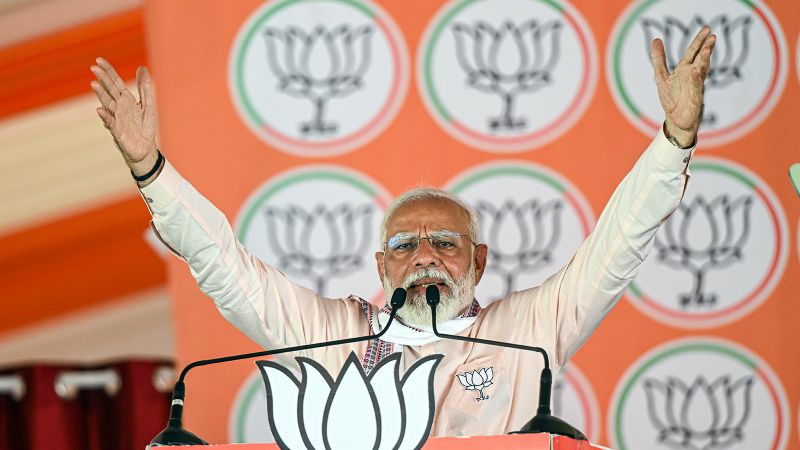
The whir of the helicopter shakes the marquee tent’s roof and kicks up a plume of dust that swirls through the thronging crowd, announcing the arrival of the man they’ve all come to see. Chanting his name, waving his party’s flag and quoting his slogans, in many of their eyes he can do no wrong. Narendra Modi, India’s hugely popular but deeply polarizing prime minister, has landed in the battleground state of Uttar Pradesh as he campaigns for a third consecutive term in power. Arrival at the rally in Aligarh, a three-hour drive from New Delhi, was preceded by a cacophony of horn-honking cars, motorcycles, and trucks all muscling their way in and out of traffic with few discernible lanes. Uttar Pradesh, India’s most populous state of 240 million people, is right in the heart of the nation’s “Hindi belt”, the predominantly Hindi-speaking Indian states where support for Modi and the devotion of his followers is especially strong. Win UP, so they say, and you win India. As the sun glares down on the dusty field in Aligarh and temperatures soar to 38 degrees Celsius (100 Fahrenheit), the crowd don’t seem to mind.


President Donald Trump has said ICE agents will head to US airports tomorrow amid a partial government shutdown. Follow for live updates

President Donald Trump said Sunday border czar Tom Homan will be in charge of deploying Immigration and Customs Enforcement agents to airports on Monday, with Homan telling CNN the agents will assist with security at entrances and exits to ease TSA workload amid a partial government shutdown.

Janet Mills and her allies are counting on a gender gap to narrow Platner’s wide lead ahead of the June 9 primary to decide who will face incumbent Republican Sen. Susan Collins. They are betting that the unfiltered style that has brought Platner widespread attention as someone who could help Democrats reach young men will backfire with women.

Why do people “pledge allegiance” to a “state” that is no longer a state? And what spurs someone to not just attack innocent people, but to then make a statement of loyalty while doing so?

A Supreme Court case examining state deadlines for election ballots sent in the mail is just the tip of the spear in President Donald Trump’s war on mail-in voting.

As a shrinking number of Transportation Security Administration agents work to keep hourslong security lines moving despite not being paid, President Donald Trump stepped into the fray Saturday, announcing he will send Immigration and Customs Enforcement officers to airports by Monday if Congress doesn’t agree to a plan to end the partial government shutdown.

Donald Trump wants us to believe that a deal with Cuba is close at hand. After this past week, I am not so sure.

The search for missing 84-year-old Nancy Guthrie, mother of “Today” show host Savannah Guthrie, has stretched into another anguished week, with mounting pressure on investigators and a family grappling with uncertainty.

Cuba’s Ministry of Energy announced Saturday evening that entire island has suffered another electrical blackout, leaving more than 10 million people without power.

Iran’s attempt to strike a US-UK base over 2,000 miles (over 3,000 kilometers) off its coast has renewed questions about Tehran’s military capabilities and how far its missiles can reach.

For years, President Donald Trump has offered crass and insensitive comments about people who died – especially his foes. That reached a new level on Saturday.

Robert Mueller, the former FBI director who led the historic probe into alleged collusion between Donald Trump’s 2016 campaign and the Russian government, has died. He was 81.

Marlon Batres is not OK. The assistant principal says he is in constant fear for his students, staff and even himself after federal agents swarmed the streets.