NGMA Bengaluru | Return of Visvakarma: ‘The focus was on pieces with an interdisciplinary character’
The Hindu
A curated version of the iconic exhibition from the 1980s is on at the NGMA in Bengaluru, with the focus on craftsmen and weavers
In 1982, India launched an ambitious ‘Festival of India’, which highlighted Indian textiles and crafts, at the Royal College of Art in Britain. The following year, in 1983, then cultural czarina, Pupul Jayakar, and her protégé, Martand Singh (both part of the organising committee), brought the exhibition to New Delhi. Titled ‘Visvakarma’, after the god of craft, it included most of the 280 works originally sent to the U.K. “India had never seen anything like it,” says Chennai-based textile expert, Gita Ram. “They pushed the boundaries of what was possible; it was a resurrection, a renaissance, for Indian textiles.”
What was cool (if you happen to be from Tamil Nadu) was that 50% of the ‘Visvakarma’ exhibit was dedicated to ‘Pudu Pavu’, or textiles and weaves from the State. The remainder included the rest of the country. Gallerist and curator Sharan Apparao recalls buying “a lovely Sikalnayakanpet sari from the Pudu Pavu” exhibit, and a kanjeevaram made by master weaver, Krishnamoorthy. She also owns drawings created by Adimoolam for this “path-breaking project”.
Seen in the light of history, what was the trickle-down effect of ‘Visvakarma’ and its creators, Jayakar and Singh? Well, that depends on who you ask. “They put the spotlight on artisanal products, but did not acknowledge the artisans,” says Uzramma, a textile expert based in Hyderabad.
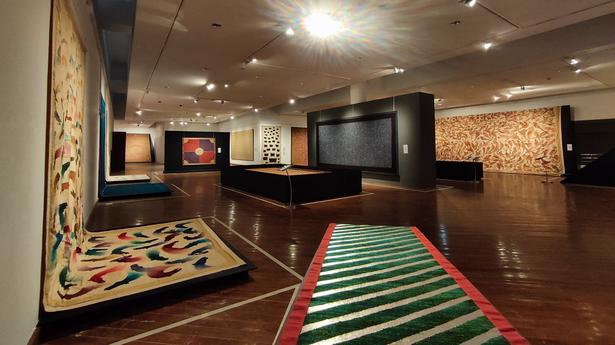
A new exhibit at the National Gallery of Modern Art (NGMA) in Bengaluru attempts to correct this perception. It is focusing on the craftsmen and the weavers, and elevating their creations to the realm of art. Titled ‘Vignette: Visvakarma Textiles: Art & Artistry’, the exhibit is a collaboration between the National Institute of Fashion Technology (NIFT) and the NGMA.
“We were thinking of ways to commemorate our silver jubilee year [2022] and honour the creation of NIFT,” says NIFT director, Susan Thomas, whose brainchild this is. “So, we chose 25 works from the original ‘Visvakarma’ exhibition with the intent that they be viewed as works of art, which they are. The focus was on pieces that have an interdisciplinary character.”
It was a year-long exercise. The original textiles are spread across museums and Weavers’ Service Centres (set up by Jayakar in the 1950s), mostly in Delhi and Mumbai. Thomas and her team made several trips to the metros, before whittling the selection down to 25. Thomas talks about sitting on the floor with her team to hand-stitch certain fabrics to fit them into the space because you cannot run them through sewing machines.
Such exhibitions have been mounted before, including one in 2018 in the Crafts Museum in Delhi. But what makes the NIFT curation special is the thematic presentation: one that embraces geometry and nature and the push to view the weaves as art. Moreover, the Weavers’ Service Centres are (and have always been) the unsung heroes in conversations around weaves. ‘Vignette’ wants to highlight “the stupendous work of the centres as opposed to the personalities around ‘Visvakarma’,” says Thomas.


South African naturalist Steve Boyes speaks on ghost elephants, ancestral tracking, and Werner Herzog’s documentary exploring Angola’s elusive highland giants

Actor-director Amol Palekar will receive META's Lifetime Achievement award for 2026 on March 25 in New Delhi.

India's artists unite against rising censorship, advocating for creative freedom and support for marginalized voices in the arts.

Written and directed by Kunal, the film also stars Sparsh Shrivastava and Vanshika Dhir

This year, Bharatnatyam artistes will present the Tyagaraja Aradhane as a dance performance

This year, Bharatnatyam artistes will present the Tyagaraja Aradhane as a dance performance

The actor, along with director Sushant Shah, speak about their upcoming series ‘Chiraiya’, Divya’s process of working on the dialect, Sushant’s approach to telling a story about women, and more

An independent video, ‘Feel the Spark’ by Raleigh Rajan with vocals by Ciera Dumas that celebrates Tamil literary giants, garnered 1.4 million views in less than 36 hours.

In ‘Jack Ryan: Ghost War’, John Krasinski is back as the savvy CIA analyst, diving headfirst into a high-stakes mission that unravels a deadly conspiracy and pits him against a rogue black-ops unit

Shriram Bharatiya Kala Kendra’s Shankarlal festival showcased rare ragas, radiant artistry, and inclusive performances, from Pt Madhup Mudgal’s serene morning ragas to Ramana Balachandran’s Saraswati veena.

Explore "Threads that Bind: The Kantha Project," an exhibition in Delhi reimagining kantha as a medium of repair and renewal.

Sean Penn skips the Oscars to meet Ukraine's Zelenskyy, who praises him as a "true friend" amid the war.

The teaser of Tamil star Suriya’s much-awaited film with director Venky Atluri, titled Vishwanath and Sons, was unveiled by the makers on Monday