New NOvA data deepens mystery of subatomic particle’s mass Premium
The Hindu
Neutrinos, elusive subatomic particles, are the focus of intense research worldwide due to their unique properties and cosmic significance.
Neutrinos are a type of subatomic particle. They don’t have an electric charge, have a small mass, and are left-handed (a physics term meaning the direction of its spin is opposite to the direction of its motion). And they are flooding the universe. They are the second-most abundant particles after photons (particles of light) and the most abundant among particles that make up matter.
The study of neutrinos is an area of immense current interest among particle physicists and astrophysicists. These particles are produced when particles called leptons interact with matter. For example, when a type of lepton called a muon interacts with matter, the interaction produces a muon-neutrino. The same goes for electrons (electron-neutrino) and tauons (tau-neutrino). However, the neutrinos themselves interact with matter very, very rarely to produce a corresponding muon, electron or tauon.
This small interaction rate makes studying neutrinos difficult. For example, a muon-neutrino will scatter off an atom’s nucleus only once out of a million times or so, producing a muon and a proton. So to study them, physicists have built detectors with very fine tracking capabilities. They are also large to maximise the number of interactions between the neutrinos and the detectors’ matter.
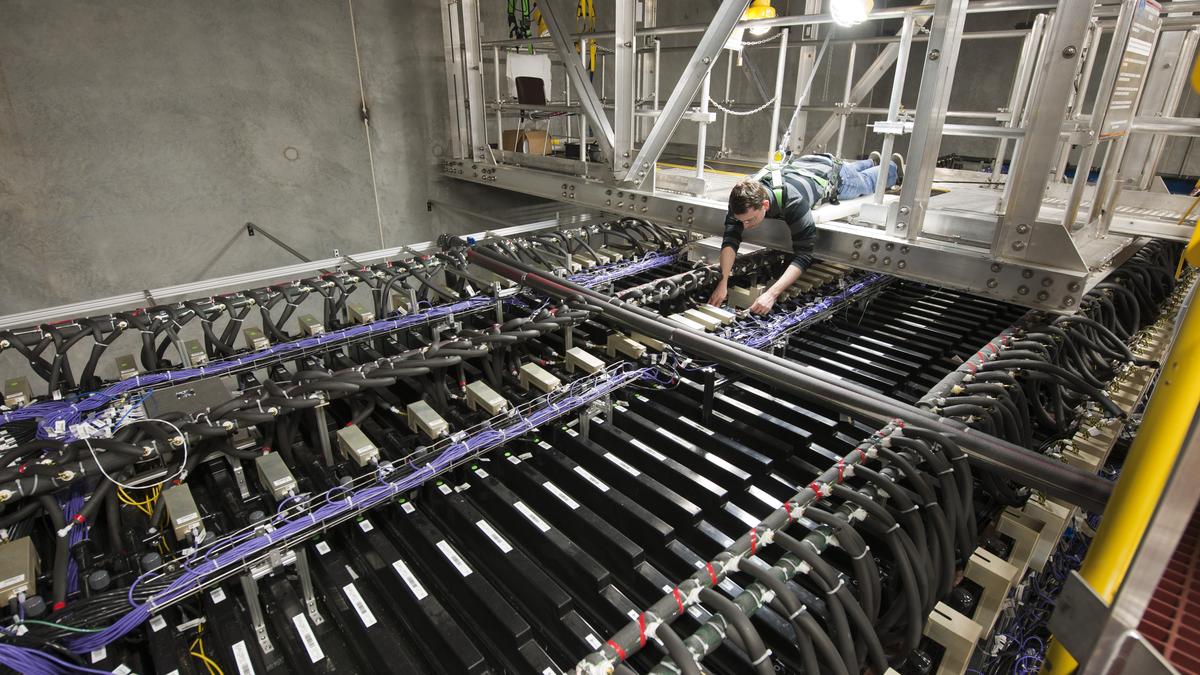
One such experiment is NovA, an acronym for ‘NuMI Off-axis 𝜈e Appearance’, in Minnesota in the U.S. It creates a beam of neutrinos that fly towards a 14,000-tonne detector located 800 km away. NOvA is managed by the Fermi National Accelerator Laboratory.
Scientists presented the latest results from the NOvA collaboration at a conference in Italy on June 17. They said the collaboration had acquired twice as much data as it had during NOvA’s previous run, four years ago. The new results complemented the previous ones with greater precision.
NOvA was designed to determine the role of neutrinos in the evolution of the cosmos. It does this by trying to understand which neutrino type has the most mass and which type the least. This is an important detail because neutrinos may get their mass through a different mechanism from other matter particles. Unravelling it could answer many open questions in physics.
In pursuit of this goal, on July 11, a study at the Large Hadron Collider in Europe also reported observing electron-neutrinos at a particle collider for the first time.


CERN's Large Hadron Collider discovers the Xi-cc-plus particle, enhancing understanding of quantum mechanics and baryon behavior.

Vibha Batra’s latest book, Spotless (Hachette India) is a novel in verse for young adults

In its first edition, the Madras Art Salon spotlights the works of journalist and artist Narayan Lakshman at The Botanical Club, a social space in the British Deputy High Commission, Chennai

Cholesterol enhances melanoma cell invasion by making nuclei squishier, revealing a potential treatment target in cancer progression.

The designers reinterpret the Swedish artist’s symbolic forms and colour energy through contemporary resortwear silhouettes

Discover the inspiring legacy of Bibha Chowdhuri, a pioneering woman in physics and a trailblazer in STEM history.

Discover the inspiring legacy of Bibha Chowdhuri, a pioneering woman in physics and a trailblazer in STEM history.

Ashdeen’s Spring 2026 collection features saris inspired by the designer’s Parsi gara archive

Red ochre burials, ritual markings and myths across cultures show that red repeatedly marks liminal thresholds such as puberty, sacrifice and death; anthropologists argue that the colour functions as a technology of collective ritual and value, binding communities through shared symbolic acts

India approves 23 institutions for quantum labs under the National Quantum Mission, aiming to advance quantum technology and research.

India approves 23 institutions for quantum labs under the National Quantum Mission, aiming to advance quantum technology and research.

The Gaza conflict exacerbates environmental damage, emitting millions of tonnes of CO2 and threatening climate stability in West Asia.

Chefs and cookery experts share smart kitchen hacks, hybrid cooking methods and appliance tips to help households reduce LPG use without compromising on food